


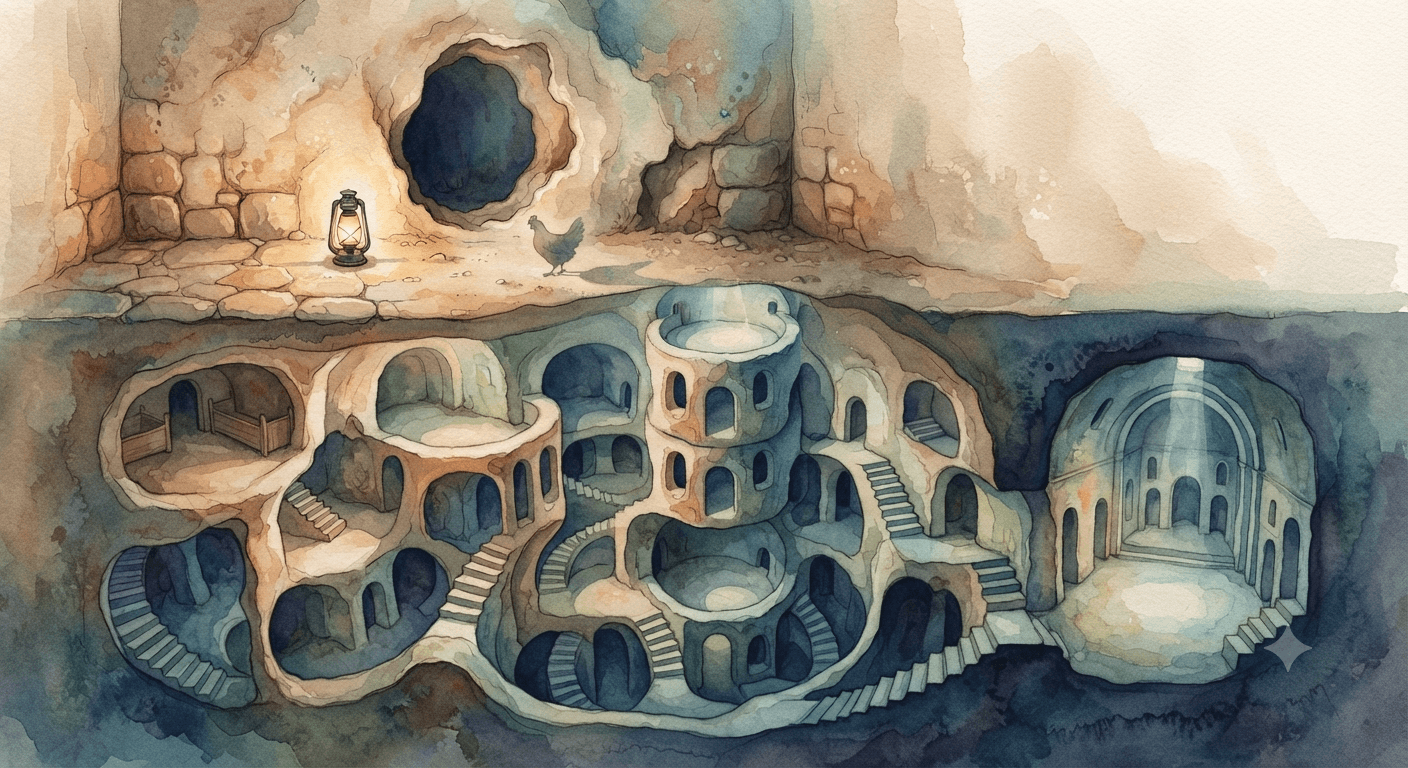
The Disappearing Chickens
In 1963, a resident of the Turkish town of Derinkuyu, in the Cappadocia region, was renovating his home when he noticed something unusual. His chickens were disappearing through a small crack in the basement wall and never coming back.
He realized the chickens were squeezing through a narrow opening in the wall, just large enough for a chicken to fit through. Once they entered, they simply vanished.
The Decision to Break the Wall
Instead of sealing the crack and forgetting about the missing chickens, the homeowner decided to investigate. He grabbed a hammer and some tools and began widening the opening.
What he found behind the wall left him speechless: a hidden chamber carved directly into the rock beneath his house.
But that was only the beginning. The chamber led to a narrow passageway, which opened into another room… then another… and another, revealing an enormous underground complex.
A City Beneath the City
What the homeowner had actually discovered was Derinkuyu—one of the largest underground cities ever found.
Some of its most remarkable features include:
- Extending about 85 meters (279 feet) below the surface—the height of roughly a 20-story building.
- 18 levels of tunnels, rooms, and passageways.
- The ability to shelter up to 20,000 people, along with their livestock and food supplies.
- Stables, dining halls, storage rooms, kitchens still blackened by ancient soot, wine and oil presses, a school, and a church measuring about 20 by 9 meters (66 by 30 feet) with a ceiling more than 3 meters (10 feet) high.
- 52 ventilation shafts and its own well connected to underground water sources—an engineering achievement that continues to impress experts today.
The homeowner’s discovery turned out to be only the first of more than 600 entrances later identified beneath houses throughout the town, all leading into the same vast underground labyrinth.
Why Was the City Built?
Historians believe Derinkuyu was originally constructed as early as the 8th or 7th century BC. Over the centuries, it served as a refuge for local communities during invasions, wars, and periods of religious persecution.
The underground city was reportedly used until the early 20th century. After the population exchange between Greece and Turkey in 1923, knowledge of the city’s entrances gradually faded as the people who had used them left the region.
Then, four decades later, a homeowner searching for his missing chickens accidentally uncovered one of history’s most extraordinary underground cities.
Sources: Smithsonian Magazine – The Underground Cities of Cappadocia
https://www.smithsonianmag.com/