


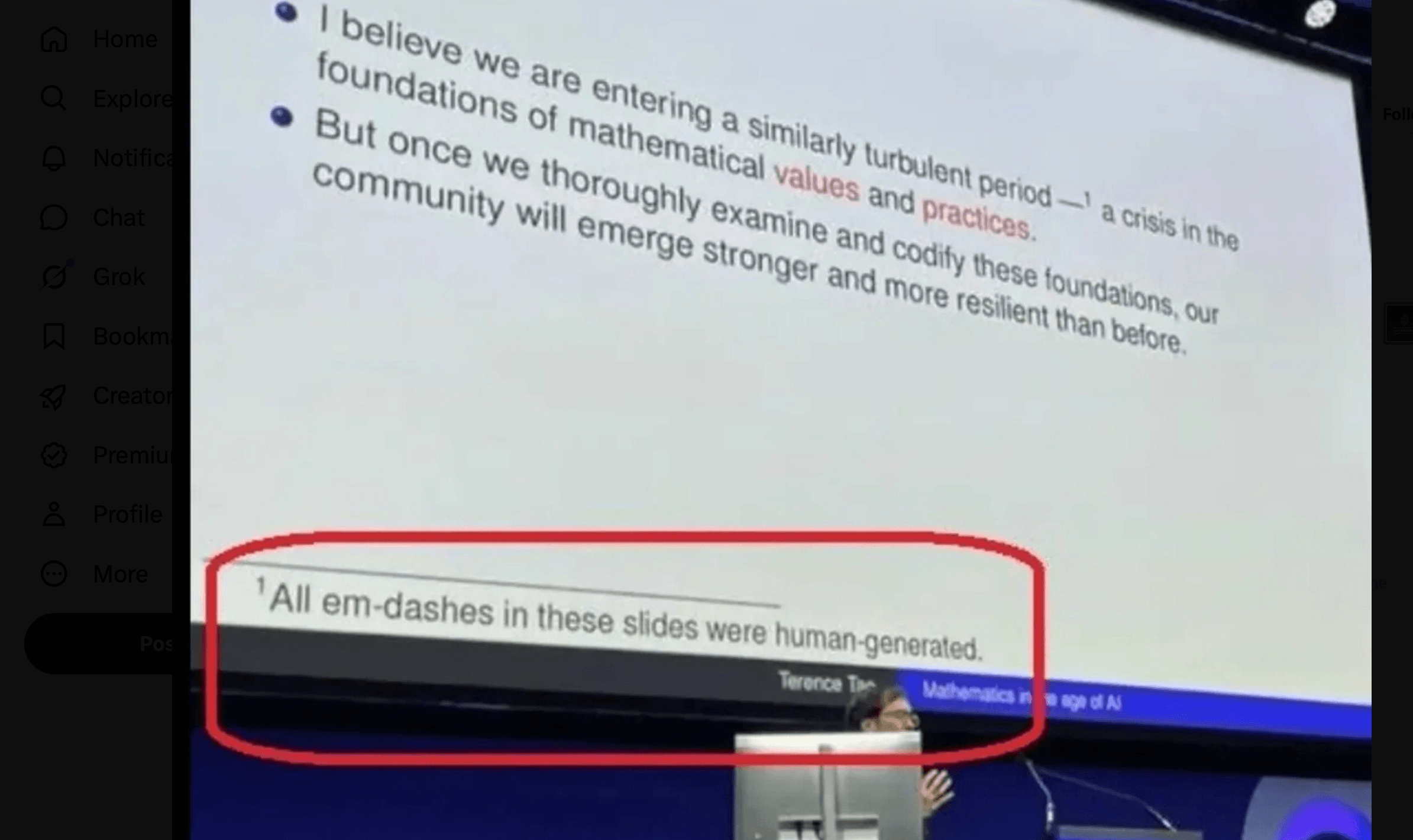
When one of the world’s most celebrated mathematicians gives a lecture about artificial intelligence, you might expect equations, algorithms and serious questions about the future of mathematics. Terence Tao delivered all of that — but one tiny footnote on his presentation slides ended up attracting attention of its own.
PHILADELPHIA — During his recent public lecture “Mathematics in the Age of AI,” renowned mathematician and Fields Medal winner Terence Tao included an unexpected disclaimer at the bottom of one of his slides:
“All em-dashes in these slides were human-generated.”
It was only one sentence, but it was a perfectly timed joke about one of the stranger side effects of the generative AI era: the humble em dash — the long punctuation mark used to separate thoughts — has increasingly become something people associate with AI-generated writing.
Tao’s joke appeared during a lecture at the 2026 International Congress of Mathematicians in Philadelphia, one of the world’s most important gatherings of mathematicians. The congress was held at the Pennsylvania Convention Center from July 23 through July 30, while Tao delivered his public lecture on July 24.
The irony was particularly fitting because Tao was speaking about a much bigger question: what happens to mathematics when artificial intelligence becomes increasingly capable of assisting with reasoning, proofs and research?
Tao, a professor at UCLA who received the Fields Medal in 2006, has been actively discussing the changing relationship between mathematics and AI. Ahead of the conference, he said that AI and formalization are likely to transform mathematical research and education, while emphasizing the importance of preserving the distinctly human aspects of mathematics. (Simons Foundation)
That debate was not limited to Tao’s lecture. Artificial intelligence was one of the major themes surrounding this year’s International Congress of Mathematicians, with discussions ranging from machine-verifiable mathematical proofs to the role of AI in education and the future of mathematical research.
And perhaps that is why Tao’s tiny footnote works so well.
At a time when people are examining writing for clues that a machine may have produced it, one of the world’s leading mathematicians decided to certify something far less complicated than a mathematical proof:
The em dashes were his own.
Sometimes even the age of artificial intelligence needs a footnote — written by a human.
Sources: Simons Foundation, International Congress of Mathematicians (ICM 2026), and a social media post documenting Tao’s presentation.