


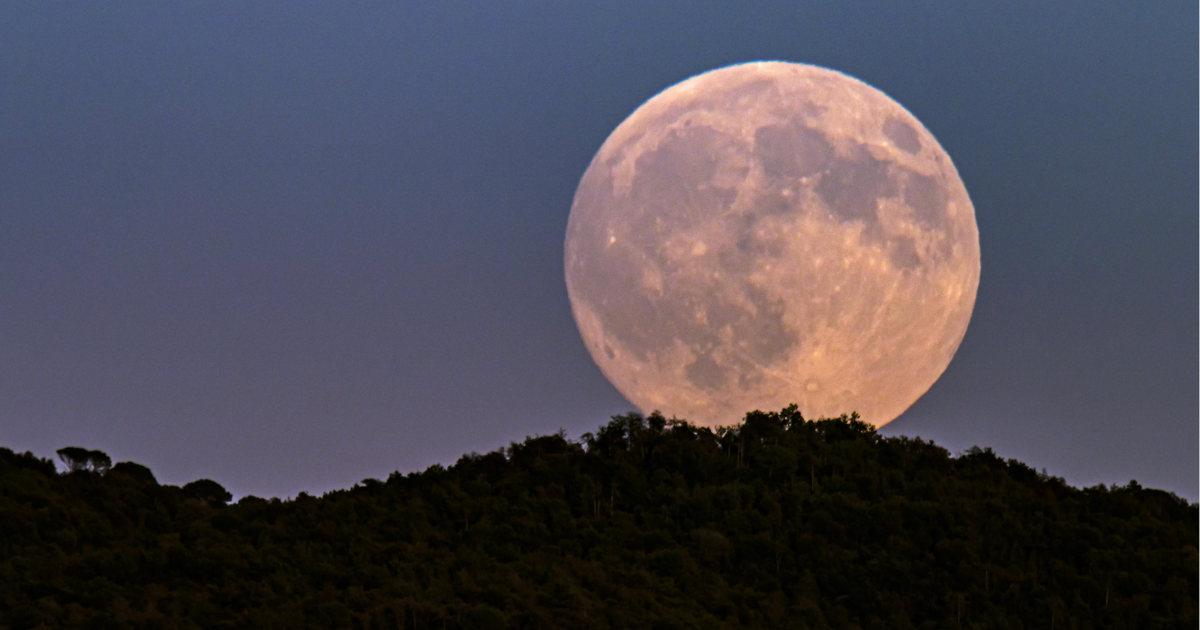
New Jersey residents looking toward the eastern sky Tuesday evening had an opportunity to witness one of November’s most beautiful astronomical events.
The Full Beaver Supermoon rose above the horizon shortly after 4 p.m., appearing larger and brighter than an average full moon. The celestial event arrived just two days before Thanksgiving, offering a spectacular sight for skywatchers across the Garden State.
NEW JERSEY — November 24, 2026 — The Full Beaver Supermoon illuminated the evening sky Tuesday, marking the beginning of a series of consecutive supermoons extending into early 2027.
The Moon reached its full phase at approximately 9:53 a.m. Eastern Time, although the best opportunity to observe it came around moonrise, shortly after 4 p.m.
According to astronomical calculations, November’s supermoon appeared approximately 6.5% larger and 13.5% brighter than an average full moon.
A supermoon occurs when a full moon coincides with the Moon’s position near perigee, the closest point to Earth in its elliptical orbit.
Although the difference in size may be difficult to recognize without a direct comparison, the Moon can appear particularly impressive when rising near buildings, trees or the coastline.
This visual phenomenon, known as the Moon illusion, makes the Moon seem unusually large when viewed close to the horizon.
Why Is It Called the Beaver Moon?
The November full moon is traditionally known as the Beaver Moon, a name associated with seasonal changes in North America.
According to The Old Farmer’s Almanac, the name refers to the time of year when beavers prepare for winter, building and strengthening their lodges and storing food.
Other traditional names for November’s full moon reflect the arrival of colder weather and changing animal behavior.
Where to See It in New Jersey
Residents across New Jersey can enjoy the supermoon wherever skies are clear and the eastern horizon is unobstructed.
Beaches along the Jersey Shore, waterfront parks and elevated viewpoints offer particularly attractive locations for observing and photographing the Moon.
In Bergen County, open views toward the Hudson River and the New York City skyline can provide a dramatic setting as the Moon rises above distant buildings.
No telescope or special equipment is needed. The supermoon is easily visible with the naked eye, although binoculars can reveal more detail on its surface.
More Supermoons Are Coming
Tuesday’s Beaver Supermoon is the first in a series of three consecutive supermoons.
The next will reach its full phase on December 23 at 8:28 p.m. Eastern Time, followed by another on January 22, 2027.
December’s supermoon is expected to be particularly impressive because the Moon will be even closer to Earth.
For New Jersey skywatchers, Tuesday’s event offers a reminder that some of nature’s most remarkable displays can be enjoyed simply by looking up.
Sources: NASA; The Old Farmer’s Almanac; Space.com; Bergen County Camera; Time and Date.
By NJ RADAR Team