


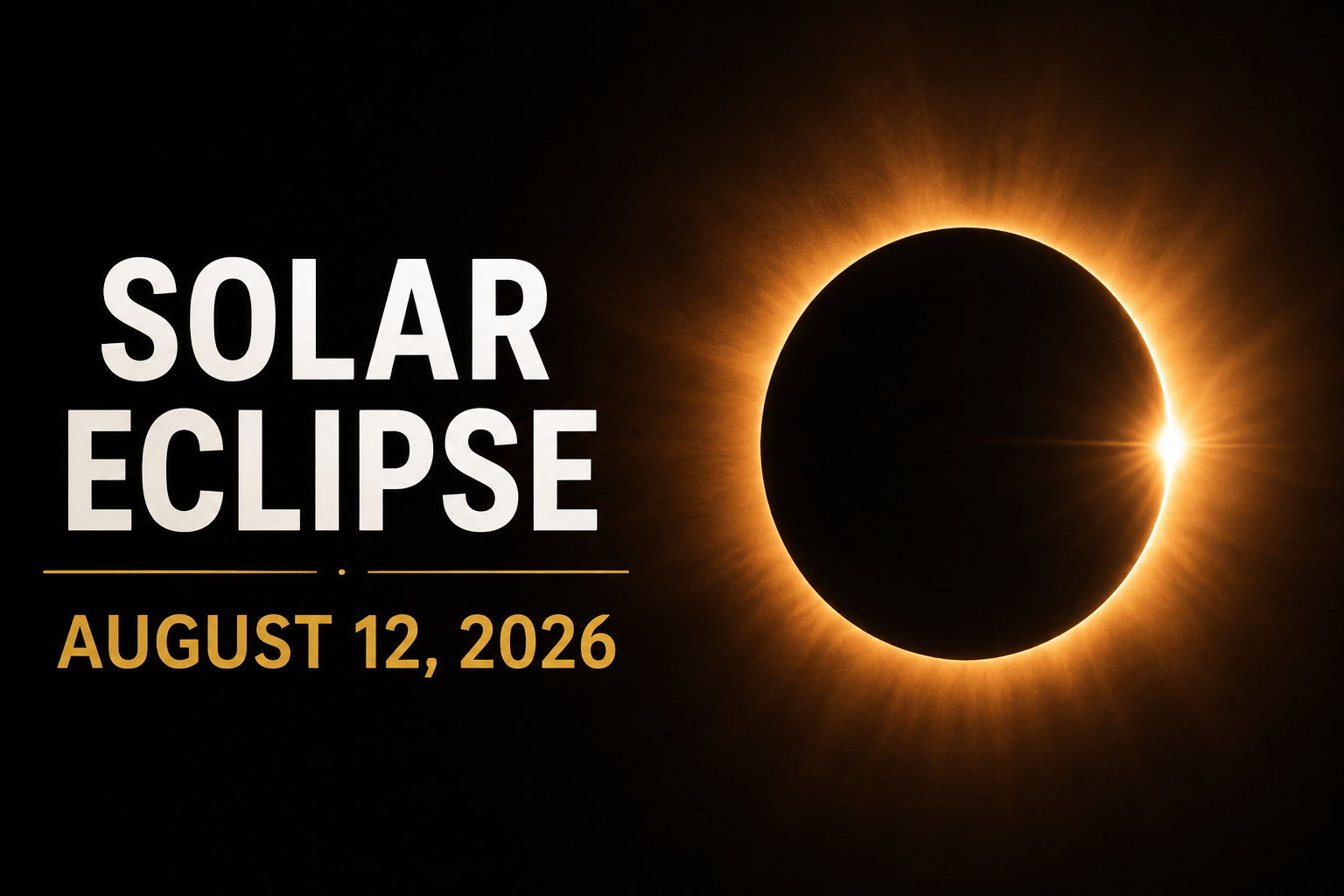
One of the most anticipated astronomical events of the year will take place on August 12, 2026, when the Moon will completely cover the Sun for observers located within the narrow path of totality. It will be the first total solar eclipse visible from mainland Europe since 1999.
According to estimates, around 602 million people worldwide will be able to witness either a total or partial solar eclipse. However, only those within the narrow path of totality will experience complete daytime darkness, while millions of others will see a partial eclipse.
The path of totality begins over northern Russia, crosses the Arctic, eastern Greenland, western Iceland, the North Atlantic, and ends in northern Spain, briefly touching northeastern Portugal. The maximum duration of totality will be 2 minutes and 18 seconds, with the longest total eclipse occurring near Iceland.
For Spain, this will be a historic event, as several northern cities—including Burgos, León, Valladolid, and Soria—will experience totality shortly before sunset.
Will the Eclipse Be Visible from New Jersey?
Yes, but only as a partial solar eclipse.
Residents of New Jersey will not experience complete darkness, but the Moon will cover approximately 18% of the Sun’s diameter (an eclipse magnitude of about 0.18). In northern New Jersey, the eclipse is expected to begin at approximately 1:07 p.m. EDT, reach its maximum around 1:53 p.m., and end at about 2:37 p.m. The exact appearance will vary slightly depending on location, but the effect will be far less dramatic than in Europe.
Although the eclipse will only be partial in New Jersey, it is never safe to look directly at the Sun without proper eye protection. Astronomers recommend using ISO 12312-2 certified eclipse glasses or another safe solar viewing method throughout the entire partial eclipse. Looking directly at the Sun without proper protection can cause permanent eye damage.
Sources:
Night Sky Today on X (@NightSkyToday)
NASA Science – Total Solar Eclipse on August 12, 2026 NASA on X (@NASA)
[…] say this month will bring an exceptional series of celestial events, including a total solar eclipse, the peak of the Perseid meteor shower, a deep partial lunar eclipse, and several beautiful […]