


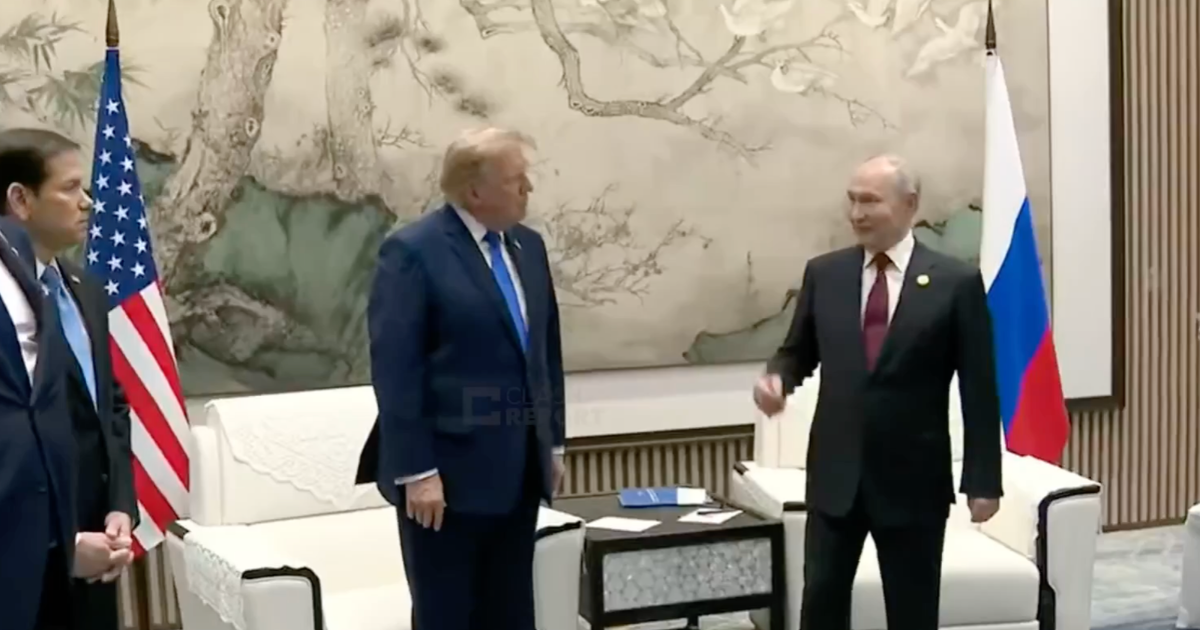
SHENZHEN, China — November 19, 2026 — President Donald Trump and Russian President Vladimir Putin held a separate meeting Thursday on the sidelines of the Asia-Pacific Economic Cooperation (APEC) summit in Shenzhen, China, amid renewed diplomatic efforts to address the war in Ukraine and growing concerns over nuclear weapons.
The roughly 40-minute meeting marked their first direct talks since the August 2025 summit in Alaska, where discussions failed to produce an agreement ending Russia’s war against Ukraine.
Trump greeted Putin warmly, described the Russian president as a longtime friend and expressed optimism about renewed diplomacy.
“Wonderful things can come out of this — or at least start,” Trump told reporters.
The meeting took place ahead of an unprecedented three-way summit involving Trump, Putin and Chinese President Xi Jinping, bringing together leaders of the world’s three largest nuclear powers.
Ukraine War Remains a Major Diplomatic Challenge
Russia’s war against Ukraine remains one of the most difficult issues confronting Washington and Moscow.
Despite repeated diplomatic initiatives, the conflict has continued, and major disagreements remain over territorial control, security guarantees and the conditions for a possible peace settlement.
Trump has promoted negotiations as a way to bring the war to an end, but his administration’s approach has raised concerns among Ukrainian and European officials.
Kyiv and its European partners have emphasized that decisions about Ukraine’s future must include Ukraine itself.
The latest meeting also follows tensions over American sanctions against Russia and U.S. military support for Ukraine.
According to the Associated Press, the Trump administration has declined to impose additional sanctions on Moscow, while disruptions affecting satellite services used by Ukrainian forces have further complicated relations between Washington and Kyiv.
The Kremlin has not publicly released a detailed account of Thursday’s private Trump-Putin conversation. Russian officials separately confirmed that Putin and Xi discussed Ukraine during their talks in China.
No breakthrough on Ukraine was announced following the American and Russian presidents’ meeting.
Nuclear Weapons Become a Central Issue
Beyond Ukraine, nuclear arms control is expected to be a major subject of discussions involving Washington, Moscow and Beijing.
The New START treaty, the last major nuclear arms agreement between the United States and Russia, expired in February 2026.
Trump has called for a new agreement that would include China alongside the United States and Russia.
Such negotiations would face substantial obstacles.
The United States and Russia each possess nuclear stockpiles numbering more than 5,000 warheads, while China is estimated to have more than 600.
Beijing has historically resisted joining the same arms limitation framework as Washington and Moscow, arguing that its arsenal is significantly smaller.
Arms control experts have cautioned that a single high-level meeting is unlikely to produce a comprehensive nuclear agreement, although it could establish the groundwork for future negotiations.
China’s Growing Role in Global Diplomacy
The Shenzhen summit also highlights China’s growing diplomatic influence.
President Xi has maintained close ties with Putin despite Western sanctions imposed on Russia following its full-scale invasion of Ukraine in 2022.
China and Russia have expanded economic cooperation, while Beijing continues to seek a more influential role in international diplomacy.
At the same time, China’s relationship with Washington remains complicated by disagreements over trade, technology, tariffs and access to advanced semiconductors.
The United States and China are also approaching another important deadline in their trade relationship, with their existing trade truce scheduled to expire in January 2027.
For Beijing, hosting the American and Russian presidents offers an opportunity to demonstrate its importance in international negotiations.
Iran and the Broader International Agenda
The conflict involving Iran is another major issue expected to feature in discussions among the three leaders.
Trump has indicated that he wants to address the war in Iran and explore possible diplomatic arrangements with China and Russia.
Both Moscow and Beijing have maintained economic and diplomatic relationships with Tehran, complicating Washington’s efforts to isolate Iran.
The conflict has also disrupted energy markets and added pressure to the global economy.
Those competing interests make the Shenzhen discussions particularly consequential, even if immediate agreements remain unlikely.
High Expectations, Uncertain Results
Trump has portrayed his diplomatic relationships with Xi and Putin as important tools for negotiating international agreements.
However, personal relationships between leaders do not necessarily translate into changes in national policies.
The United States, Russia and China remain divided over several fundamental issues, including military alliances, sanctions, territorial disputes and global security.
European leaders have also expressed concern that negotiations involving the three powers could affect other countries without their direct participation.
Thursday’s private meeting offered Trump and Putin another opportunity for direct communication after more than a year without a face-to-face encounter.
For now, however, the meeting has produced no publicly announced agreement on Ukraine, sanctions or nuclear arms control.
The outcome of the broader Shenzhen summit will depend on whether the leaders can move beyond diplomatic gestures toward concrete commitments.
Sources: Associated Press (November 19, 2026) | Reuters (November 18–19, 2026) | The Kyiv Independent (November 18, 2026) | Al Jazeera (November 14–19, 2026)
By NJ RADAR Team