


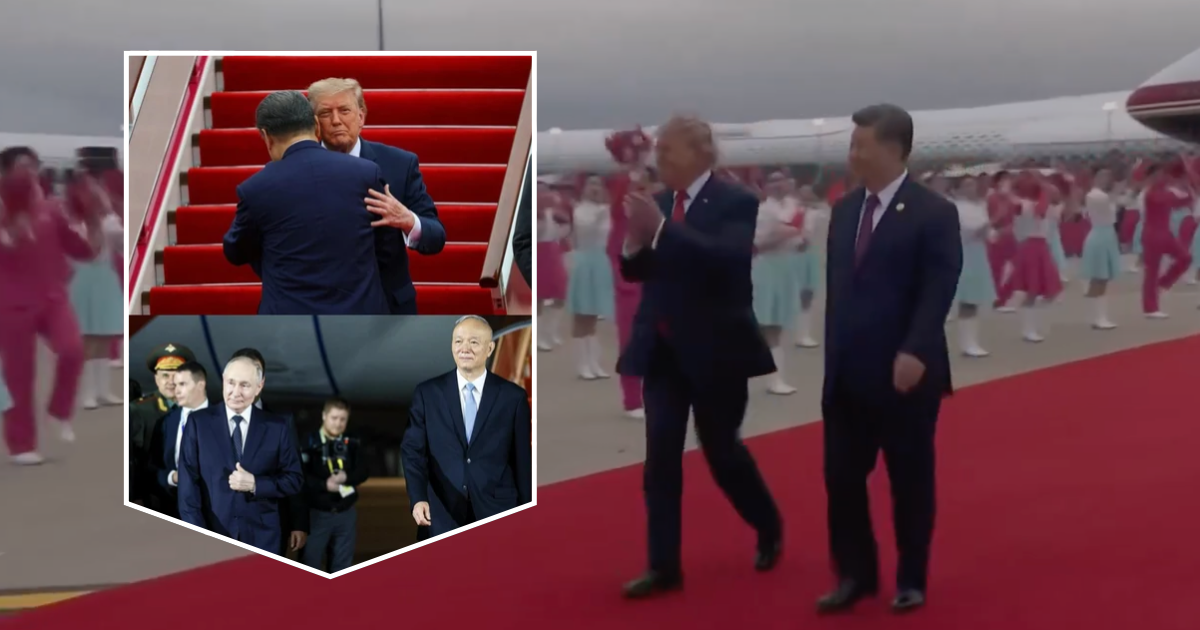
SHENZHEN, CHINA — November 18, 2026 — China welcomed the leaders of the United States and Russia with an elaborate display of ceremony and pageantry Wednesday, bringing three of the world’s most powerful political figures together ahead of high-stakes talks on global security, trade and ongoing wars.
President Xi Jinping personally greeted U.S. President Donald Trump at Shenzhen Bao’an International Airport, an unusual diplomatic gesture accompanied by a red carpet, military formations, a fighter jet flyover and hundreds of performers carrying flowers.
The carefully choreographed welcome resembled the mass ceremonial performances for which China is known, with rows of participants creating a coordinated visual spectacle.
Later, Trump and Russian President Vladimir Putin exchanged greetings in Xi’s presence before an official banquet at the Asia-Pacific Economic Cooperation (APEC) summit.
The three leaders are scheduled to hold formal talks Thursday, November 19.
A Grand Welcome With Political Meaning
The reception was more than an ordinary diplomatic formality.
China used music, synchronized formations, military displays and ceremonial hospitality to present itself as a confident global power capable of bringing together leaders whose countries have deeply conflicting interests.
Xi’s personal appearance at the airport was particularly significant. Chinese presidents do not routinely greet visiting foreign leaders on the airport tarmac.
The decision highlighted the importance Beijing attaches to its relationship with Washington, even as the two countries compete over trade, technology, Taiwan and global influence.
Shenzhen, a city transformed from a relatively small settlement into one of China’s leading technology and manufacturing centers, provided a symbolic setting for the gathering.
The ceremony also reflected China’s broader diplomatic approach: presenting economic strength, organizational discipline and national prestige through carefully staged public events.
Even the Robots Joined the Spectacle
The elaborate welcome extended beyond traditional ceremonies. In Shenzhen, approximately 100 humanoid robots developed by Chinese robotics company EngineAI performed a synchronized dance as part of the city’s APEC-related technology celebrations.
The coordinated performance resembled a traditional mass choreography, with rows of machines moving together before spectators.
Other robotics demonstrations featured humanoid machines performing martial arts movements and serving ice cream.
The displays highlighted China’s growing ambitions in artificial intelligence and advanced robotics, transforming the international gathering into a showcase of the country’s technological capabilities.
For Beijing, the message extended beyond diplomatic hospitality. Hosting world leaders in one of China’s leading technology centers offered an opportunity to demonstrate industrial innovation alongside political influence.
Three Leaders, Different Political Interests
Despite the cordial reception, substantial disagreements remain.
Trump arrives seeking progress on several major international issues, including the war in Ukraine, the conflict involving Iran and nuclear arms control.
Washington also faces difficult negotiations with Beijing over trade barriers, advanced technology and economic competition.
Xi has emphasized international trade, cooperation and China’s role in shaping a more multipolar world. Earlier Wednesday, he called for resisting protectionism and strengthening international economic cooperation.
Putin, meanwhile, criticized Western sanctions and defended Russia’s position on international security.
Russia’s continuing war in Ukraine remains one of the greatest obstacles to improved relations between Moscow and Western governments.
China has maintained close economic and diplomatic ties with Russia while also seeking to preserve important commercial relationships with the United States and Europe.
Ukraine, Iran and Nuclear Weapons on the Agenda
Thursday’s planned trilateral meeting is expected to address several of the world’s most serious geopolitical disputes.
The war in Ukraine remains central to discussions about European security, sanctions and relations between Russia and Western powers.
The conflict involving Iran is another potential point of discussion, particularly given China’s and Russia’s relationships with Tehran and Washington’s military involvement.
Nuclear weapons and arms control could also feature prominently.
All three countries possess nuclear weapons, but their strategic priorities and approaches to arms control differ substantially.
Artificial intelligence, global trade and international economic stability are among the additional issues expected to arise during the summit.
No agreement has been announced, and it remains uncertain whether the talks will produce concrete diplomatic results.
Diplomacy Behind the Spectacle
The images from Shenzhen present an unusual scene: the leaders of three competing powers standing together amid elaborate ceremonies and carefully arranged displays.
Yet the visual unity of the reception should not be confused with political agreement.
For China, hosting the gathering offers an opportunity to demonstrate diplomatic influence. For the United States, the talks provide a chance to negotiate directly with two major strategic competitors. For Russia, participation offers an important international platform amid continuing Western sanctions.
The contrast between the ceremonial welcome and the difficult issues awaiting negotiation captures the significance of the summit.
Wednesday belonged to diplomatic pageantry. Thursday will test whether the three leaders can translate their encounter into meaningful progress on the disputes separating them.
Sources: Reuters, November 18, 2026; Associated Press, November 18, 2026; AFP, November 18, 2026; Chinese Ministry of Foreign Affairs; Deutsche Welle, November 17, 2026.
By NJ RADAR Team