


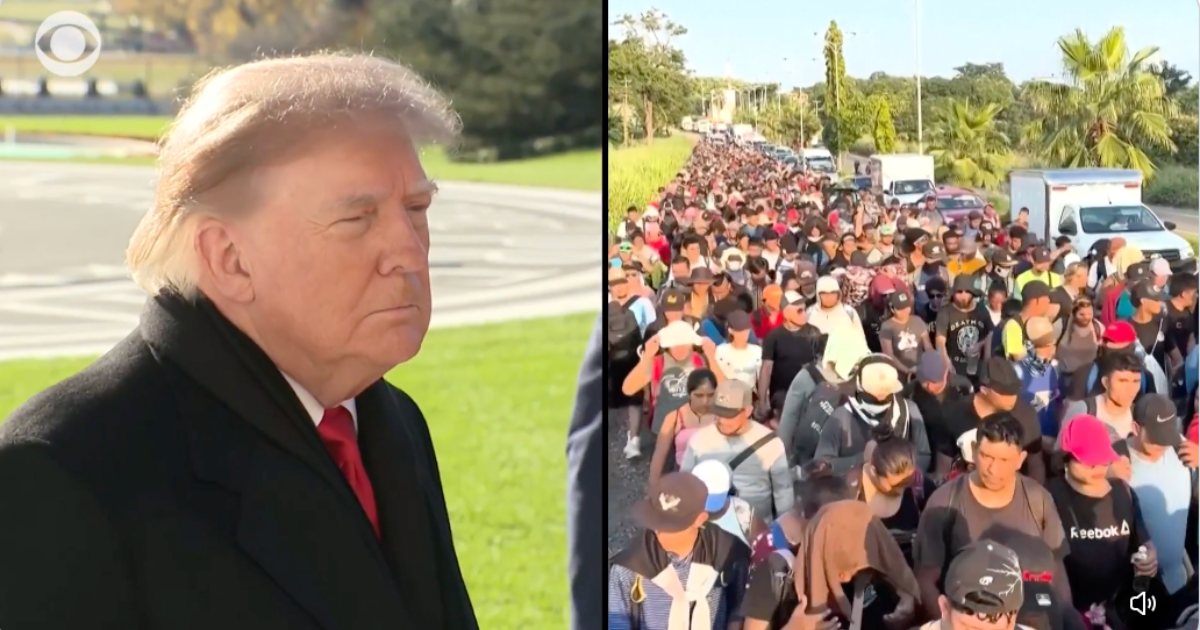
WASHINGTON, DC — President Donald Trump said Monday, November 16, that migrants traveling through Mexico toward the United States would not be allowed to enter the country. He explicitly threatened to impose heavy tariffs on Mexico if its government failed to stop them.
“They will not be allowed in,” Trump told reporters when asked about migrant caravans moving toward the U.S. southern border following the midterm elections.
“They said that they were going to stop them, and if they don’t stop them, we’re going to put heavy tariffs on Mexico.”
Trump’s statement made his position clear: he expects Mexican authorities to stop the migrants before they reach the United States, and he is prepared to use trade penalties if Mexico does not fulfill that expectation.
Migrant Groups Gather in Southern Mexico
Several groups of migrants, many from Central America, have recently gathered near Mexico’s southern border with Guatemala.
One group began moving from Tapachula, in the state of Chiapas, while another gathered near Huixtla.
Estimates of the number of participants have varied. Mexican migration authorities reported approximately 870 people gathering in Huixtla, while local observers and humanitarian organizations estimated between 1,500 and 2,000.
Many of the migrants are seeking opportunities to reach the United States after the recent congressional elections, which will change the balance of power in Washington when the new Congress takes office in January.
However, the formation of a caravan in southern Mexico does not mean the group has reached the American border.
The journey from Chiapas to the United States covers thousands of miles and can take weeks, depending on transportation, weather, enforcement activity and the circumstances of the migrants.
Mexico’s President Disputes Claims of a New Border Crisis
Mexican President Claudia Sheinbaum has challenged Trump’s description of the situation.
Speaking on November 13, she said that no migrant caravan was currently traveling through Mexico toward the northern border.
According to Sheinbaum, one previously formed group had dispersed, with many participants returning to their countries of origin, while another group was only beginning to organize.
She also said that no migrant caravan had reached the U.S. border since Trump returned to office in January 2025.
Mexican authorities have been informing migrants about the difficulties of entering the United States under current immigration policies and have discussed options for voluntary return.
Sheinbaum has maintained that Mexico will address migration through its own procedures and has rejected the use of repression against migrants.
Her statements highlight an important disagreement between the two governments: Trump is warning about caravans approaching the United States, while Mexico says the groups remain far from the northern border or have already dispersed.
Trump Uses Tariffs as Pressure on Mexico
The president’s remarks on Monday repeated a warning he first issued on November 12.
At that time, Trump threatened to double tariffs on Mexican imports if Mexico failed to prevent migrants from reaching the United States.
The latest statement did not specify a tariff rate, identify the products that might be affected or announce when additional duties could take effect.
No new tariff measure was formally announced during Monday’s remarks.
Tariffs are taxes imposed on imported goods, generally paid initially by the importing businesses. Depending on market conditions, part of those costs may ultimately be passed on to American consumers.
The economic consequences could be significant because Mexico is one of the United States’ largest trading partners.
The two countries exchanged approximately $779 billion in goods during the first nine months of 2026, according to figures reported by Reuters.
Their economies are deeply connected through automobile manufacturing, agricultural products, electronics, medical equipment and other industries.
Any substantial increase in tariffs could create additional costs for companies operating on both sides of the border.
Immigration and Trade Become One Negotiating Issue
Trump’s threat demonstrates how his administration is using trade policy to pursue immigration enforcement objectives.
Instead of treating tariffs solely as tools for negotiating market access or protecting domestic industries, the president is using the possibility of higher import duties to pressure another government into taking action against migrant movements.
The approach places Mexico in a difficult position.
Its government must manage migration through its territory while maintaining a trading relationship that is essential to both economies.
Mexico’s Economy Minister Marcelo Ebrard has said the emerging migrant groups have not disrupted trade negotiations with Washington.
The two governments are already engaged in discussions about their broader commercial relationship following disagreements over the future of the United States, Mexico and Canada trade agreement.
Additional tariffs linked to migration could complicate those talks.
What Happens Next?
For now, Trump’s announcement remains a warning rather than a new trade measure.
The president says Mexico will stop the migrant caravans, while Mexican authorities insist that no large group is currently approaching the U.S. border.
It also remains unclear how many migrants will continue their journeys north or whether the groups gathering in southern Mexico will remain together.
The coming days will show whether Mexican authorities can prevent additional caravans from advancing and whether Washington follows through on its threat of higher tariffs.
The dispute illustrates how immigration enforcement has become closely connected to economic negotiations between the United States and Mexico.
For Trump, the message is that the migrants will not enter the United States. For Mexico, the challenge is to manage the movement of people without triggering a trade confrontation that could affect businesses and consumers in both countries.
Sources: CBS News, November 16, 2026; White House Press Remarks, November 16, 2026; Reuters, November 12 and 13, 2026; Associated Press; Mexican Presidency; Mexico’s National Migration Institute.
By NJ RADAR Team