


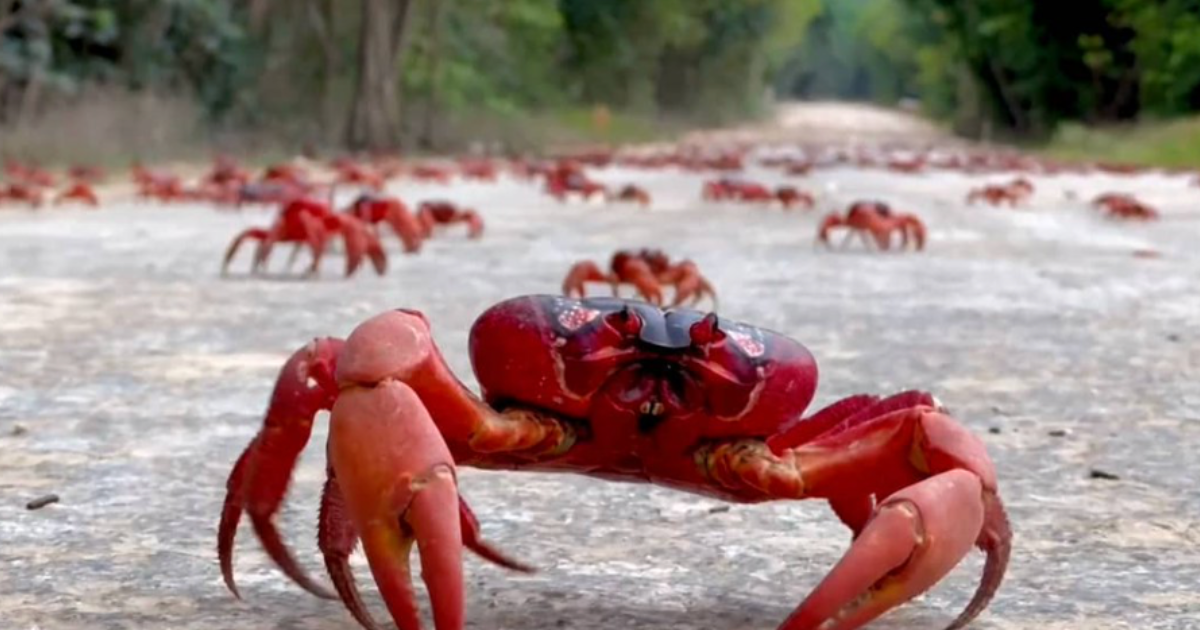
CHRISTMAS ISLAND, AUSTRALIA — Roads are turning red on Australia’s Christmas Island as millions of crabs emerge from the rainforest and march toward the ocean in one of nature’s most extraordinary annual migrations.
Videos recorded on November 14 and 15 show enormous numbers of bright red crabs covering roads, climbing specially constructed bridges and moving in the same direction, almost as if hypnotized by an invisible force.
And in a remarkable way, their journey is guided by two natural signals: the arrival of seasonal rain and the phases of the moon.
A Journey That Begins With Rain
Christmas Island, an Australian territory in the Indian Ocean, is home to more than 100 million red land crabs.
For much of the year, these animals remain in the rainforest, sheltering in burrows and feeding on leaves, flowers and fallen fruit.
But when the first heavy rains of the wet season arrive, the island undergoes a dramatic transformation.
Millions of crabs begin leaving their forest homes almost simultaneously, heading toward the coast to reproduce.
The males usually begin the journey first, followed by the females.
From above, the moving crowds resemble rivers of red flowing across the landscape. Roads, gardens, rocky slopes and forest paths become part of their route to the sea.
How Does the Moon Guide Millions of Crabs?
Perhaps the most fascinating part of this migration is its connection to the lunar cycle.
According to Parks Australia, the crabs synchronize their journey so that females can release their eggs into the ocean just before dawn, as the high tide begins to recede during the moon’s last quarter.
The timing is remarkably precise.
If the rains arrive early, the crabs may travel more slowly, stopping to feed along the way. If the rains come close to the ideal spawning date, they move much faster.
If conditions are too dry, some will delay their journey until the following lunar cycle.
Watching millions of animals move together can give the impression that they are under a spell. In reality, their behavior is an extraordinary example of biological timing shaped by rainfall, tides and the moon.
Roads Close and Special Bridges Open
For residents of Christmas Island, the annual migration transforms everyday life.
Roads may be temporarily closed to protect the animals, while workers install roadside barriers that guide crabs toward specially constructed bridges and underpasses.
These crossings allow enormous numbers of crabs to travel safely without being crushed by vehicles.
National park staff prepare months in advance, clearing routes and installing protective barriers.
The sight has become one of the island’s greatest natural attractions, drawing visitors eager to witness the spectacle.
Up to 100,000 Eggs From a Single Female
After reaching the coast, the crabs mate in burrows near the shoreline.
Each female can produce up to 100,000 eggs, which she carries until they are ready to be released into the sea.
When the lunar conditions are right, the females gather along the coast and release their eggs into the water before sunrise.
The eggs hatch into tiny larvae that spend several weeks developing in the ocean.
Only a small fraction survive predators and other dangers.
Those that do eventually return to land as miniature crabs, beginning another remarkable journey from the shoreline into the rainforest.
In years when large numbers survive, the returning young crabs can cover beaches and roads in even greater numbers than the adults.
One of Nature’s Most Remarkable Migrations
The migration has fascinated scientists, photographers and wildlife enthusiasts for decades.
Naturalist David Attenborough once described witnessing the movement of Christmas Island’s red crabs as one of his most memorable wildlife experiences.
For the island’s residents, it is an annual reminder of how closely wildlife can be connected to natural cycles.
And for anyone watching the latest videos, the scene is almost unbelievable: millions of brilliant red creatures moving together across roads and forests, following a seasonal rhythm that ultimately leads them to the sea.
They are not truly hypnotized. But their extraordinary synchronization with the moon makes the migration look like one of nature’s most carefully choreographed performances.
Sources: Parks Australia; Christmas Island National Park; Christmas Island Tourism Association; Euronews, November 16, 2026; ABC News.
By NJ RADAR Team