


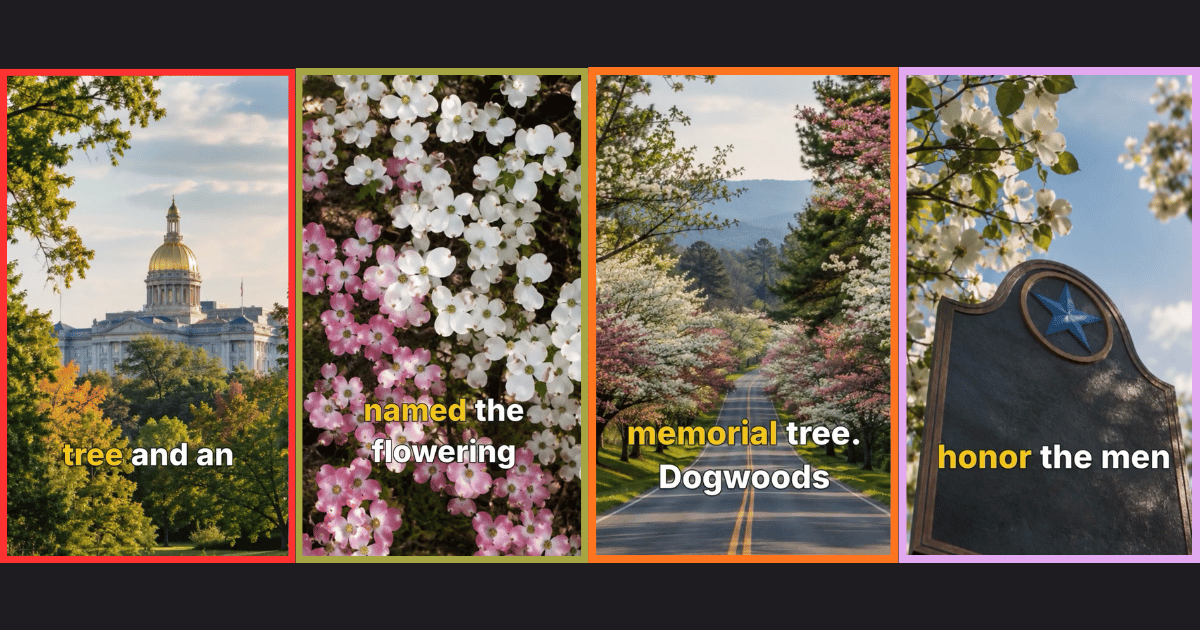
NEW JERSEY — Every spring, flowering dogwood trees brighten New Jersey neighborhoods, parks and woodlands with delicate white and pink blossoms. But behind their beauty is a story that connects the state’s military history, a living tribute to American service members and decades of scientific research at Rutgers University.
The flowering dogwood (Cornus florida) has been New Jersey’s official state memorial tree since 1951, although many residents may be more familiar with the northern red oak, which became the official state tree one year earlier.
The distinction reflects two different roles. The red oak represents New Jersey as its state tree, while the dogwood carries a special commemorative purpose.
A Living Memorial to American Service Members
The story began during World War II, when the Garden Club of New Jersey launched an ambitious project to plant thousands of flowering dogwoods along a section of Route 22.
The trees were intended to honor the men and women serving in the U.S. Armed Forces.
The project became known as Blue Star Memorial Drive, named for the blue stars displayed by American families with loved ones serving in the military.
In 1944, the first trees were planted along the highway. By the following years, thousands more had been added along a stretch between North Plainfield and Mountainside.
Rather than constructing a traditional stone monument, organizers envisioned a living memorial that would grow, bloom and renew itself every spring.
In 1951, the New Jersey Legislature formally designated the flowering dogwood as the state’s memorial tree, encouraging its use in parks, along highways and around public buildings as a tribute to military service members.
A Tree With Beauty in Every Season
The flowering dogwood is native to the eastern United States and grows naturally in many parts of New Jersey.
Its spring display features four prominent white or pink bracts surrounding clusters of small flowers.
During summer, the tree provides green foliage and shade. In autumn, its leaves turn shades of red and burgundy, while bright red berries provide food for birds.
Its relatively compact size has made it popular in residential landscapes, parks and gardens.
But the tree has also faced a serious environmental challenge.
Rutgers Scientists Helped Save the Dogwood
Beginning in the 1970s, Rutgers University plant scientist Elwin Orton worked to develop stronger varieties of dogwood after disease threatened native trees.
One of the most serious threats was dogwood anthracnose, a fungal disease capable of damaging and killing susceptible trees.
Orton’s breeding work produced the Stellar series of hybrid dogwoods, combining attractive flowers with improved disease resistance.
His research also contributed to the development of Venus, a dogwood known for its exceptionally large white blooms.
The work continued under Rutgers professor Thomas Molnar, who helped develop new varieties suited to changing environmental conditions and consumer preferences.
Among the most successful is Scarlet Fire, a kousa dogwood with deep pink blossoms.
The variety has attracted considerable attention from nurseries and gardeners because of its distinctive color, durability and ornamental value.
From New Jersey Research to Gardens Around the World
Rutgers-developed dogwoods have become successful commercial plants.
According to Rutgers University, approximately 40,000 Scarlet Fire dogwood trees are sold annually in the United States and Europe.
The university receives royalties from sales, helping finance continued research and the development of additional varieties.
The program demonstrates how research conducted in New Jersey can influence gardening and horticulture far beyond the state.
It also highlights the important relationship between university science, commercial nurseries and the preservation of ornamental trees.
More Than a Springtime Flower
For New Jersey, the flowering dogwood represents more than seasonal beauty.
Its designation as a memorial tree reflects an effort to honor military service through the natural landscape, while the Rutgers breeding program connects that history to modern scientific innovation.
What began as a wartime tribute along Route 22 has become part of the state’s botanical and cultural identity.
The next time a flowering dogwood blooms in a New Jersey neighborhood, its blossoms may offer a reminder of a story that began more than eight decades ago, with a decision to honor service members by planting trees rather than building monuments.
Sources: New Jersey State Library; New Jersey Legislature; Federal Highway Administration; Rutgers University; News 12 New Jersey; Garden Club of New Jersey.
By NJ RADAR Team