


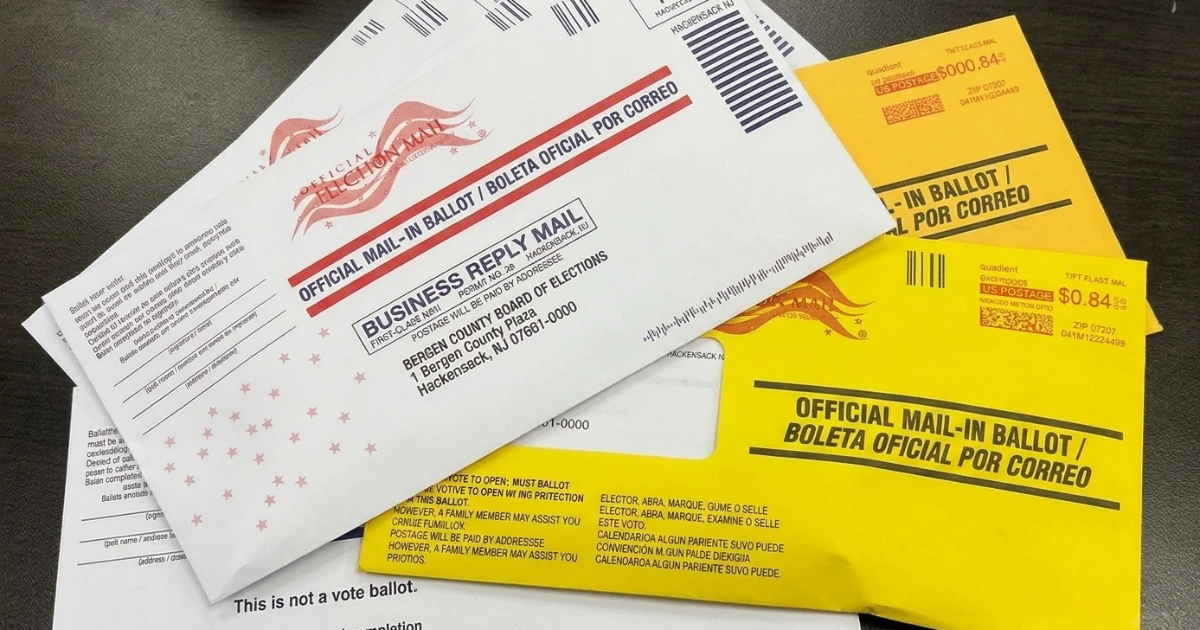
NEW JERSEY — Democrats entered Election Day on November 3 with a substantial advantage in mail-in voting, having returned 290,408 more ballots than Republicans across New Jersey. The lead extended to every county in the state, including areas that have traditionally favored Republican candidates.
According to an analysis published Wednesday, November 11, by David Wildstein of the New Jersey Globe, preliminary data through November 5 showed that registered Democrats had returned 408,636 mail-in ballots, compared with 118,228 returned by registered Republicans.
Democrats accounted for 63.5% of returned mail ballots, Republicans for 18.4%, and unaffiliated voters for the remaining 18.1%.
The figures reflect voters’ party registrations, not necessarily which candidates received their votes. Because ballots are secret, a registered Democrat may vote for a Republican candidate, and vice versa.
Democrats Led in All 21 Counties
The Democratic advantage extended across all 21 New Jersey counties, all 12 congressional districts, and 39 of the state’s 40 legislative districts.
Even in traditionally Republican strongholds, more registered Democrats than Republicans returned mail-in ballots.
In Ocean County, Democratic voters returned 19,249 ballots, compared with 15,743 from Republicans. In Hunterdon County, the difference was 7,661 to 3,672.
Cape May County, another Republican stronghold, also recorded a Democratic advantage of 1,136 returned mail ballots.
The pattern suggests that mail voting has become an increasingly important part of how Democrats organize their campaigns and encourage supporters to participate before Election Day.
Mail Voting Played a Role in Several Major Races
The November 3 election brought Democratic victories in several counties where Republicans had held power for years.
In Morris County, Democrat Chris Russo defeated Republican Tayfun Selen in a county commissioner race, receiving 106,074 votes to Selen’s 84,929.
Before Election Day, registered Democrats in Morris County had already returned 12,058 more mail-in ballots than Republicans. Russo’s victory marked the first Democratic win in a countywide election there since 1973.
In Monmouth County, Democrats won two county commissioner seats and the surrogate’s office, securing their first countywide victories since 2008.
The Democratic mail-ballot advantage in Monmouth reached 13,877, more than twice the 6,514-vote margin by which Democrat Anthony Cherry defeated Republican Surrogate Maureen Raisch.
Similar patterns appeared in Atlantic and Cumberland counties, where Democrats also gained control of important county offices.
Although mail voting was not the only factor behind these victories, the figures show how much participation had already occurred before voters arrived at polling places on Election Day.
Congressional Races Showed the Same Pattern
The Democratic advantage was also visible in two closely watched congressional contests.
In New Jersey’s 7th Congressional District, Democrat Rebecca Bennett defeated Republican Rep. Tom Kean Jr. by 54,536 votes. Registered Democrats had returned 23,648 more mail ballots than Republicans in the district.
In the 2nd Congressional District, Democrat Zach Mullock defeated Republican Rep. Jeff Van Drew by 7,597 votes.
The Democratic advantage in returned mail ballots in that district was 15,588, more than twice Mullock’s eventual winning margin.
These comparisons do not establish how individual mail voters cast their ballots or prove that mail voting alone determined either result. They do, however, illustrate the scale of the Democrats’ early participation advantage.
Higher Ballot Return Rates
Democrats not only received more mail-in ballots but also returned them at a higher rate.
Of the 535,804 mail ballots issued to registered Democrats, approximately 76% had been returned by November 5.
Republicans returned about 67% of the 176,341 ballots issued to their registered voters, while the return rate among unaffiliated voters was approximately 55%.
That difference gave Democratic campaigns a significant organizational advantage, allowing them to secure participation from many supporters before Election Day while continuing to reach voters who had not yet cast their ballots.
Republicans, meanwhile, relied more heavily on in-person voting to close the gap. They succeeded in some counties, demonstrating that a mail-ballot advantage does not automatically translate into an election victory.
What the Numbers Mean for 2027
New Jersey voters will elect all 80 members of the General Assembly and all 40 state senators in 2027.
The November 2026 mail-voting figures may offer both parties valuable information as they prepare for those elections.
In seven legislative districts expected to receive particular attention, registered Democrats returned a combined 73,574 mail ballots, compared with 28,885 from Republicans.
That represents an advantage of 44,689 returned ballots across those districts.
Future election outcomes will depend on more than voting methods. Candidate performance, campaign organization, local issues, and turnout among unaffiliated voters will all remain important.
Still, the 2026 results highlight a significant change in New Jersey elections: For many campaigns, a large share of voter participation now takes place well before Election Day.
Sources: New Jersey Globe, David Wildstein, November 11, 2026; New Jersey Division of Elections.
By NJ RADAR Team