


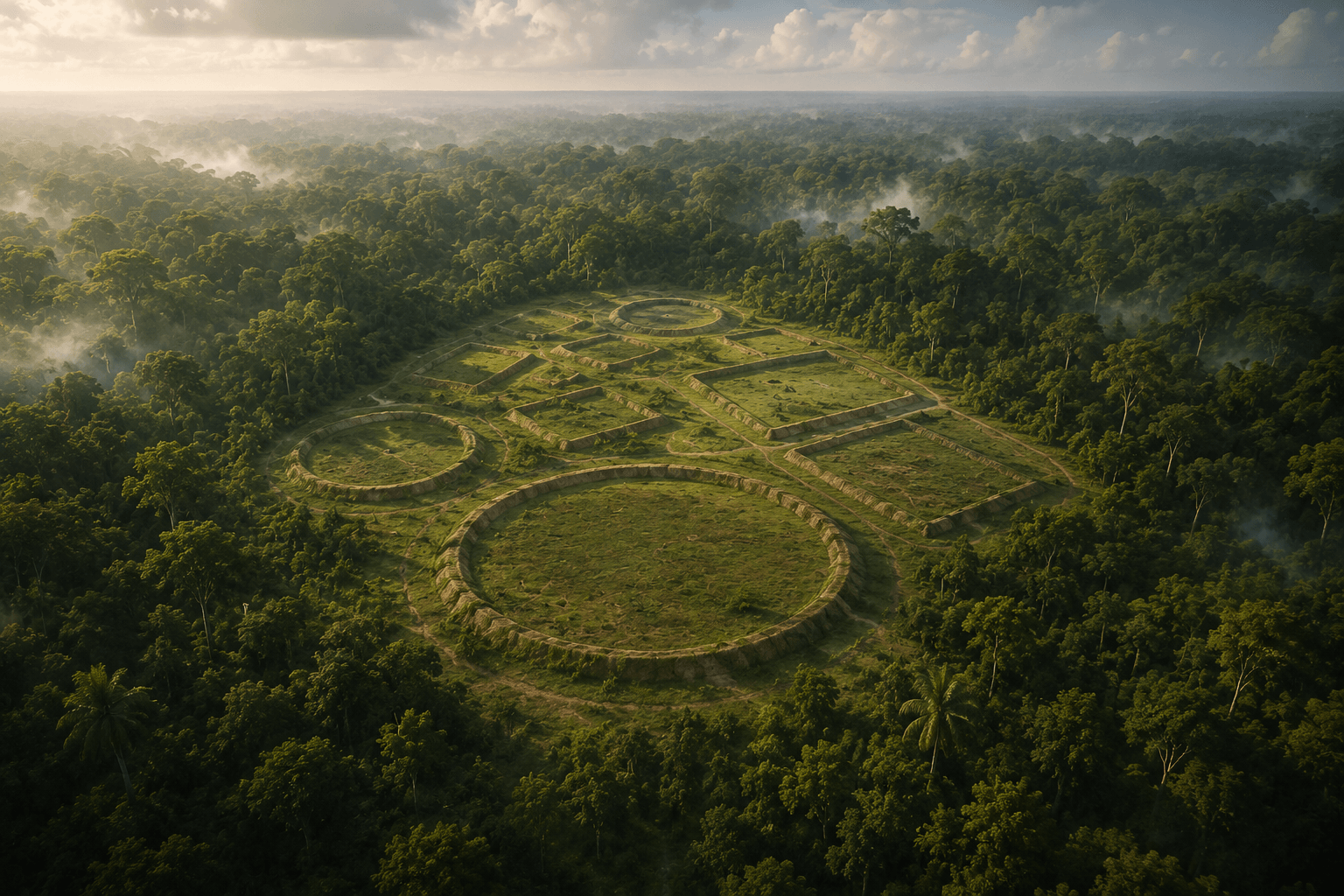
Archaeologists have discovered nearly 400 previously unknown geoglyphs—monumental earthworks—hidden beneath the dense canopy of the Amazon rainforest in western Brazil using LiDAR (Light Detection and Ranging)technology. The study was published on July 29, 2026, in the prestigious journal Nature, after researchers flew more than 4,400 kilometers and surveyed approximately 4,500 square kilometers of rainforest.
These geometric structures—circles, squares, and rectangles—were built between 600 BC and AD 850, with researchers believing the culture responsible reached its peak between AD 100 and 300. They were constructed by an ancient culture that researchers refer to as Aquiry, named after the Acre River. The word “aquiry” comes from the Arawak language and means “caiman river.” According to the study’s authors, the population associated with this culture may have reached as many as three million people, based on estimates that approximately 300 people were required to build and maintain each geoglyph. However, some archaeologists believe those population estimates are likely too high.
The geoglyphs average about seven acres in size, while some cover as much as 123 acres, with ditches up to 12 meters (39 feet) wide and 5 meters (16 feet) deep. Researchers believe they were built entirely without metal tools or draft animals, making their precision even more remarkable.
The geoglyphs served as ceremonial centers, surrounded by settlements with longhouses where people cultivated maize, squash, and other crops. Researchers believe there may be between 24,000 and 30,000 similar structures across the region, reinforcing the idea that the Amazon was not an uninhabited wilderness but home to complex societies long before the arrival of Europeans.
Not all scientists, however, fully agree with these conclusions. Some independent archaeologists argue that the large number of discovered sites may partly reflect the Aquiry people’s habit of relocating their settlements rather than evidence of an exceptionally dense, permanent population. As a result, questions remain about how large this culture actually was at any given time.
Particularly fascinating is the testimony of a representative of the Apuriña Indigenous people, who participated in the research. According to him, his community knows these geoglyphs as “kymyrury”—places regarded as “homes of the spirits.” This tradition gives the discovery not only archaeological significance but also a profound cultural dimension.
The discovery is therefore more than a remarkable archaeological finding—it is also a reminder that the memory of ancient civilizations continues to live on among the Indigenous peoples who have inhabited the Amazon for centuries.
Sources & References
- Nature (published July 29, 2026)
- Archaeology Magazine on X
- Live Science