


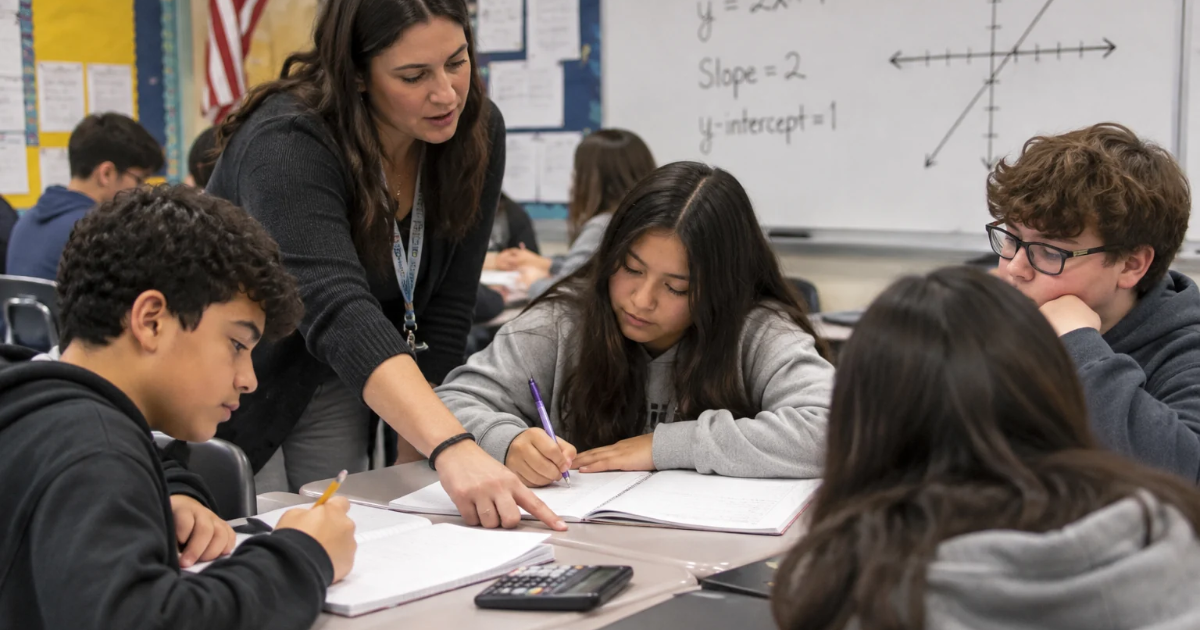
TRENTON, NJ — November 9, 2026 — After years of investment in tutoring, literacy programs and academic recovery efforts, fewer than half of New Jersey students are meeting grade-level expectations in mathematics. The state’s latest test results also reveal substantial differences in achievement among student groups, raising new questions about whether education initiatives are delivering the improvements they were designed to produce.
Results from the spring 2026 New Jersey Student Learning Assessments show that 51.1% of students met or exceeded expectations in English language arts, while only 41.7% reached that level in mathematics.
That means nearly six in ten students tested in math did not demonstrate proficiency at their grade level.
The findings were presented to the New Jersey State Board of Education in early November, prompting board members to question how effectively the state is measuring the impact of its education spending.
The results come as New Jersey continues to invest millions of dollars in programs intended to help students recover from learning disruptions, strengthen reading skills and improve mathematics performance.
A Troubling Divide Between Student Groups
The statewide averages conceal substantial differences in academic performance.
Nearly 80% of Asian students met grade-level expectations in English language arts, compared with approximately 36% of Black and Hispanic students.
The gap was even wider in mathematics.
While approximately 75% of Asian students demonstrated proficiency, only 23% of Black students reached the same standard — a difference of 52 percentage points.
Economic circumstances were also closely associated with student performance.
Among students classified as economically disadvantaged, 34% met expectations in English language arts and just 24.7% did so in mathematics.
Multilingual learners recorded proficiency rates of approximately 21% in both subjects.
These disparities have persisted through multiple rounds of education reform and targeted assistance programs. They are particularly important for districts serving large numbers of students from low-income households or students who are learning English.
The results do not establish that race or ethnicity causes differences in achievement. They highlight patterns that education officials must examine alongside access to educational resources, economic conditions, language support and other factors affecting learning.
Millions Invested, but Where Are the Results?
New Jersey has committed substantial resources to improving literacy and mathematics instruction.
Governor Mikie Sherrill’s fiscal year 2027 budget includes nearly $20 million for high-impact tutoring and literacy initiatives, including early reading screenings and literacy coaches.
An additional $11.5 million in federal funding supports literacy improvement efforts.
These investments are intended to identify struggling students earlier and provide additional instruction before academic difficulties become more severe.
Yet the statewide proficiency figures remain close to levels reported in previous years.
In 2025, approximately 53% of students met English language arts standards and about 41% met mathematics standards. The latest figures are 51.1% and 41.7%, respectively.
There is an important limitation to that comparison.
New Jersey introduced a redesigned adaptive assessment in 2026. Unlike the previous test, which presented students in the same grade with a fixed set of questions, the new version adjusts question difficulty based on individual responses.
The assessment also incorporates updated state learning standards and revised proficiency thresholds.
State education officials have cautioned that the new results should be treated as a baseline rather than directly compared with earlier testing years.
Still, the broad pattern remains troubling: a substantial proportion of students are not demonstrating the reading and mathematics skills expected at their grade levels.
And the latest results do not yet establish whether the state’s newest investments will improve future performance.
Education Officials Demand Better Accountability
During the State Board of Education discussion, board member Nedd James Johnson, a former school administrator in Bridgeton, questioned whether the state has sufficient information to determine which interventions are working.
Johnson called for closer examination of tutoring programs and other initiatives intended to close achievement gaps.
Education Commissioner Lily Laux acknowledged the need for stronger evaluation.
She said the department is refining a strategic plan that includes a system for measuring the effectiveness of individual education initiatives.
For high-impact tutoring, Laux emphasized the importance of ensuring that students receive the appropriate amount and quality of instruction and that educators examine actual academic results.
The discussion reflects a broader concern among board members: allocating money to an education program is not the same as demonstrating that the program improves learning.
Officials want more detailed evidence showing which students benefit, which programs produce measurable gains and where additional changes are necessary.
Mathematics Remains a Particular Concern
Mathematics has been one of the most persistent challenges in New Jersey’s public schools.
The 2026 results show that difficulties become particularly visible in the middle grades, although differences in course placement and testing populations complicate direct comparisons.
For example, only about 22.6% of students taking the eighth-grade mathematics assessment met proficiency standards. However, many higher-performing eighth graders take Algebra I instead, meaning that the eighth-grade test does not represent every student enrolled in that grade.
The distinction matters when interpreting the results.
Nevertheless, the overall statewide mathematics proficiency rate of 41.7% leaves considerable room for improvement.
Mathematical skills develop cumulatively. Students who struggle with fractions, proportional reasoning or basic algebraic concepts may face increasing difficulties in later courses.
That makes early identification, consistent instruction and carefully evaluated intervention programs particularly important.
What Happens Next?
School districts must present their statewide assessment results to their local boards of education by December 8, 2026.
Those reports are required to include performance data for different student groups, comparisons where appropriate and strategies for addressing academic weaknesses.
Parents will also receive individual student reports showing how their children performed.
The state is expected to continue studying the redesigned assessment system and refining how it measures student progress.
For families, teachers and policymakers, the central question is not simply how much New Jersey spends on education, but whether the instruction and support students receive are producing measurable improvements.
With fewer than half of students meeting mathematics expectations and large achievement gaps still evident, the latest results give school leaders a clear set of problems to address.
Sources: New Jersey Department of Education, Spring 2026 Statewide Assessment Results; NJ Spotlight News, Catherine Carrera, November 9, 2026; New Jersey State Board of Education, November 2026 meeting; New Jersey Principals and Supervisors Association, November 2026 State Board report; New Jersey School Boards Association, September 2026.
By NJ RADAR Team