


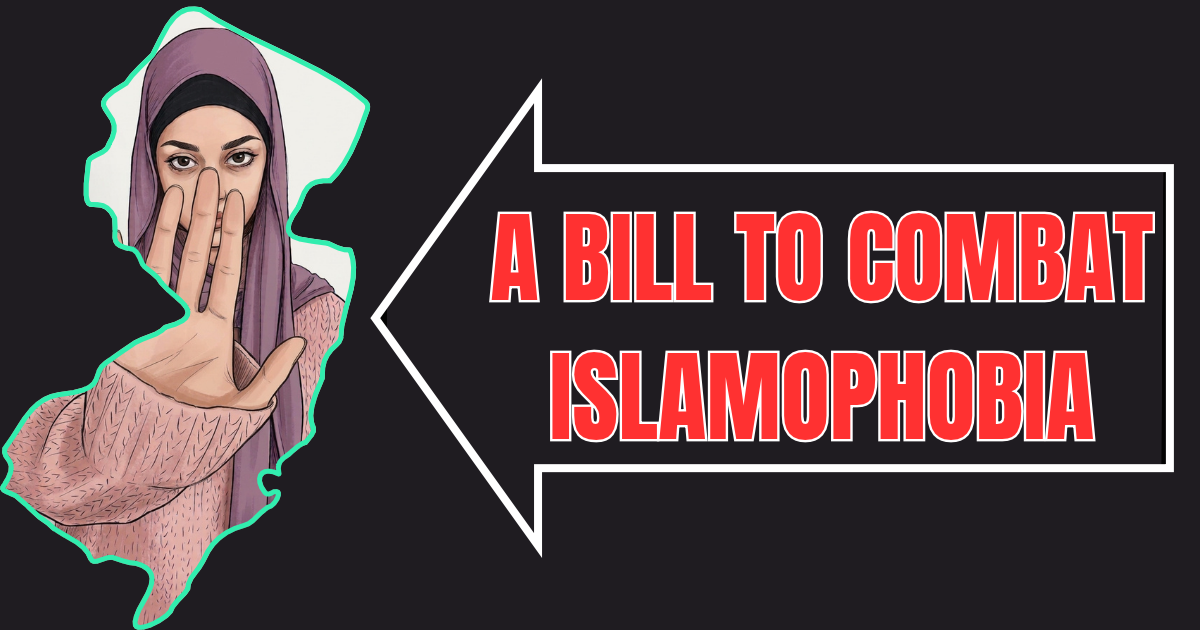
Why has A1146, a bill aimed at addressing Islamophobia, been sitting in a New Jersey Assembly committee for nearly ten months?
Nearly ten months after its introduction, Assembly Bill A1146 remains before a New Jersey General Assembly committee. It would give the state its first official definition of Islamophobia. Police officers and public officials would have to consider that definition when examining whether someone was targeted for assault, intimidation, or discrimination because of anti-Muslim bias.
The bill’s reach is modest. It could help investigators recognize anti-Muslim bias more consistently, but it gives people who feel unsafe because of publicly expressed hatred no new legal grounds to seek protection. Will New Jersey pass even a measure this limited? If even this bill is so contentious, are prejudices against Muslims more deeply rooted than we are willing to admit?
What Is Islamophobia, and How Does It Show Up?
Islamophobia is prejudice, hostility, or discrimination directed at people because they are Muslim or are perceived to be Muslim. A1146 describes it as a form of racism that can target people whose clothing, name, or appearance is associated with a Muslim identity. Mosques, cemeteries, and other Muslim community institutions can also be targets. Religious teachings and practices are open to debate. Prejudice becomes apparent when people are treated as dangerous, guilty, or disloyal because of their faith.
At the individual level, Islamophobia can take the form of insults on the street, spitting, pulling off a woman’s hijab, threats, or physical assault. It can also target property, as when someone paints hateful messages on a mosque wall or damages headstones in a Muslim cemetery. Such acts affect people who were never there when they happened. A message left at a mosque entrance can leave worshippers wondering whether it is safe to return.
At the institutional level, prejudice can influence who gets a job, who finds housing, and who has equal access to public services. It can also take the form of religious profiling, when a person’s faith is treated as grounds for suspicion. The consequences are especially serious when that pattern recurs within an institution that makes decisions about the rights or opportunities of many people. New Jersey law already prohibits religious discrimination in employment, housing, and access to services open to the public.
In public discourse and the media, Islamophobia can show up in repeated portrayals of Muslims as a security threat or as people who supposedly cannot fit into society. One example in A1146 is the claim that Muslims as a group are prone to terrorism. When that claim is repeated in public, Muslims can find themselves expected to prove their loyalty or answer for the actions of people with whom they have no connection.
Why Is It Dangerous for Society as a Whole?
The harm begins before any physical attack. A woman who starts avoiding a particular street after being repeatedly insulted for wearing a hijab has already had to change how she lives. A student who keeps quiet about being Muslim to avoid ridicule has already felt the consequences. A family that wonders whether it is safe to go to the mosque after receiving threats faces a constraint on everyday life, even if a physical attack never occurs.
Public expressions of hatred can make insults, exclusion, and intimidation seem more acceptable. Collective blame becomes routine when an entire community is expected to answer for one person’s actions. That deepens divisions, erodes trust, and can lead young people to withdraw from places where they expect to be treated with suspicion because of their faith.
It also affects trust in institutions. People who expect their complaints to be brushed aside are less likely to come forward. When rules guaranteeing equal treatment are applied differently depending on who seeks protection, confidence in the rule of law erodes. That is why it matters how institutions identify discriminatory motives and what they can do for people who are already changing how they live because of publicly expressed hatred.
What Would A1146 Actually Change?
Under the bill’s key provision, a police officer or other public official examining a possible violation of an existing anti-discrimination rule would have to consider the official definition of Islamophobia when assessing motive. That would include cases in which the person responsible wrongly assumed the victim was Muslim.
If someone damages a mosque and leaves a message calling Muslims terrorists, that message can help investigators determine why the mosque was targeted. If someone pulls off a woman’s hijab while insulting her faith, her account of what the attacker said can help establish motive. Investigators can already consider religious bias. A1146 would require officials to take the same statewide definition into account when making that assessment.
That distinction can matter when an incident first appears to be an ordinary case of vandalism or assault, but the circumstances suggest that a person or place was targeted because of a connection to Islam. The definition alone cannot establish what happened. Officials would still need to examine the circumstances and gather evidence.
Where Would the Bill Leave a Gap in Protection From Hate Speech?
A public statement that “Muslims are terrorists” could fall within A1146’s description of Islamophobia. Falling within that definition would not, by itself, make the statement punishable. The bill creates no new criminal offense and expressly preserves constitutional protections for free speech. Serious threats and discriminatory harassment that meet the relevant legal standards can already be investigated under existing law.
That leaves a question that may matter most to people exposed to this kind of speech. What protection can they seek when publicly expressed hatred toward Muslims already makes them feel unsafe, but the conduct falls short of the threshold for action under existing law? A1146 would give officials a standard for assessing motive when there are already grounds to examine a case. Where those grounds are absent, its reach is limited.
The European and American Approaches
The European Union requires member states to punish intentional public incitement to violence or hatred against a group or its members based on religion, race, or origin. How that requirement applies depends on the country’s laws and the circumstances of the case. In the United States, the constitutional threshold for punishing speech as incitement to unlawful conduct is higher. The speech must be intended to bring about imminent unlawful action and be likely to do so. A1146 would leave that threshold in place.
Political Opposition and the British Influence
Republican Assemblyman Paul Kanitra warned that the bill could land people in jail for criticizing Islam. A1146 provides no such penalty. Criticizing Islam is one thing. Vilifying Muslims because of their faith is hate speech. The breadth of the definition is open to debate. The claim about jail time should be weighed against what the bill actually requires of public officials.
There is a British connection. The bill’s explanatory statement says the definition was modeled in part on a working definition proposed in 2018 by a cross-party group of British parliamentarians. The British government did not adopt that group’s definition. In March 2026, it accepted a different, legally nonbinding definition of anti-Muslim hostility.
Who Decides, and Will the Bill Even Get a Vote?
Democratic Assemblyman Joe Danielsen is the bill’s lead sponsor. Verlina Reynolds-Jackson, Mitchelle Drulis, and Roy Freiman are co-sponsors. A1146 was introduced on January 13, 2026, and referred that day to the Assembly State and Local Government Committee. Two related bills introduced in 2024, Assembly Bill A3684 and Senate Bill S1592, were also referred to committees and did not become law. Nearly ten months after A1146 was introduced, its committee referral is still the last recorded action. No vote has been announced.
For the bill to become law, the New Jersey General Assembly and Senate must pass the same text. It would then go to the governor for consideration. If it fails to pass both chambers by the end of the 2026–2027 legislative session, it would have to be reintroduced in the next session. As written, it would take effect immediately upon enactment. So far, there is no timetable for passage.
Even a Modest Bill Could Be a First Step
The clearest benefit would be greater consistency in how investigators assess anti-Muslim bias. A shared definition could also make it easier to compare similar cases, identify patterns, and develop future policies based on a clearer picture of the problem. How much good it would do depends on how it is used. The bill provides for no mandatory training for officials, new reporting system, or dedicated support for victims.
Will it pass? The delay in committee alone tells us little about why the bill has stalled. But when a requirement to consider anti-Muslim bias is portrayed as a threat of jail time for criticizing Islam, it is worth asking how willing we are to have a serious conversation about prejudice against Muslims and its consequences.
Passing A1146 would still be a step forward. If officials more consistently recognize why someone was targeted, complaints may get a more thorough review. That could open the door to more concrete measures. Their value would be felt by a woman who wants to walk down the street without fearing another insult over her hijab, or a child who wants to talk about their faith at school without fear of humiliation. They need protection before hatred turns into a physical attack.
Democrats in New Jersey can count on the support of many Muslim voters. What do those voters get in return? A1146, introduced by Democratic lawmakers, has been sitting in an Assembly committee for nearly ten months. Passing it would be a modest but concrete step toward recognizing anti-Muslim bias more consistently in investigations. Now that the election is over, will Democrats show that protecting Muslims matters enough to bring the bill up for debate and a vote?
Sources: New Jersey Legislature — Assembly Bill A1146 · LegiScan — A1146 and predecessor bills A3684 and S1592 · New Jersey Attorney General — Law Against Discrimination · Cornell Law School — U.S. standard for incitement · UK Government — A Definition of Anti-Muslim Hostility · Shore News Network — Paul Kanitra’s comments on A1146
Aziza Smailovic