


TRENTON, NJ — October 31, 2026 — New Jersey voters are turning out in large numbers ahead of the November 3 midterm elections, with more than 950,000 ballots already recorded through early in-person voting and vote-by-mail.
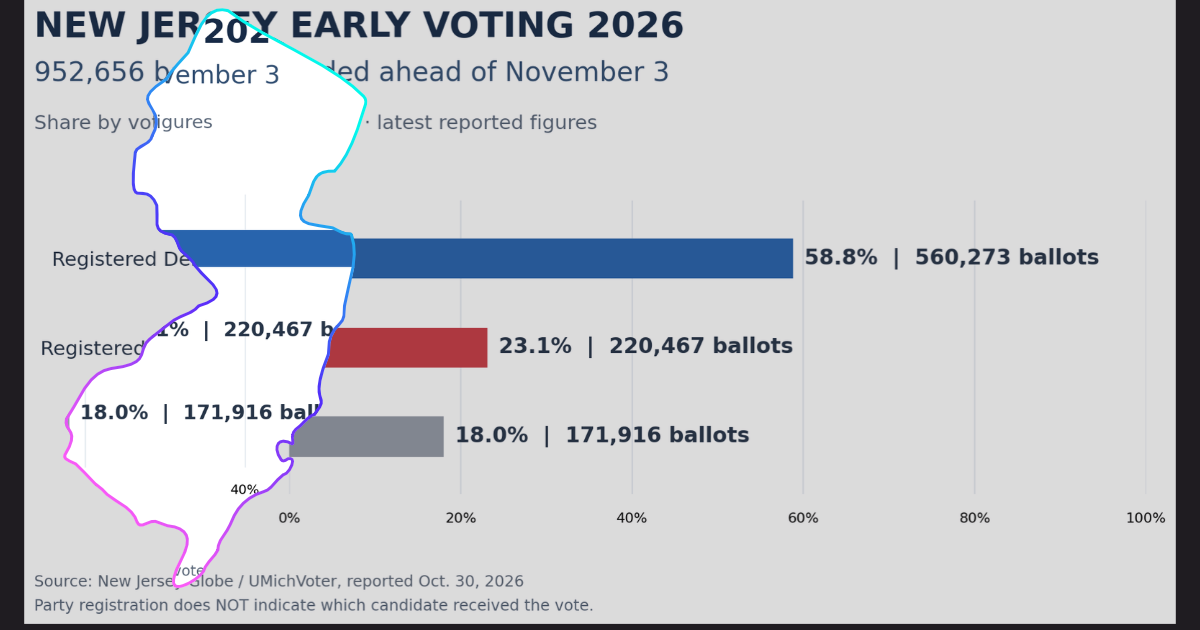
According to the latest figures reported by the New Jersey Globe, 952,656 residents had cast their ballots in advance, revealing a substantial participation gap between registered Democratic and Republican voters.
The figures provide an early picture of voter participation across the state, although they do not reveal which candidates are receiving support.
With the final weekend of early voting underway, attention is turning to whether Republicans can narrow the participation gap and how unaffiliated voters will influence the overall electorate.
Democrats Account for Nearly 59% of Early Voters
The latest reported breakdown shows:
- Registered Democrats: 560,273 ballots (58.8%)
- Registered Republicans: 220,467 ballots (23.1%)
- Unaffiliated and third-party voters: 171,916 ballots (18.0%)
Registered Democrats have submitted approximately 340,000 more ballots than registered Republicans.
That means Democratic voters have participated in early voting at roughly two and a half times the number of Republican voters recorded so far.
However, these figures represent party registration, not actual votes for Democratic or Republican candidates.
A registered Democrat may vote for a Republican candidate, and a registered Republican may support a Democrat. Unaffiliated voters are not committed to either major party.
Therefore, the early voting figures should not be interpreted as election results.
Republican Participation Shows Signs of Improvement
Although Democrats maintain a substantial overall advantage, daily early voting figures reveal a more complicated picture.
According to the New Jersey Globe, the Democratic advantage among in-person voters narrowed during the first six days of early voting.
On the opening day, October 24, Democrats held a 32.1-percentage-point advantage in in-person turnout.
By Thursday, October 29, that daily advantage had narrowed to 16.7 percentage points.
This suggests that Republican participation was becoming more competitive as the early voting period progressed.
Republicans have traditionally relied more heavily on Election Day voting, making it particularly important not to draw conclusions from early voting totals alone.
The final composition of the electorate will depend on how many voters participate during the remaining early voting period and on November 3.
What the Numbers Tell Us
The early voting data reveal several important developments.
First, Democratic voters have demonstrated strong participation well before Election Day.
Second, the daily voting pattern suggests that the party composition of early voters is changing as the election approaches.
Third, the significant number of unaffiliated voters reinforces the importance of voters who do not formally identify with either major political party.
Most importantly, early voting statistics measure participation, not political preferences.
They can show which groups are more active, but they cannot establish how those groups voted.
How Does 2026 Compare With Previous Elections?
Early voting has become an increasingly important part of New Jersey elections.
In the 2024 presidential election, approximately 1.2 million New Jersey residents voted early in person.
During the 2025 gubernatorial election, approximately 742,000 voters used in-person early voting.
Those figures cannot be directly compared with the current total of more than 950,000 because this year’s reported total includes both mail-in ballots and in-person early voting.
A more useful comparison comes from examining voter participation at similar points in previous elections.
New Jersey Globe reported that Democratic early participation increased compared with the corresponding period of the 2025 election, while Republican participation initially declined.
The difference suggests that enthusiasm, campaign organization, and voting preferences regarding when to cast a ballot may vary considerably between election cycles.
A Closer Look at the Political Landscape
New Jersey has generally favored Democratic candidates in recent statewide federal elections, but political competition varies significantly by county and congressional district.
Some areas remain reliably Democratic, while others have competitive races or strong Republican voting traditions.
In 2026, voters are choosing a U.S. senator, representatives in all 12 congressional districts, and candidates for various county and municipal offices.
The U.S. Senate contest between Democratic incumbent Cory Booker and Republican Justin Murphy is among the major statewide races.
Congressional contests are also attracting attention, particularly in districts where the two major parties are competing for control.
Early voting numbers provide useful information about participation in these races, but they do not determine their outcomes.
Why the Final Weekend Matters
Saturday, October 31, and Sunday, November 1, represent the final opportunity for voters to cast an early ballot in person.
New Jersey’s early voting centers are open:
Saturday, October 31: 10 a.m. to 8 p.m.
Sunday, November 1: 10 a.m. to 6 p.m.
Election Day is Tuesday, November 3, when polling places will be open from 6 a.m. to 8 p.m.
The remaining voting days will help determine whether the current party participation gap continues, narrows, or changes.
Early Voting Is Not an Election Forecast
The substantial Democratic lead in early participation has attracted attention, but it would be premature to interpret these figures as proof of an eventual election victory.
Voting patterns differ between mail-in voting, early in-person voting, and Election Day participation.
Some voters prefer to cast ballots as soon as possible, while others traditionally wait until Election Day.
The political preferences of unaffiliated voters also remain unknown.
Even historical voting patterns cannot establish how individual voters marked their ballots this year.
The most reliable conclusion is that New Jersey residents are actively participating in the democratic process ahead of November 3.
The early voting numbers tell us who is showing up. The final election results will tell us whom New Jersey voters have chosen.
Sources: New Jersey Globe – Latest early voting analysis; New Jersey Globe – First-day turnout; New Jersey Division of Elections. New Jersey Globe+2
By NJ RADAR Team