


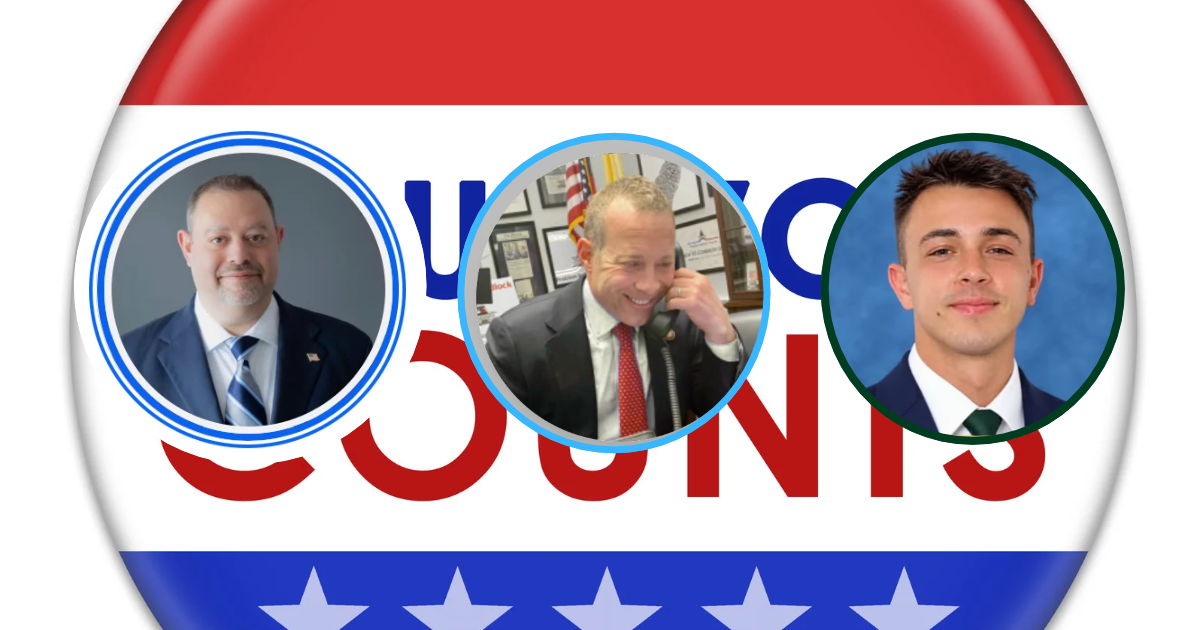
As the November 3 election approaches, three candidates are competing for a seat in the U.S. House of Representatives in New Jersey’s 5th Congressional District, which includes parts of Bergen, Passaic, and Sussex counties: Democratic incumbent Josh Gottheimer, Republican Sean Kirrane, and Adam Rueda, representing the smaller Humane Sustainable Future Party.
Although they offer different political approaches, the three candidates enter the final days of the campaign with very different levels of experience, financial resources, and established political support.
Adam Rueda is seeking to distinguish himself as an alternative to the two major parties while openly challenging the political positions of incumbent Congressman Josh Gottheimer.
What do previous election results tell us about the district, and is there room for a candidate outside the traditional Democratic-Republican divide?
What Do Previous Elections Tell Us?
In the November 2024 election, Democrat Josh Gottheimer received 208,359 votes, approximately 54.6% of the total.
His Republican opponent, Mary Jo Guinchard, received 165,287 votes, or 43.3%.
Three minor-party candidates collectively received 8,243 votes, approximately 2.2% of the total.
Green Party candidate Beau Forte received 3,428 votes, or about 0.9%.
These results show that Republicans maintain a substantial voter base in the 5th District, while candidates outside the two major parties received a relatively small share of the vote in the previous election.
However, the 2024 results should not be treated as a direct prediction of the 2026 election. The candidates are different, political circumstances have changed, and voter turnout may vary.
Josh Gottheimer: Political Experience and Financial Strength
Josh Gottheimer has represented New Jersey’s 5th Congressional District since January 2017, when he became the first Democrat in decades to win the seat.
Over nearly ten years in Congress, he has developed a reputation as a moderate Democrat, emphasizing bipartisan cooperation, national security, and economic issues.
His advantages include extensive political experience, name recognition, an established campaign organization, and substantial financial resources.
According to available campaign finance filings, Gottheimer had raised approximately $5.79 million during the election cycle by mid-October 2026, while holding approximately $13.53 million in available campaign funds.
Those resources allow for extensive advertising, campaign operations, and direct voter outreach.
Gottheimer’s Unsuccessful Run for Governor
Gottheimer’s recent political history also includes a significant electoral setback.
In New Jersey’s June 2025 Democratic gubernatorial primary, Gottheimer received 97,384 votes, or 11.6%, finishing fourth among six candidates.
Mikie Sherrill won the primary with approximately 34% of the vote.
Gottheimer performed considerably better in Bergen County, where he finished first.
The difference illustrates the contrast between his support in his local political base and his performance statewide.
Losing the gubernatorial primary does not automatically mean losing support in his congressional district, but it remains an important part of understanding his current political position.
Sean Kirrane: The Republican Challenger
Sean Kirrane is the Republican candidate seeking to unseat Gottheimer.
He comes from a business background, with experience in healthcare, finance, and technology.
His campaign has emphasized housing affordability, healthcare, and government accountability.
He has presented proposals addressing homeownership, basic health coverage, and homelessness.
Republicans have an established voter base in the district, as demonstrated by the 2024 election results.
However, Kirrane faces a significant financial disadvantage compared with the incumbent.
According to available figures from mid-October, his campaign reported approximately $104,000 in receipts.
An important question for Kirrane is how effectively his campaign can communicate its proposals to voters beyond the traditional Republican base.
Adam Rueda: A Candidate Seeking a Different Political Direction
Adam Rueda of Newton is running under the Humane Sustainable Future Party banner.
His platform emphasizes environmental protection, climate change, accessible healthcare, science, education, sustainable agriculture, human rights, and political reform.
He advocates greater public participation in politics and reducing the influence of large corporations and special interest groups on political decisions.
Rueda has also raised concerns about the obstacles faced by candidates outside the Democratic and Republican parties.
Unlike his opponents, he does not have the organizational infrastructure of either major political party behind him.
Available campaign finance databases do not provide a comparable, verified total for his campaign’s fundraising. However, that does not mean he has no support or has not invested resources in his campaign.
What makes his candidacy particularly interesting is that much of his political criticism is directed toward Gottheimer, especially over his positions on Israel and Palestine, American military assistance, and the influence of political donors.
Israel, Palestine, and AIPAC’s Political Influence
One of the most significant political differences between Gottheimer and Rueda concerns U.S. policy toward Israel and Palestine.
Gottheimer has long advocated strong U.S.-Israel relations and continued American military support for Israel.
His campaign also has documented financial ties to AIPAC’s political action committee, an influential pro-Israel organization.
According to Federal Election Commission records, Gottheimer’s campaign reported more than $70,000 in contributions bundled through AIPAC PAC in a 2025 filing.
Gottheimer was also among the sponsors of the Antisemitism Awareness Act, legislation that would require consideration of the International Holocaust Remembrance Alliance (IHRA) definition of antisemitism in certain federal investigations involving discrimination in education.
Supporters argue that the legislation would provide additional protection for Jewish students.
Critics, including civil liberties and Palestinian rights organizations, warn that applying the definition could lead to some criticism of Israeli government policies being treated as antisemitism, potentially restricting political expression.
Gottheimer’s approach to the Palestinian issue has also generated controversy in Bergen County.
In October 2026, CAIR-NJ condemned the removal of a “Gaza Must Live” sign from a classroom at Bergen County Technical Schools.
According to the organization, Gottheimer’s office contacted school administrators following a parent’s complaint, after which the sign was removed.
CAIR-NJ argued that the incident reflected unequal treatment of pro-Palestinian messages compared with other social and political messages displayed at the school.
Rueda, by contrast, has publicly criticized American military assistance to Israel and AIPAC’s political influence.
His candidacy has also received the endorsement of CAIR Action, which explicitly criticized Gottheimer’s record on Palestinian rights when announcing its support.
These differences demonstrate that the disagreement between the two candidates extends beyond environmental protection, healthcare, and electoral reform. It also involves substantially different approaches to American foreign policy.
However, reliable district-level polling is not available to establish how strongly the Palestinian issue influences voter preferences in the 5th District.
What Do Election Analysts Say?
Major election analysis organizations, including the Cook Political Report, Inside Elections, and Sabato’s Crystal Ball, classify New Jersey’s 5th Congressional District as strongly Democratic.
These assessments concern the district’s overall political characteristics and the incumbent’s position, rather than measured support for Adam Rueda.
Minor-party candidates face challenges involving limited financial resources, reduced media visibility, and the absence of large party organizations.
Nevertheless, campaign funding is not the only factor that matters in an election.
Political messaging, grassroots organization, volunteers, direct voter engagement, and the ability to reach people who are usually less involved in politics also play important roles.
What Support Could Rueda Find Among Muslim, Latino, and African American Voters?
One of the more interesting questions in this race is whether Adam Rueda can attract voters who feel unrepresented by the two major political parties, including members of Muslim, Latino, and African American communities.
According to demographic data used in congressional redistricting, approximately 16.2% of the 5th District’s population is Latino and 5.2% is African American.
The U.S. Census does not separately collect data on religious affiliation, so precise figures for Muslim voters in the district are not available.
Rueda’s positions on human rights, Palestine, immigration enforcement, healthcare, and economic equality may be relevant to individual voters across different communities.
However, there are no reliable polls showing how much support he currently has among these groups.
Previous elections demonstrate that campaigns without the largest financial resources can sometimes attract substantial attention and produce unexpected results.
One example is Zohran Mamdani, who won New York City’s mayoral election in 2025. His campaign relied heavily on volunteers, small-dollar contributions, and direct voter engagement, while his main opponent, Andrew Cuomo, benefited from substantial support by major political donors.
During the 2024 U.S. presidential election, the war in Gaza became a leading political concern for some Muslim voters.
According to research reported by Al Jazeera, 61% of surveyed Muslim voters in Georgia, Pennsylvania, and Michigan identified the war in Gaza as their top political priority.
Similar developments occurred in the United Kingdom, where five independent candidates campaigning on pro-Palestinian platforms won parliamentary seats in 2024.
These examples illustrate that issues such as Palestine can play a significant role in certain electoral environments.
However, results from New York, other U.S. states, or the United Kingdom cannot automatically be applied to New Jersey’s 5th Congressional District.
It would also be inaccurate to assume that Muslim, Latino, or African American voters behave as unified political blocs. Each community includes people with different priorities, political views, and party affiliations.
The question remains how many individual voters from these communities may connect with Rueda’s message and whether any interest will translate into votes.
Three Candidates, Three Different Paths to Congress
The November 3 election presents voters in New Jersey’s 5th Congressional District with three different political choices.
Josh Gottheimer brings nearly a decade of congressional experience, an established political organization, and substantial financial resources. His record also includes an unsuccessful gubernatorial campaign and criticism of his positions on Israel and Palestine.
Sean Kirrane represents the Republican alternative, focusing on housing affordability, healthcare, and government accountability while campaigning with considerably fewer financial resources than the incumbent.
Adam Rueda offers a third option, emphasizing environmental protection, human rights, healthcare, and political reform. His candidacy also raises a broader question about how much room the American electoral system leaves for political alternatives outside the two major parties.
Previous election results show that minor-party candidates have received relatively small shares of the vote in this district. However, political circumstances, candidates, and campaign issues change from one election to another.
Without reliable polling that includes all three candidates, the current level of support for each cannot be fully established.
Ultimately, this congressional race is about more than campaign finances, political experience, or previous election results. It is also about the different priorities voters expect their representative to address and whether they are seeking continuity, a Republican alternative, or a different form of political representation.
Voters across Bergen, Passaic, and Sussex counties will make their choice on November 3.
Sources: New Jersey Division of Elections | Federal Election Commission | Ballotpedia | NJ Spotlight News | Cook Political Report | Inside Elections | Sabato’s Crystal Ball | CAIR-NJ | CAIR Action | Al Jazeera | Reuters | UK House of Commons Library
Aziza Smailović