


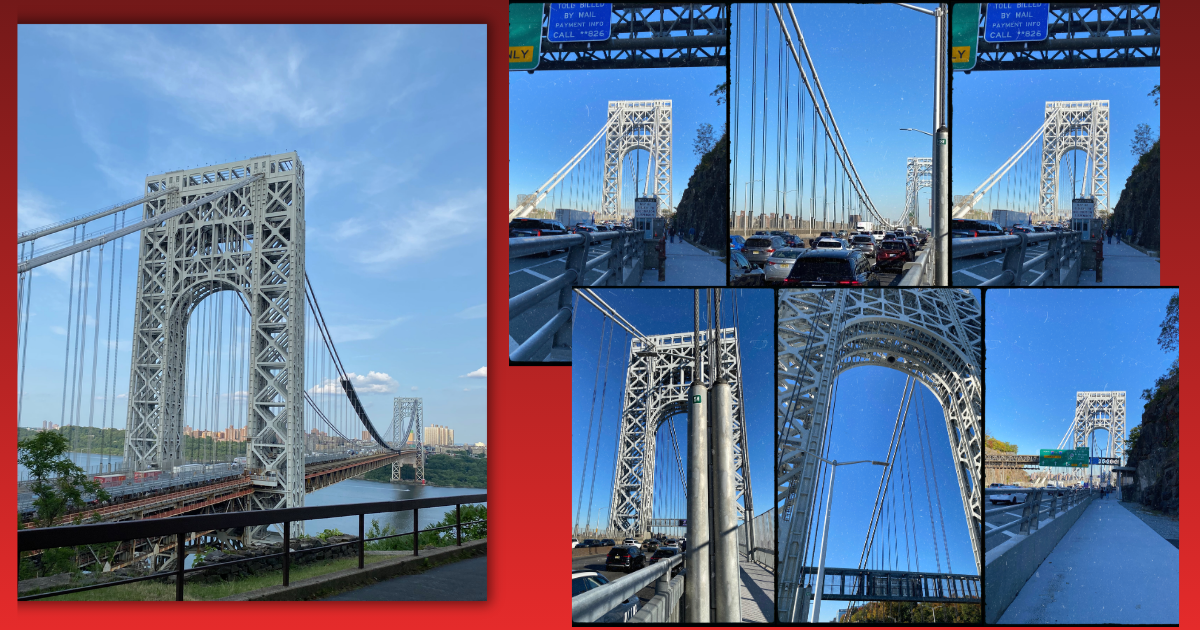
Today, on its 95th birthday, I decided to try the newly reopened South Walk of the George Washington Bridge. It seemed like the best way to get to know the bridge all over again. After all, although George is almost a century old, he doesn’t seem to age. He keeps renewing himself, changing and moving with the times.
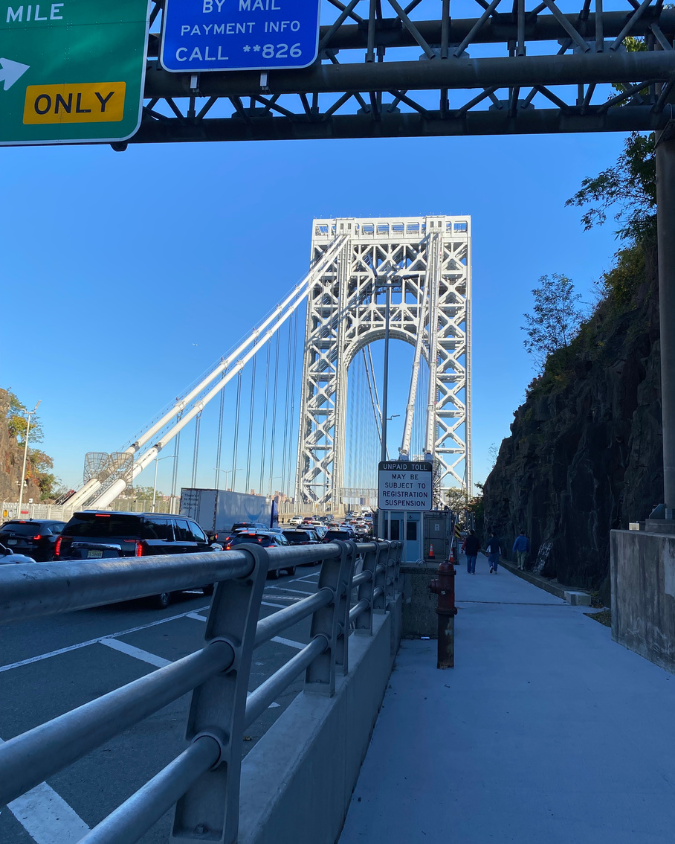
From Fort Lee Historic Park, the bridge looks almost like something out of a fairy tale, a perfect picture floating above the Hudson River. But once you step onto it, the experience is entirely different. Up close, it is an enormous steel structure, constantly vibrating under the weight of traffic. I could feel those vibrations beneath my feet, despite the powerful steel cables and towers holding this magnificent structure together.
Streams of cars flowed past me like rivers that never run dry. Thousands of vehicles, one after another, as though racing against time. Their drivers probably never even think about the forces acting on the bridge as they cross it.
But I did.
I thought about resonance, that fascinating physical phenomenon in which even relatively small, rhythmically synchronized forces can produce resonance when their frequencies align. Engineering history remembers bridges that collapsed not simply under the weight they carried, but because of resonance. That is precisely why soldiers break step when crossing bridges: synchronized footsteps can cause a dangerous increase in the amplitude of a bridge’s vibrations.
And I admit, I was a little frightened. I didn’t cross the entire bridge. I made it halfway, to the point where the forces of the river and the bridge’s iron structure seemed to meet.
I looked toward Manhattan, down at the Hudson far beneath me, and up at the steel towers that have stood against the passage of time for 95 years.
And I thought about what an extraordinary achievement this is, born of human imagination and human hands. A bridge that trembles beneath your feet yet has remained standing for almost a century.
A bridge that changes, renews itself and shines with new lights, yet never stops doing what it was built to do — connecting two shores and the people who live on them.
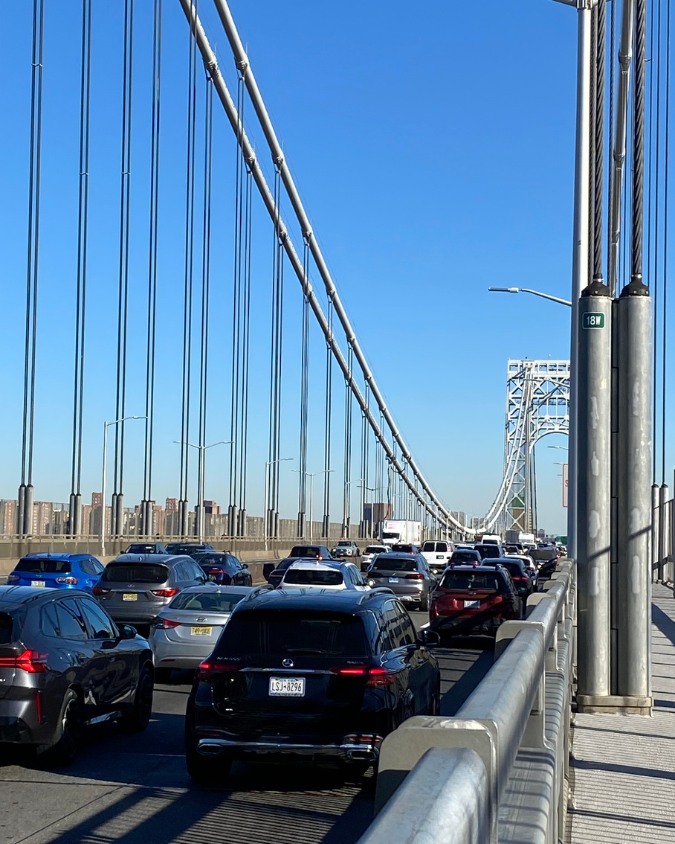
It connects more than Fort Lee and Manhattan. It connects two states, New Jersey and New York, but also two worlds that depend on each other every day.
For some, it is simply the road to work. For others, the road home. For families, it may mark the beginning of a journey or the final crossing after a long day.
Every morning, thousands of people cross it carrying their plans, responsibilities and hopes. Every evening, many return, sometimes tired, sometimes happy, and sometimes lost in thought about everything the day has brought.
The bridge does not know their names, but it has been part of their lives for generations.
Ninety-Five Years of Engineering and History
When the George Washington Bridge opened in 1931, it was the longest suspension bridge in the world, an extraordinary engineering achievement designed by Othmar H. Ammann.
Its enormous steel towers, rising more than 180 meters above the Hudson River, became one of the most recognizable features of the New York skyline.
Originally built with a single roadway level, the bridge gained a lower level in 1962 to accommodate increasing traffic.
Today, with its 14 traffic lanes, it remains one of the busiest bridges for motor vehicles in the world.
It is difficult even to imagine how many individual journeys have been made across this structure over the past 95 years.
Millions of travelers, countless family visits, deliveries, business trips and new beginnings have depended on this extraordinary connection.
A Bridge That Brings in Millions
The George Washington Bridge is much more than an engineering landmark. It is also one of the region’s most important economic links.
Every day, vehicles crossing toward New York generate toll revenue for the Port Authority of New York and New Jersey.
But its economic significance reaches far beyond toll collections.
The bridge supports commerce, transportation, employment and the daily movement of people and goods between the two states.
Its value cannot be measured in dollars alone. It can also be measured in time, opportunity and the countless ways it makes life easier on both sides of the Hudson.
A New Light After 95 Years
One of the most beautiful changes in the bridge’s recent history came this summer.
On June 29, 2026, the Port Authority announced that the bridge’s two steel towers would be illuminated every evening, from dusk until 10 p.m.
For decades, the towers had generally been illuminated only on holidays and special occasions. Now, for the first time in the bridge’s history, their lights have become part of the everyday nighttime skyline.
Nearly 800 older bulbs were replaced with energy-efficient LED lighting, reducing energy consumption and costs by approximately 40 percent.
The project is part of the bridge’s broader modernization program, known as Restoring the George.
When darkness falls, the illuminated towers give the old bridge an entirely new beauty.
What was once partly hidden in the darkness has become a shining landmark above the Hudson.
And perhaps that is the most beautiful part of this transformation: the bridge has not changed its purpose, but it has found a new way to be seen.
A New Path for Those Who Cross on Foot
This anniversary comes just days after another important milestone.
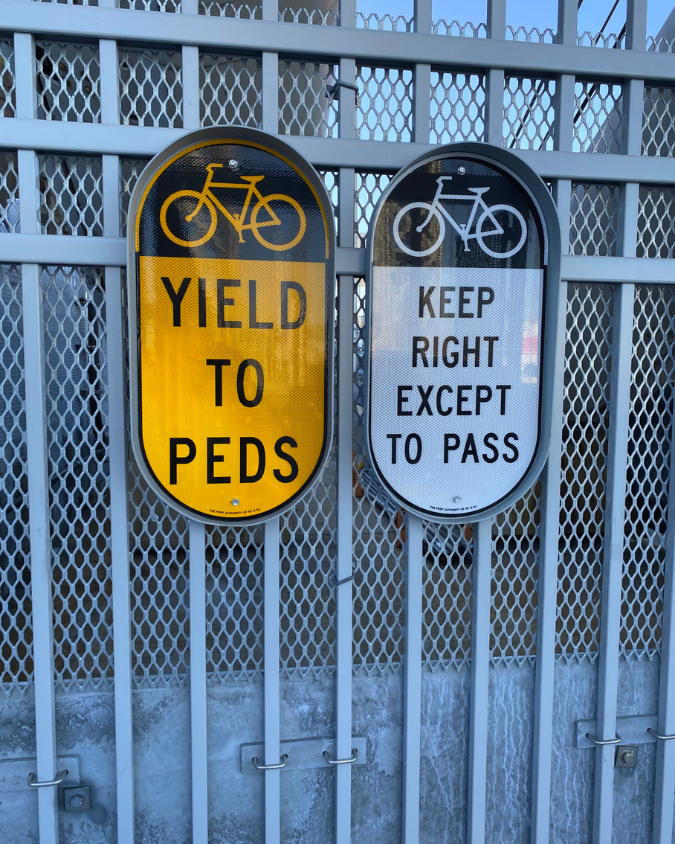
On October 15, the Port Authority reopened the renovated South Walk, while the North Walk is now reserved exclusively for cyclists.
Approaches have been improved, accessibility enhanced, new viewing areas opened, and additional lighting and safety features installed.
After decades of carrying millions of vehicles, the bridge is becoming more welcoming to those who want to experience it at a slower pace.
Crossing a bridge on foot is an entirely different experience from driving across it.
In a car, the crossing is often just another part of a busy day. On foot, there is time to look at the river, the city skyline and the enormous steel structure that has stood above the water for almost a century.
Happy Birthday, George!
Today, on its 95th birthday, I wanted to see the George Washington Bridge as more than a famous regional landmark or an extraordinary feat of engineering.
I wanted to think about the people who built it, those who crossed it before us, and those who will continue crossing it long after we are gone.
A bridge may be made of steel, concrete and cables, but its true purpose is to connect people.
It brings people closer, shortens distances and makes two shores part of one shared life.
Perhaps that is why the George Washington Bridge means so much to this region.
For 95 years, it has stood through changing seasons, storms, celebrations and ordinary days, quietly carrying the stories of generations.
And tonight, when its towers light up above the Hudson River, it will celebrate its birthday in a way that was not possible for most of its long history.
Happy 95th birthday, George!
May you continue connecting people, cities and dreams for generations to come.
Aziza Smailović