


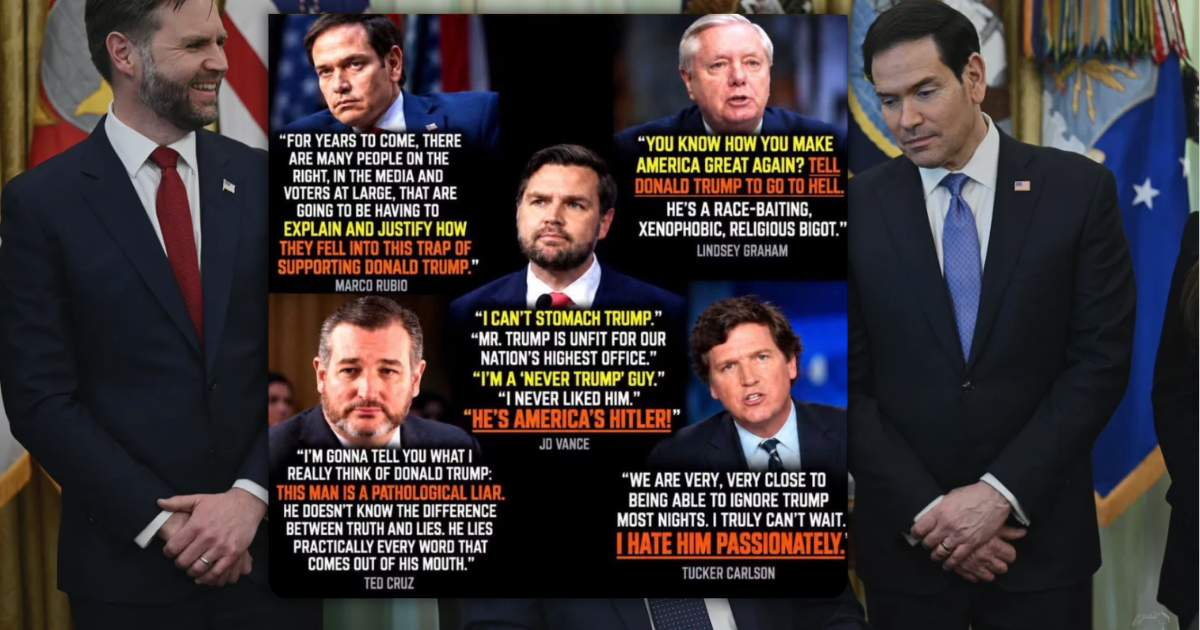
Some of Donald Trump’s most prominent political allies were once among his harshest critics. From Marco Rubio and Lindsey Graham to JD Vance and Ted Cruz, their earlier statements reveal how dramatically relationships within the Republican Party have changed over the past decade.
Old video recordings, interviews and previously private messages have resurfaced, reminding Americans of a time when several influential Republicans openly questioned Trump’s character, judgment and fitness for the presidency.
Today, some of those same politicians hold powerful positions in his administration, while others have become important political supporters.
Marco Rubio: A Warning About Supporting Trump
During the 2016 Republican presidential primaries, Marco Rubio was one of Trump’s rivals and repeatedly criticized his political approach.
In an interview with CNN, Rubio warned that Republicans who embraced Trump would eventually have to explain their decision.
He argued that Trump’s leadership style threatened to divide the Republican Party and damage its future.
Nearly a decade later, Rubio serves as secretary of state in Trump’s administration, representing a remarkable transformation from political rival to one of his senior officials.
Lindsey Graham: From Fierce Critic to Supporter
Senator Lindsey Graham was especially outspoken during Trump’s first presidential campaign.
In December 2015, Graham strongly condemned Trump’s proposal to prohibit Muslims from entering the United States.
During an appearance on CNN, he called Trump a politician who exploited racial divisions and expressed religious intolerance.
Graham also told Republicans that making America great again required rejecting Trump.
His position changed significantly after Trump became president. Graham eventually became one of Trump’s most visible defenders in Congress.
The contrast between his earlier statements and later support remains one of the most frequently cited examples of changing political relationships in Washington.
JD Vance: From “Never Trump” to Vice President
JD Vance’s political transformation is particularly striking.
In 2016, long before entering the Senate or becoming Trump’s running mate, Vance openly opposed him.
He described Trump as unfit for the presidency, said he could not tolerate him and identified himself with the “Never Trump” movement.
In a private message to a friend, Vance even compared Trump to Adolf Hitler, although the message expressed uncertainty rather than making a straightforward declaration.
Years later, Vance explained that his views had changed as he came to support Trump’s political agenda.
In 2024, Trump selected him as his vice-presidential running mate. Vance now serves as vice president of the United States.
Ted Cruz: A Bitter Rivalry in 2016
Senator Ted Cruz and Donald Trump were involved in one of the most contentious rivalries of the 2016 Republican primary campaign.
In May of that year, Cruz publicly called Trump a pathological liar and accused him of being unable to distinguish truth from falsehood.
The remarks came after Trump repeated allegations involving Cruz’s father and the assassination of President John F. Kennedy.
Despite their bitter exchanges, Cruz later supported Trump’s presidential campaigns and became an important Republican ally in the Senate.
Tucker Carlson: What Private Messages Revealed
Unlike the politicians featured in the recordings, conservative commentator Tucker Carlson expressed some of his strongest criticism privately.
In January 2021, following Trump’s election defeat, Carlson sent messages expressing frustration with the president.
He wrote that he looked forward to the time when he would no longer have to discuss Trump on television and admitted that he hated him passionately.
Those messages became public in March 2023 through court documents in Dominion Voting Systems’ defamation lawsuit against Fox News.
Carlson subsequently endorsed Trump in the 2024 presidential election and spoke in support of him at the Republican National Convention.
However, his relationship with Trump and the Republican Party has changed again. In 2026, Carlson publicly distanced himself from the party, particularly over disagreements about the war with Iran.
How Much Can Politics Change?
The statements featured in these videos and recordings are not recent. Most date back to 2015 and 2016, while Carlson’s private messages were written in 2021.
They reflect different political circumstances and, in several cases, the intense competition of Republican presidential primaries.
Political figures can change their positions over time, and some have publicly explained why they reconsidered their views of Trump.
Still, the contrast between their earlier criticism and later alliances raises a broader question about American politics: how do personal convictions, political priorities and party loyalty influence the positions public figures take?
The recordings offer an opportunity to look back at what these influential voices once said, compare it with their later actions and draw conclusions based on their own words.
Sources: CNN | CBS News | PBS NewsHour | The Guardian | The Washington Post | The American Presidency Project | Reuters | Associated Press
By NJ RADAR Team