


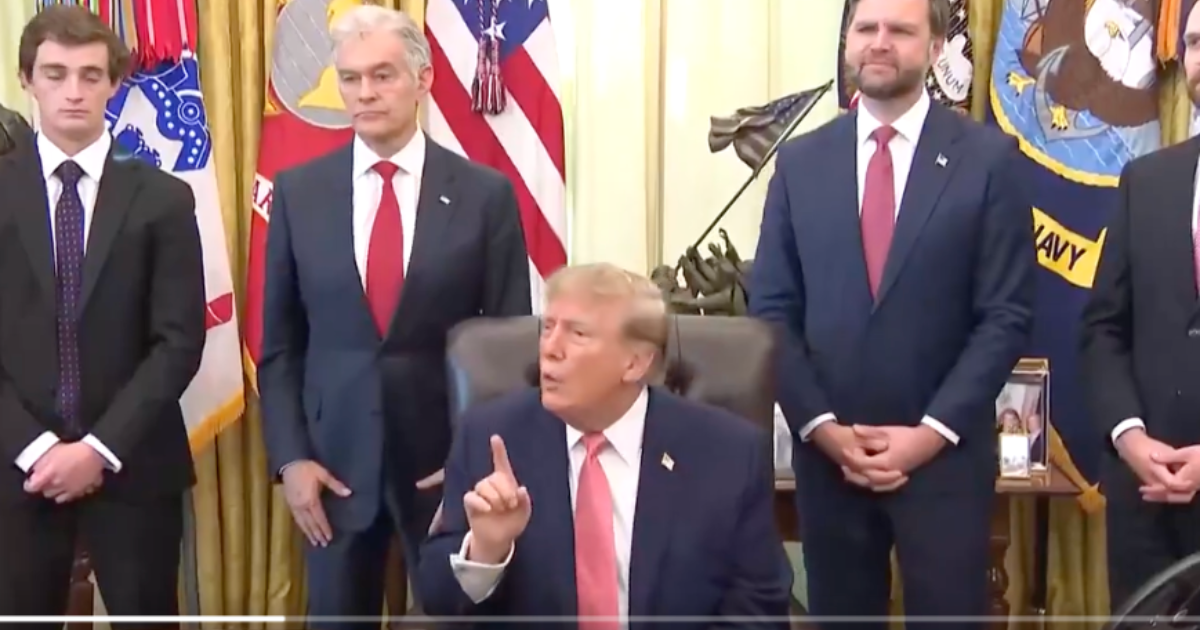
President Donald Trump engaged in a series of tense exchanges with reporters at the White House on Tuesday, October 20, raising his voice, demanding silence, and questioning one journalist during a contentious question-and-answer session.
The confrontations occurred during an Oval Office event attended by Vice President JD Vance, where the administration announced a new federal program offering financial rewards to people who report suspected fraud involving government funds.
Video clips circulated widely on social media, drawing attention to the president’s increasingly confrontational exchanges with members of the press.
Trump Questions Reporter During Exchange
In a video shared by political commentator Aaron Rupar, Trump can be heard repeatedly telling a reporter to remain quiet before questioning the journalist.
“Wait, wait. Quiet. Quiet!” Trump said, before asking what was wrong with the reporter and whether the person was sick.
The journalist responded that, as far as they knew, they were not.
Rupar described the exchange as the third confrontation involving reporters during the same question-and-answer session.
In another reported exchange, Trump told a journalist he did not know who they were and warned that they should be careful.
The comments contributed to an increasingly tense atmosphere during an event originally intended to highlight the administration’s efforts to combat fraud.
The full question immediately preceding the exchange in Rupar’s video has not been independently established, making it difficult to determine what specifically prompted the president’s reaction.
White House Announces $25 Million Anti-Fraud Initiative
The exchanges took place as Trump and Vance introduced the Fraud Whistleblower Incentive Program, known as WHIP.
The initiative establishes a $25 million fund to reward individuals who provide credible information about fraud involving federal programs and taxpayer money.
According to the White House, people whose information leads to fraud convictions or significant enforcement actions may qualify for rewards of up to $30,000.
The Justice Department will administer the program.
Trump also indicated that he would personally help determine which individuals qualify for payments, including situations involving competing claims.
The administration argues that financial incentives will encourage people to report misconduct and help recover improperly obtained government funds.
Questions About the President’s Relationship With the Press
The latest exchange has renewed attention to Trump’s often contentious relationship with journalists.
Throughout his political career, Trump has frequently challenged reporters, criticized news organizations, and disputed questions he considers unfair or misleading.
His supporters have often defended these confrontations as responses to aggressive or biased questioning.
Critics, meanwhile, argue that hostile remarks directed at journalists can discourage scrutiny of government decisions and contribute to an adversarial climate for the press.
The distinction between challenging a question and personally attacking the person asking it remains central to this debate.
Journalists are expected to question elected officials, including about controversial policies. Public officials, in turn, have the opportunity to explain their decisions, dispute factual premises, or decline to answer.
A Debate Beyond One Exchange
The October 20 confrontation comes during a politically sensitive period, with congressional midterm elections approaching and economic concerns, immigration, and government accountability dominating national debate.
The incident also illustrates how short video excerpts can rapidly shape public discussion.
A brief clip may accurately capture a statement while omitting the broader exchange that led to it. For that reason, the complete context remains important when evaluating what occurred.
What is clear is that the president’s remarks became a prominent moment during an event focused on a new federal anti-fraud initiative.
The exchange raises a familiar question in American political life: how elected leaders should respond when confronted with questions they find challenging, repetitive, or objectionable.
In a democratic system, disagreements between political leaders and journalists are inevitable. Maintaining the public’s ability to hear questions and evaluate answers remains an essential part of government accountability.
Sources: Associated Press, October 20, 2026 | CBS News, October 20, 2026 | The Washington Post, October 20, 2026 | Aaron Rupar (@atrupar), X video
By NJ RADAR Team