


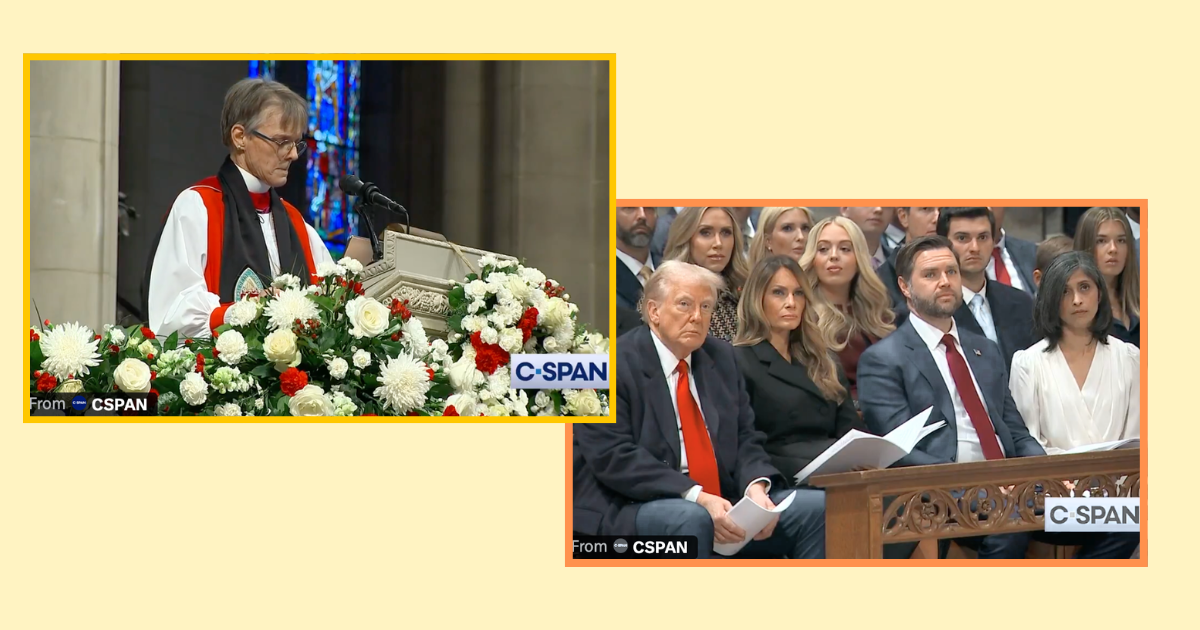
Standing before President Donald Trump at Washington National Cathedral, Bishop Mariann Edgar Budde called for compassion toward immigrant families, workers, refugees, and children living in fear. Her message was simple: immigration status should never erase a person’s humanity.
WASHINGTON — On January 21, 2025, just one day after Donald Trump’s second presidential inauguration, Episcopal Bishop Mariann Edgar Budde delivered a sermon at Washington National Cathedral that would become one of the most widely discussed religious appeals of the new administration.
President Trump, First Lady Melania Trump, Vice President JD Vance, and other officials were seated in the cathedral when Budde turned toward the president with a direct request.
“In the name of our God, I ask you to have mercy upon the people in our country who are scared now.”
Her words were not a political slogan. They were part of a religious appeal centered on human dignity, compassion, and the responsibility of those in power.
The Workers Who Help Keep America Running
Bishop Budde reminded the president of the millions of immigrants whose daily labor supports American communities and the economy.
She spoke about people who harvest crops, clean office buildings, work in poultry farms and meatpacking plants, wash dishes in restaurants, and work overnight shifts in hospitals.
Many of these workers, she acknowledged, may not have citizenship or proper immigration documentation.
But she made an important distinction: lacking legal immigration status does not automatically mean someone has committed a criminal offense.
“The vast majority of immigrants are not criminals,” Budde declared.
She reminded the president that immigrants pay taxes, contribute to their neighborhoods, raise families, and take part in American community life.
Her words challenged the tendency to portray immigrants collectively as dangerous or criminal, without distinguishing between immigration violations and criminal conduct.
Churches, Mosques, Synagogues, Gurdwaras, and Temples
One of the most meaningful moments of the sermon came when Budde described immigrants not only as workers, but as neighbors and members of religious communities.
She specifically mentioned churches, mosques, synagogues, gurdwaras — Sikh places of worship — and temples.
This was a significant message from a Christian bishop speaking before the president of the United States.
Rather than limiting her concern to members of her own faith, Budde acknowledged the religious diversity of immigrant communities.
She reminded her listeners that these individuals are not simply statistics in immigration debates. They are people with families, beliefs, traditions, responsibilities, and relationships.
Their lives are deeply connected to the broader American society.
A Plea for Children Who Fear Losing Their Parents
Budde also spoke about one of the most painful consequences of immigration enforcement: the fear experienced by children who worry that their parents may be taken away.
For families facing possible deportation, immigration policy is not merely an abstract political debate. It can determine whether parents and children remain together.
The bishop asked Trump to consider those children and their families with compassion.
She also urged him to welcome people fleeing war, persecution, and violence in their home countries.
Her appeal was not limited to immigrants. She also mentioned gay, lesbian, and transgender children, including those in Democratic, Republican, and independent families who were experiencing fear about their future.
Throughout the sermon, her central concern remained the same: the dignity and vulnerability of human beings.
“Be Merciful to the Stranger”
Perhaps the most important part of Budde’s message was her reminder of a fundamental religious teaching: strangers should be treated with mercy.
She invoked the biblical tradition of compassion toward outsiders, recalling that Americans themselves come from a history shaped by migration.
Her words connected the treatment of immigrants to a moral obligation that extends beyond citizenship, nationality, religion, or political affiliation.
The message was particularly striking because Budde was addressing a president whose administration had begun implementing a series of restrictive immigration measures.
She was not arguing that governments should abandon immigration laws. Instead, she was asking that the enforcement of those laws be accompanied by humanity, fairness, and compassion.
Trump’s Reaction and the Political Backlash
President Trump did not welcome the bishop’s remarks.
After the service, he criticized the sermon. He later attacked Budde on his Truth Social platform, describing her as politically biased and demanding an apology.
Republican Representative Mike Collins of Georgia also drew attention when he suggested that the bishop should be placed on a deportation list.
Budde is an American citizen, and the suggestion did not represent an established legal basis for deportation.
The controversy highlighted the tension between the bishop’s moral appeal and the administration’s approach to immigration enforcement.
For Trump’s supporters, stronger immigration enforcement is necessary to protect national security, maintain border control, and uphold the law.
For critics of the administration’s policies, the bishop’s words reflected concerns about family separation, sweeping characterizations of immigrants, and the human consequences of deportation.
Not Every Immigration Violation Is a Criminal Offense
The bishop’s statement about immigrants and criminality also raised an important legal distinction.
Being present in the United States without lawful immigration status is generally a civil immigration violation. Certain actions, including unlawful entry or unlawful reentry after removal, can also carry criminal penalties.
But undocumented status alone does not establish that someone has been convicted of a crime.
Nor does it establish that an individual poses a threat to public safety.
Budde did not claim that immigrants never commit crimes. Her argument was that entire communities should not be judged as criminals simply because of their immigration status.
That distinction is essential to understanding her appeal.
More Than a Sermon About Immigration
In a subsequent CNN interview, Budde explained that the people she mentioned were not abstract figures to her. They were people she knew.
She wanted the president to recognize their humanity and understand the fear many families were experiencing.
Her sermon raised a question that remains relevant far beyond the political controversy of January 2025:
Can a country enforce its immigration laws while also showing compassion toward people who may be affected by them?
Budde’s appeal suggested that these responsibilities need not be mutually exclusive.
A society can debate border security, citizenship, and immigration policy without abandoning the principles of human dignity and individual fairness.
And a religious leader can call upon political leaders to remember the people whose lives are shaped by their decisions.
Bishop Mariann Edgar Budde did not ask the president to view immigrants as perfect or exempt from the law.
She asked him to see them as human beings — workers, parents, children, neighbors, and people of faith — and to remember that mercy toward strangers is a moral responsibility, not a sign of weakness.
Sources: Washington National Cathedral | Episcopal News Service | Reuters | CNN | Religion News Service | Forbes
By NJ RADAR Team