


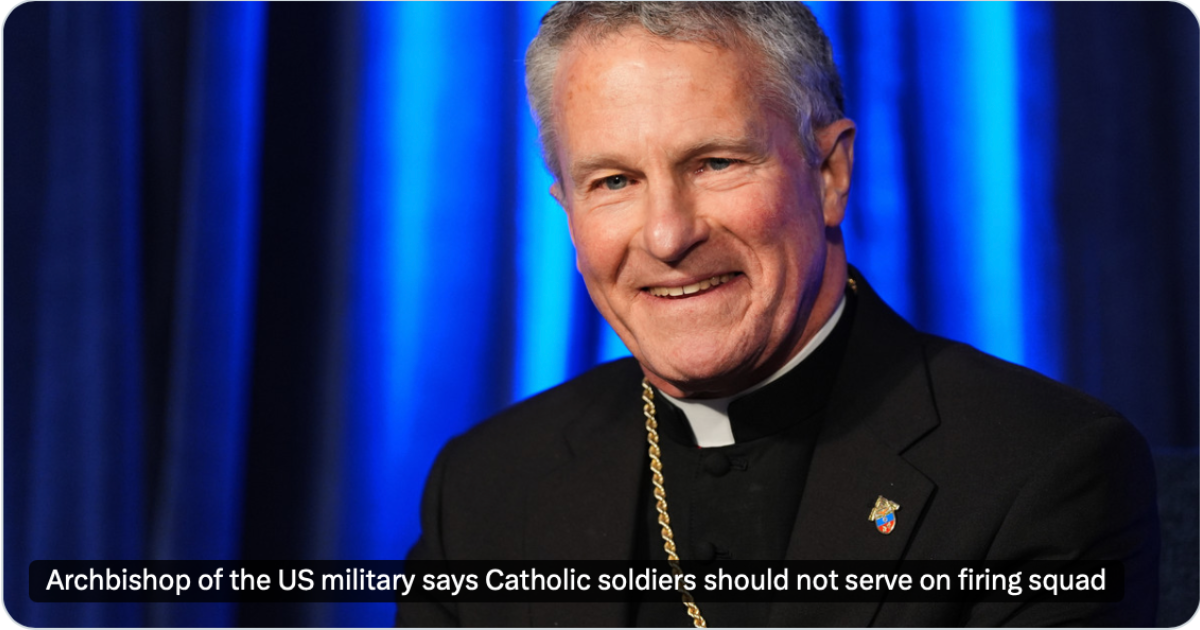
Archbishop Timothy Broglio condemns the planned livestream of Nidal Hasan’s execution, raising questions about religious conscience, human dignity, and the death penalty.
WASHINGTON — October 12, 2026 — Archbishop Timothy Broglio, who oversees Catholic pastoral services for members of the United States military, has called on Catholic soldiers to seek exemption from any firing squad assigned to execute Nidal Hasan, the former Army psychiatrist convicted of killing 13 people at Fort Hood, Texas, in 2009.
In a statement released Monday, Broglio argued that participating in such an execution would contradict the teachings of the Catholic Church. He also strongly criticized plans to broadcast the execution live to the public.
His intervention comes as the Pentagon prepares for Hasan’s execution, scheduled for December 3, 2026.
Catholic Soldiers Should Request Exemption
Broglio, who leads the Archdiocese for the Military Services, USA, said Catholic service members assigned to the firing squad should ask to be excused on religious grounds.
His statement reflects the Catholic Church’s opposition to capital punishment, which it considers incompatible with respect for the dignity of human life.
The archbishop’s position also raises questions about how the military should accommodate the religious convictions of soldiers ordered to participate in an execution.
Broglio’s appeal does not itself establish a legal exemption. Any request would have to be addressed through applicable military procedures.
Archbishop Condemns Plans to Livestream the Execution
Broglio expressed particular concern over the Pentagon’s proposal to broadcast Hasan’s death.
He acknowledged the seriousness of the crime committed in 2009 but questioned whether turning the execution into a public event would serve justice.
“The crime committed by Hasan was heinous, but does exposing the public to his execution serve any purpose?” he asked.
The archbishop also warned that broadcasting the death of a man in a wheelchair could damage the reputation of the United States military.
His criticism comes amid growing objections to the proposed livestream from religious leaders, lawmakers, and human rights advocates.
Some critics argue that publicly broadcasting an execution would transform a legal punishment into a spectacle, while supporters of the death sentence emphasize the gravity of Hasan’s crimes and the suffering of the victims’ families.
The 2009 Fort Hood Shooting
Nidal Malik Hasan, a former Army major and psychiatrist, was convicted of killing 13 people and wounding more than 30 others during a shooting at Fort Hood, Texas, on November 5, 2009.
Among those killed was Michael Grant Cahill, a civilian who attempted to intervene during the attack.
Archbishop Broglio revealed that he had personally presided over Cahill’s funeral, underscoring his connection to the tragedy.
Hasan was sentenced to death by a military court in 2013. He was left paralyzed following the shooting and uses a wheelchair.
President Donald Trump approved his execution in October 2026, and military officials subsequently announced that it would be carried out by firing squad on December 3.
The execution would mark the first carried out by the U.S. military since 1961, although legal challenges could still affect the scheduled date.
A Growing Debate Over Public Executions
The proposed livestream has generated objections beyond religious circles.
Some lawmakers, including Republicans, have questioned whether broadcasting a prisoner’s death is appropriate for the United States.
The debate has also brought renewed attention to the use of firing squads, a method rarely employed in modern American executions.
The Catholic Church has increasingly emphasized its opposition to the death penalty, arguing that punishment should respect human dignity even when the underlying crime is exceptionally serious.
Broglio’s position reflects that teaching while recognizing the suffering caused by Hasan’s actions.
His statement does not dispute Hasan’s conviction or minimize the deaths of the 13 victims. Instead, it challenges the morality of involving Catholic soldiers in an execution and the decision to display that death publicly.
Religious Conscience and Military Duty
The archbishop’s intervention places religious conscience at the center of a broader debate about military responsibility.
Service members are generally expected to follow lawful orders, but the military also maintains procedures for considering religious accommodation requests.
Whether soldiers assigned to an execution could obtain an exemption would depend on the applicable rules and individual circumstances.
Broglio has made his position clear: Catholic soldiers should not be required to set aside their religious convictions to participate directly in carrying out a death sentence.
His statement raises a larger question about the limits of punishment and the responsibilities of government institutions.
Even when a person has been convicted of a devastating crime, should the state turn an execution into a public spectacle — and should soldiers be expected to participate when doing so conflicts with their faith?
Sources: Associated Press | POLITICO | OSV News | Reuters | Archdiocese for the Military Services, USA
By NJ RADAR Team