


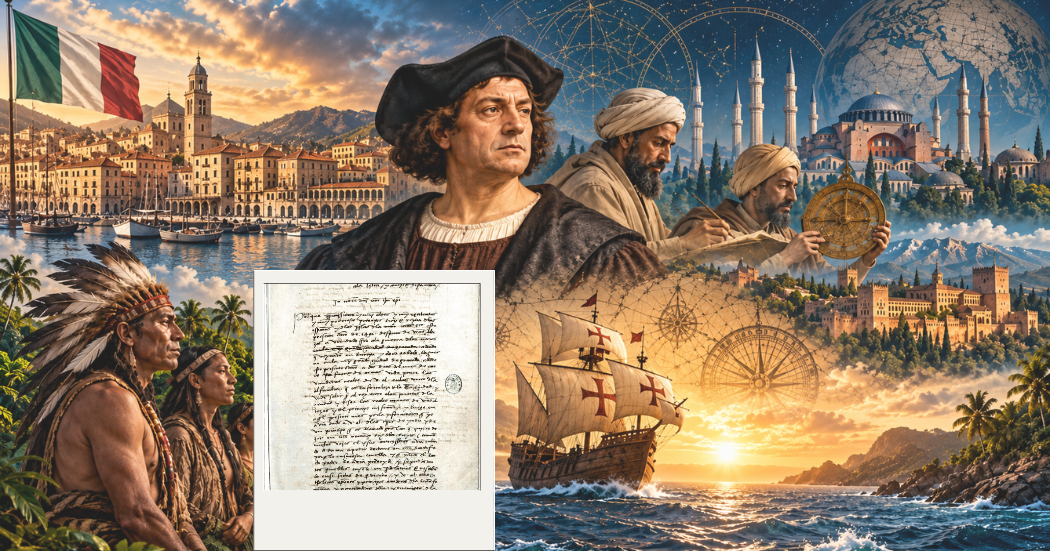
Italian Americans see it as a symbol of their heritage, Indigenous peoples as a reminder of the beginning of colonization, while the history of the Muslim world connects 1492 with the fall of Granada and the scientific legacy of Islamic civilization.
October 12, 2026 | History & Society
Every year, on the second Monday in October, the United States observes Columbus Day, a holiday dedicated to Christopher Columbus, the navigator who reached the Caribbean in 1492. On the same day, many Americans observe Indigenous Peoples’ Day, a day honoring the Indigenous peoples of the Americas.
For some, Columbus symbolizes courage, great voyages of exploration, and Italian heritage. For others, he represents the beginning of European colonization, conquest, and the suffering of Indigenous populations.
However, this historical story has another, much less widely known dimension. Columbus’s voyage was also connected to the history of the Muslim world, the great scientific achievements of Islamic civilization, the fall of Constantinople, and the end of Muslim rule in Spain.
To understand the year 1492, it is not enough to look at just one ship, one navigator, and one ocean.
The Italian Perspective: Why Do Italian Americans Celebrate Columbus?
Christopher Columbus was born in Genoa in 1451, then an independent republic and today part of Italy. Although he sailed under the Spanish flag, his origins became an important symbol of Italian-American identity.
When Italian immigrants arrived in the United States during the 19th and early 20th centuries, they often faced discrimination, poverty, and violence.
One of the most tragic incidents occurred in New Orleans in 1891, when a mob lynched eleven Italians.
A year later, in 1892, President Benjamin Harrison called on Americans to commemorate the 400th anniversary of Columbus’s voyage. The commemoration also acquired special significance for the Italian community, which was struggling for social recognition.
Over the following decades, Columbus became a symbol of Italian-American pride.
For many Italian Americans, Columbus Day therefore represents more than celebrating a man who crossed the Atlantic. It represents recognition of generations of their ancestors who helped build American society.
Yet this is where a historical paradox emerges: a man of Italian origin, who became a symbol of an immigrant community in America, made his most famous voyages in the service of the Spanish monarchy.
The Indigenous Perspective: America Was Not Undiscovered
Columbus’s voyage has traditionally been described as the discovery of America.
But America was not an empty land waiting to be discovered.
For thousands of years, its continents had been home to peoples with developed societies, trade networks, agriculture, art, and their own political systems.
When Columbus reached the Caribbean on October 12, 1492, he encountered people whose ancestors had lived on those islands for generations.
His expeditions opened an era of sustained European colonization. Enslavement, forced labor, land seizures, wars, and epidemics followed, taking an enormous number of lives.
That is why many Indigenous peoples reject the idea of celebrating Columbus exclusively as a hero.
Indigenous Peoples’ Day provides an opportunity to place at the center of historical attention the peoples who lived in the Americas long before European navigators arrived, as well as their descendants, who continue to preserve their languages, cultures, and traditions today.
The Influence of the Muslim World on Columbus’s Voyage
The history of Columbus’s voyage cannot be fully understood without considering the major changes that took place in the Muslim world during the 15th century and in its relations with European states.
While Muslim political rule in Western Europe was weakening and finally ended with the fall of Granada in 1492, the Ottoman Empire was growing stronger in the East. With the conquest of Constantinople in 1453 under Sultan Mehmed II the Conqueror, the Ottomans became one of the most significant political and military powers of their time.
The rise of Ottoman power changed political and commercial relations between Europe and Asia and was one of the factors encouraging European states to seek new maritime routes to Asian markets.
At the same time, European maritime exploration also drew upon the scientific legacy of Muslim mathematicians, astronomers, and geographers, whose works had been translated, studied, and used for centuries.
The influence of the Muslim world on the history of Columbus’s voyage can therefore be traced through three interconnected developments: the end of Muslim rule in Granada, the rise of the Ottoman Empire in the East, and the contributions of Islamic science to the development of geography, astronomy, and navigation.
1. The Fall of Granada and Columbus’s Journal
Christopher Columbus himself mentions the conquest of Granada in the introduction to the journal of his first voyage.
In the text, he describes how, on January 2, 1492, he saw the royal banners of Ferdinand and Isabella raised on the towers of the Alhambra, and the last Muslim ruler of Granada leaving the city before the victors.
He then describes the Spanish monarchs’ decision to support his plan to reach India by sailing west.
In the same introduction, Columbus also connects his expedition with the religious ambitions of the Spanish monarchy.
That document, preserved through the later transcription and summary by Bartolomé de las Casas, shows how closely the conquest of Granada and Columbus’s expedition belonged to the same historical moment.
In 1492, the Spanish monarchy also ordered the expulsion of Jews who refused to convert to Christianity. Muslims in Granada were initially promised certain religious rights, but those rights were later revoked. Forced conversions and persecution followed, and in the early 17th century, the Moriscos were expelled.
2. Muslim Scholars and the Knowledge Columbus Used
There is another connection that deserves particular attention: the role of Islamic science in developing the geographical knowledge that preceded European maritime expeditions.
During the Middle Ages, Muslim mathematicians, astronomers, and geographers developed methods for measuring the Earth, determining geographical positions, and producing maps.
This knowledge did not remain confined to the Islamic world.
Through the translation of Arabic scientific works into Latin, it became part of the European scientific tradition.
Interestingly, this very subject was explored in the Spanish historical television series Isabel.
In one scene, Columbus speaks with a Muslim scholar who points out errors in his geographical calculations.
Spain’s public broadcaster RTVE published an article on November 25, 2013, titled Cristóbal Colón y la influencia islámica en el descubrimiento de América.
The article’s author, historian and consultant on Arab history for the series Mabel Villagra, explains that the scene has a historical basis.
RTVE cites part of a letter Columbus wrote in 1501, in which he states that he had spoken with learned people from different communities: Christians, Greeks, Jews, and Muslims.
Nevertheless, it is important to distinguish between what the historical document confirms and what the television series portrays through artistic interpretation.
The document confirms Columbus’s contacts with learned people from different traditions, but it does not prove that a particular Muslim scholar from Granada personally prepared maps for him.
Even so, the scientific influence of the Islamic world on European geography and astronomy undoubtedly existed.
3. Al-Farghani: The Muslim Astronomer and Columbus’s Error
One particularly interesting scholar in this story was Al-Farghani, a ninth-century astronomer known in medieval Europe as Alfraganus.
His works contained astronomical calculations, including estimates of the Earth’s size, and were also translated into Latin. Columbus was familiar with his results.
However, according to the historical explanation presented by RTVE, Columbus misinterpreted the units of length used in these calculations. Instead of using the longer Arabic mile, he calculated using the shorter Italian mile, further underestimating the Earth’s circumference and the distance between Europe and Asia by a westward route.
Incorrect estimates of distance were among the reasons he believed that sailing across the Atlantic to Asia was feasible.
And so, paradoxically, the scientific legacy of a Muslim astronomer became part of the story of a miscalculation that accompanied one of the most famous maritime voyages in history.
4. Al-Biruni: Mathematical Calculations and the Possibility of an Unknown Landmass
Al-Biruni (973–around 1050), one of the greatest mathematicians, astronomers, and geographers of the medieval world, holds a special place in this history. He lived approximately 440 years before Columbus’s voyage.
Using geometry and trigonometry, he developed methods for determining the Earth’s dimensions.
Based on his study of the Earth’s size and the distribution of known landmasses, he considered the possibility that an unknown landmass existed in the vast oceanic space between Europe and Asia.
5. The Fall of Constantinople and the Search for New Routes
One of the events that influenced Europe’s search for new trade routes was the Ottoman conquest of Constantinople in 1453. Sultan Mehmed II the Conqueror captured the city, now known as Istanbul, bringing the Byzantine Empire to an end.
This event changed the political balance between Europe and the Ottoman world.
European states had long been interested in spices, silk, and other products that reached Europe from Asia through complex trading networks.
Trade between Asia and Europe did not come to a complete halt. Nevertheless, political changes, commercial competition, and European states’ desire to establish direct connections with Asian markets further encouraged the search for new maritime routes.
The Portuguese explored a route around Africa.
Columbus believed that Asia could be reached by sailing west. For years, he tried to persuade European rulers to finance his plan, until he finally secured the support of Ferdinand and Isabella.
On August 3, 1492, he departed from the Spanish port of Palos with three ships, reaching the Caribbean on October 12.
He did not reach India, as he had expected, but instead arrived in the Caribbean, beginning a new era of contact, trade, and European colonial expansion. He himself did not realize where he had actually arrived.
The Political Perspective: Trump Defends Columbus and His Legacy
In recent years, Columbus Day has also become part of a broader political debate over American identity, historical monuments, and how the United States presents its past.
President Donald Trump strongly supports preserving Columbus’s legacy and opposes the removal of monuments dedicated to the navigator.
In a presidential proclamation dated October 7, 2026, Trump praised Columbus’s courage, determination, and historical significance, presenting him as a symbol of the spirit of exploration and Western civilization.
His administration also installed a monument to Christopher Columbus on White House grounds. It is a replica of a monument that was toppled in Baltimore during protests in 2020. It was installed in March 2026 near the Eisenhower Executive Office Building, and the organization that owns it loaned it to the White House until the end of Trump’s term.
For Trump’s supporters, such actions represent a defense of American history and recognition of Italian-American heritage.
Critics, however, argue that celebrating Columbus exclusively as a hero overlooks documented violence against Indigenous populations and the consequences of European colonization.
This political debate therefore extends beyond the question of a single monument or holiday. It demonstrates how differently Americans understand history and what they believe deserves public recognition.
The Educational Perspective: How Should the Full History Be Taught?
For teachers and historians, Columbus Day provides an opportunity to examine how historical narratives are created and how the ways we pass them on to new generations change over time.
For decades, American students were taught that Christopher Columbus discovered America in 1492.
That explanation was simple and easy to remember, but it did not capture the full historical complexity of the event.
Today, many historians and educators seek to present a more complete picture: the existence of developed Indigenous societies before the arrival of Europeans, the significance of transatlantic voyages, the scientific knowledge that made those voyages possible, and the consequences of European colonization.
Through its Native Knowledge 360° educational program, the Smithsonian’s National Museum of the American Indian particularly encourages the inclusion of Indigenous perspectives, including those of the Taíno people, whom Columbus encountered in the Caribbean.
History education should not be limited to simple divisions between heroes and villains. It is important to understand achievements as well as their consequences.
That is precisely why Columbus’s voyage can serve as an example of how history, geography, mathematics, astronomy, politics, and cultural relations intersect.
New Jersey: One Date, Different Observances
In New Jersey, Columbus Day remains an official state holiday, observed in 2026 on Monday, October 12.
October is also Italian-American Heritage Month, a time to highlight the cultural, social, and economic contributions of the Italian community.
Italian-American heritage is especially visible in New Jersey, where generations of immigrants from Italy have made significant contributions to the development of cities, businesses, and cultural life.
However, not every community observes this date in the same way.
The city of Newark, for example, observes October 12 as Indigenous Peoples’ Day.
The city administration announced that City Hall and most non-emergency municipal services would be closed that day, while police, fire, and other emergency services would continue operating.
Thus, even within a single state, different approaches to the same historical date can be seen.
For some, it is Columbus Day, a holiday associated with Italian-American heritage. For others, it is Indigenous Peoples’ Day, a day honoring the history, culture, and survival of Indigenous peoples.
In this way, New Jersey reflects the broader American debate about historical memory and cultural identity.
Can Both Histories Be Recognized?
One of the most important questions in the contemporary debate is whether recognizing one historical perspective must mean rejecting another.
Some Americans believe that Italian-American heritage and Indigenous history should be commemorated separately, so that recognition of one community does not come at the expense of another.
Others believe that Columbus, because of his role in colonial expansion, should no longer remain the central symbol of a public holiday.
There is also an approach that emphasizes the need for broader historical education.
From this perspective, Columbus’s voyage can be recognized as an event that changed world history while simultaneously acknowledging its devastating consequences for Indigenous peoples.
Such an understanding of history makes it possible to recognize the contributions of Italian immigrants, the scientific legacy of different civilizations, and the experiences of the peoples who lived in the Americas before Europeans arrived.
Different historical perspectives do not necessarily cancel one another out. On the contrary, they can contribute to a fuller understanding of the past.
A Holiday That Raises a Much Bigger Question
Columbus Day is about much more than commemorating a single voyage across the Atlantic Ocean.
It connects the histories of migration, national identity, cultural pride, colonial conquest, scientific achievement, and the struggle for historical recognition.
For Italian Americans, it can represent a symbol of belonging and recognition for generations of immigrants.
For Indigenous peoples, the same date recalls land loss, colonization, and suffering, but also their survival and cultural resilience.
From a European perspective, Columbus’s voyage opened a new era of maritime trade, exploration, and political expansion.
And from an educational perspective, these different meanings demonstrate exactly why history should not be reduced to a single sentence or a single individual.
Perhaps the most important question Columbus Day raises today is not whether a historical event should be celebrated or condemned.
More important is how to recognize its significance without overlooking the people, cultures, and civilizations whose destinies were connected to it.
For history belongs not only to conquerors, explorers, or rulers. It also belongs to those whose knowledge made great voyages possible, and to the peoples on the other shore who already had histories of their own.
Sources: Fordham University – Columbus’s Journal | RTVE – Islamic Influence on Columbus | Smithsonian Magazine – Italian-American History | Smithsonian – Native Knowledge 360° | White House – Columbus Day 2026 | The Washington Post – Columbus Monument | New Jersey Government – State Holidays | NJ Department of State – Heritage Month | City of Newark – Indigenous Peoples’ Day | Acta Via Serica – Silk Routes | Academic Study – Fall of Constantinople and Trade
By Aziza Smailovic
[…] But the story of Columbus extends even further, connecting Indigenous peoples, Italian-American heritage, European expansion, and the often-overlooked historical and scientific influence of the Muslim world. […]