


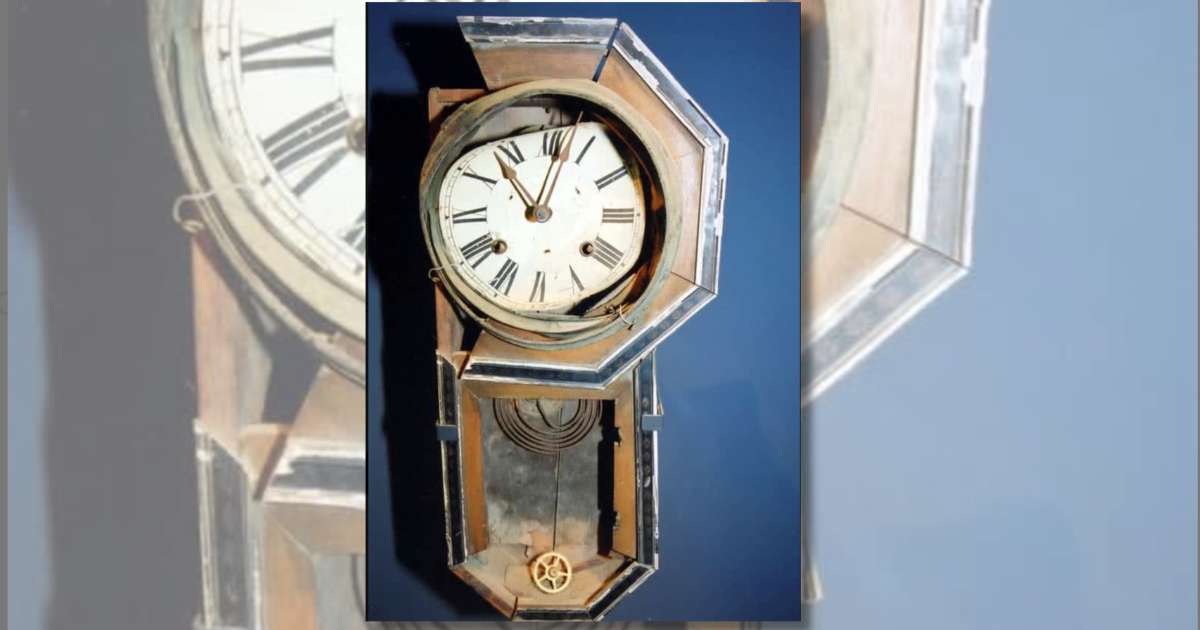
Inside the Nagasaki Atomic Bomb Museum is a damaged clock whose hands are frozen at 11:02 a.m.
That was the exact time the atomic bomb exploded over Nagasaki on August 9, 1945.
The clock, recovered from a home near the blast area, has become one of the most powerful physical reminders of the moment an ordinary morning was transformed into catastrophe.
Nagasaki City itself records the detonation at 11:02 a.m., and the museum specifically highlights a clock that stopped at that time because of the force of the explosion.
A City Changed in Seconds
The bomb dropped on Nagasaki was a plutonium weapon known as “Fat Man.”
It exploded roughly 500 meters above the city’s Urakami district.
The heat, blast and radiation devastated the surrounding area. Nagasaki City records 73,884 deaths and 74,909 injuries connected to the bombing by the end of 1945.
Entire neighborhoods were destroyed, fires spread across the city and thousands of survivors later suffered from radiation-related illnesses.
The damaged clock is powerful precisely because it does not show the scale of the destruction.
It shows one moment.
11:02.
Nagasaki Was Not the First Target
Nagasaki was not the primary target of the mission that morning.
The B-29 bomber Bockscar first flew toward Kokura, where the crew intended to drop the bomb.
But smoke, haze and cloud cover made it difficult to clearly identify the target.
With fuel becoming a concern, the aircraft diverted to its secondary target:
Nagasaki.
Clouds also covered much of Nagasaki.
For a time, it appeared that the mission might have to be abandoned.
Then a break in the cloud cover allowed the crew to identify the target area and release the bomb.
A city came within minutes — and perhaps a patch of cloud — of a completely different history.
Why Physical Objects Matter
More than eight decades later, the Nagasaki Atomic Bomb Museum continues to preserve objects damaged by the explosion.
The city’s museum describes such artifacts — including the clock stopped at 11:02 — as a way for visitors to understand how the bombing destroyed everyday life.
These objects are becoming increasingly important as the generation that personally experienced the bombing grows smaller.
A broken roof tile, a burned piece of clothing or a stopped clock can sometimes communicate something that statistics cannot.
They belonged to real homes and real families.
They existed before the bomb.
And they survived after it.
Preserving the Stories Behind the Objects
Nagasaki has also been working to preserve not only the physical artifacts but the personal stories connected to them.
The city has undertaken projects to document the backgrounds of materials held by the Atomic Bomb Museum by interviewing donors, survivors and family members.
The goal is to ensure that future generations understand not simply what an object is, but who owned it, where it was found and what happened to the people connected to it.
That effort has taken on greater urgency as Nagasaki looks toward a future when few, if any, direct survivors remain alive.
The city is also continuing to update the museum’s exhibitions so the bombing is not understood simply as a distant historical event, but as something whose human consequences remain relevant today.
11:02
A clock is normally a symbol of time continuing.
This one represents the opposite.
Its hands never moved beyond 11:02 a.m.
For the people of Nagasaki, however, history did.
The survivors rebuilt their city, told their stories and preserved the objects left behind.
Today, the damaged clock remains in the museum not simply as a relic of war, but as evidence of one precise moment when tens of thousands of lives were changed forever.
Sources: Nagasaki City; Nagasaki Atomic Bomb Museum; Nagasaki City historical records
By NJ RADAR Team