


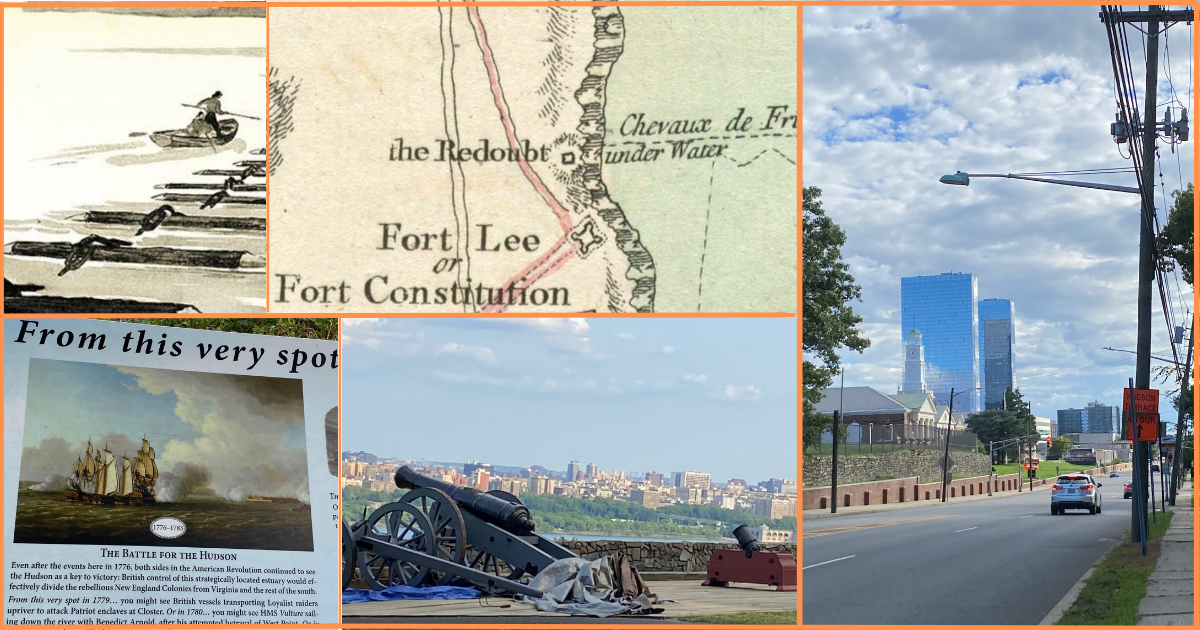
Long before Fort Lee became known for the George Washington Bridge, high-rise buildings and its sweeping views of Manhattan, the cliffs above the Hudson River were part of one of the most important defensive lines of the American Revolution.
And the story does not end with a fort.
It also leads north into the mountains of New Jersey, to Ringwood and Long Pond Ironworks, where furnaces, miners, ironworkers and ox carts helped supply the Continental Army with the heavy iron needed to defend the Hudson River.
Before Fort Lee, There Was Fort Constitution
In the summer of 1776, American forces began building a military fortification high on the New Jersey Palisades.
It was originally called Fort Constitution.
Its location was no accident. From the cliffs, the Continental Army could watch the Hudson and try to prevent British warships from sailing north and cutting off New England from the other colonies.
Across the river, another American stronghold was being built on Manhattan.
That was Fort Washington.
The two forts faced one another across the Hudson and were intended to work together as part of the river’s defense.
That distinction is important: Fort Lee was never Fort Washington. Fort Washington stood on the New York side of the river. Fort Constitution stood on the New Jersey side and was later renamed Fort Lee.
Why Was It Renamed Fort Lee?
Later in 1776, Fort Constitution was renamed Fort Lee in honor of Major General Charles Lee, then one of the most prominent commanders in the Continental Army.
Lee was an experienced professional soldier who had previously served in the British Army before joining the American revolutionary cause.
At the time the fort received his name, Lee was highly regarded.
His relationship with George Washington later deteriorated dramatically, and after his conduct at the Battle of Monmouth in New Jersey in 1778, Lee was court-martialed and eventually left the Continental Army.
His military career faded.
His name, however, remained on the New Jersey Palisades.
More than two centuries later, the borough still carries it.
The Americans Tried to Turn the Hudson Into a Trap
Cannons at the two forts were not the only defense.
In 1776, American forces also placed an underwater obstruction in the Hudson between the Fort Lee and Fort Washington positions.
The device was known as a chevaux-de-frise — a defensive system using heavy timber structures armed with long, iron-tipped spikes intended to tear into the wooden hulls of enemy ships.
The idea was simple but formidable: British vessels attempting to sail through the river could strike the submerged spikes and be badly damaged or even sunk.
Robert Erskine, the Scottish engineer and ironmaster based at Ringwood, New Jersey, developed designs for marine chevaux-de-frise during the Revolution. Historical accounts associate his work with defenses of this type, including those in the Hudson.
But the system did not completely seal the river.
The British eventually identified a navigable passage and succeeded in moving ships past the defenses.
The Americans learned from the failure.
And their next attempts to block the Hudson became much larger.
Then Came the Iron
The Hudson defenses required extraordinary amounts of iron — and northern New Jersey had it.
The New Jersey Highlands contained rich iron deposits, forests that could be turned into charcoal, rivers capable of powering furnaces and a growing network of ironworks.
Among the most important were Ringwood and Long Pond Ironworks in what is now West Milford, Passaic County.
Long Pond had been founded in 1766 by German ironmaster Peter Hasenclever, who brought hundreds of skilled workers and their families to the region. A dam and water-powered machinery helped operate its furnace and forge.
During the American Revolution, the ironworks supplied the Continental Army. New Jersey’s own state park history still describes Long Pond as a community that produced iron for Washington’s forces.
The products were not glamorous.
They were essential.
Cannonballs. Military fittings. Camp hardware. Iron components for river defenses.
War required enormous quantities of metal, and New Jersey was helping produce it.
Robert Erskine: Ironmaster, Engineer — and Washington’s Mapmaker
Robert Erskine is one of the most fascinating figures connecting these stories.
Born in Scotland, Erskine came to New Jersey in 1771 to manage the Ringwood iron operations.
When the Revolution began, he supported the American cause.
His engineering ability eventually attracted George Washington’s attention.
In 1777, Washington recommended Erskine to serve as Geographer and Surveyor General of the Continental Army. Erskine and his assistants went on to create more than 275 maps of roads, buildings, terrain and military routes — information that was extremely valuable to Washington’s army.
At the same time, Erskine remained connected to Ringwood’s iron production.
So one man in the New Jersey Highlands was helping Washington in two very different ways:
with maps and with iron.
More Than 30 Tons of Iron Headed Toward the Hudson
By 1777, American engineers were planning another massive obstruction farther north on the Hudson.
Records associated with the Ringwood and Long Pond operations describe more than 30 tons of iron componentsprepared for a chain-and-boom defense intended for the Hudson near Fort Montgomery.
Transporting that amount of iron in the eighteenth century was an operation in itself.
Heavy components had to be carried through the Highlands and over the Ramapo routes, much of the journey by ox cart.
Imagine more than 30 tons of iron moving slowly out of the New Jersey mountains toward the Hudson — without trucks, paved highways or modern cranes.
But before the defensive system could achieve its purpose, British forces captured Fort Montgomery in October 1777.
The iron, however, was not simply abandoned.
Much of the river-defense material was redirected toward an even more ambitious American project:
West Point.
The Great Chain Across the Hudson
By 1778, West Point had become the key location for controlling the upper Hudson.
American engineers decided to stretch an enormous iron chain across the river between West Point and Constitution Island.
It became known simply as the Great Chain.
The famous chain itself was forged primarily at Sterling Iron Works, just across today’s New York–New Jersey state line in the Sterling Forest region.
But New Jersey’s iron industry remained part of the larger defensive system.
Material connected with Ringwood and Long Pond was used for a boom positioned in front of the Great Chain — an additional floating obstacle designed to absorb or slow the impact of an approaching enemy ship before it reached the main chain.
The chain was stretched across the Hudson on April 30, 1778.
It was an extraordinary piece of eighteenth-century military engineering.
The idea was that a British warship sailing upriver would first encounter the boom and then face the enormous chain beyond it.
The British Navy never attempted to force its way through the Great Chain.
The Hudson remained under American control at this crucial point.
And the strategic nightmare that had worried Washington from the beginning of the war — Britain using the Hudson to separate New England from the rest of the states — never came to pass.
Fort Lee Fell, but the Hudson Strategy Continued
The original Fort Lee position itself had been abandoned much earlier.
After British forces captured Fort Washington on November 16, 1776, the American position across the river became extremely vulnerable.
Four days later, British troops under General Charles Cornwallis crossed the Hudson north of Fort Lee.
Washington ordered his soldiers to withdraw.
The retreat was so urgent that the Continental Army left behind artillery, supplies, tents and equipment.
American troops then began their difficult retreat across New Jersey toward the Delaware River.
It was one of the bleakest moments of the Revolution.
Thomas Paine, traveling with the army during this period, soon wrote the famous opening to The American Crisis:
“These are the times that try men’s souls.”
But the failure at Fort Lee was not the end of the effort to control the Hudson.
It was part of the learning process that eventually produced the much stronger defenses at West Point.
And What About the Chain at Ringwood Manor?
Visitors to Ringwood Manor today can see large iron chain links displayed on the grounds.
It is easy to assume they are pieces of the original Great Chain.
That story has circulated for generations.
But the chain displayed at Ringwood is generally regarded as a later representation or look-alike, rather than the original Great Chain that crossed the Hudson in 1778.
Historic documentation for Ringwood Manor itself notes that the links were traditionally “supposed” to have come from the Revolutionary chain — language reflecting the uncertainty surrounding their origin.
The more important New Jersey connection does not depend on the display.
It survives in the historical record:
Ringwood’s iron mines. Long Pond’s furnaces. Robert Erskine’s engineering and maps. The iron components hauled through the Highlands. And the boom that helped protect the Great Chain at West Point.
The History Is Still Here
Much of this history can still be visited.
Fort Lee Historic Park, above the Hudson and near the George Washington Bridge, preserves the story of the Revolutionary fort and Washington’s 1776 retreat.
Farther northwest, Ringwood Manor preserves the landscape associated with Robert Erskine and New Jersey’s historic iron industry.
And at Long Pond Ironworks State Park in West Milford, visitors can still walk among furnace ruins, stone walls, waterworks and remnants of the industrial community that once produced iron for the Continental Army. New Jersey’s Department of Environmental Protection describes the site as an important surviving example of the state’s early iron industry.
Today it is easy to think of the Hudson simply as the river separating New Jersey from New York.
In 1776, it was something much larger.
It was a military highway that could determine the survival of the Revolution.
Fort Lee stood on its first defensive line.
And farther back in the New Jersey Highlands, furnaces burned, hammers struck iron and ox carts carried the heavy pieces of another defense toward the river.
The fort gave Fort Lee its name. But New Jersey’s role in defending the Hudson stretched far beyond the Palisades.
By NJ RADAR Team