


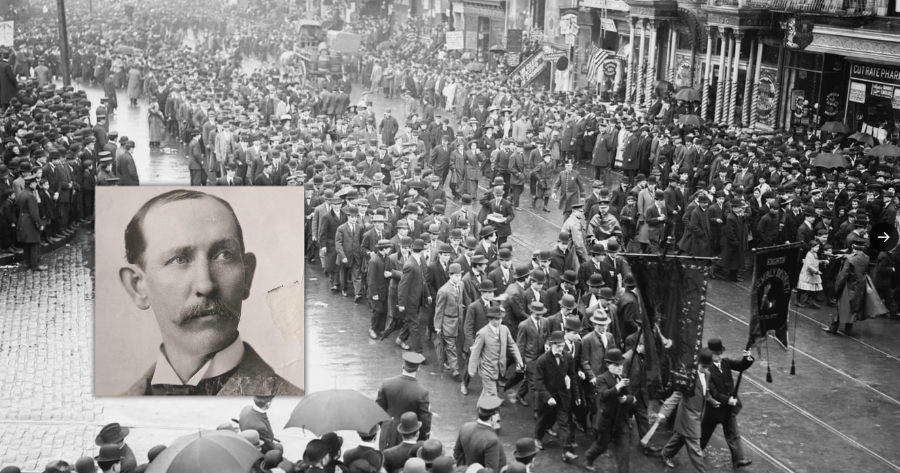
Every year on the first Monday in September, Americans observe Labor Day — a federal holiday honoring the social and economic contributions of workers. For many people, it marks the unofficial end of summer, a long weekend filled with barbecues, parades and family gatherings. But the holiday began with something much more serious: a labor movement demanding recognition for workers and better conditions during a period when long hours and difficult working environments were common.
And one of the men who may have helped create that holiday had a strong New Jersey connection.
His name was Matthew Maguire, a machinist and labor leader associated with Paterson.
Maguire was active in the labor movement during the 1870s and pushed for shorter working hours and better conditions for industrial workers. By 1882, he had become secretary of the Central Labor Union of New York, an organization that played a central role in organizing what became the first Labor Day celebration.
The first Labor Day parade took place in New York City on September 5, 1882. Thousands of workers participated, marching through the city before gathering for speeches, food and festivities. The event became the model for future Labor Day celebrations across the country.
But who actually came up with the idea?
For many years, much of the credit went to Peter J. McGuire, a prominent carpenter and labor leader who later helped found the American Federation of Labor. He is also documented as having proposed a national day honoring workers.
Yet historical research has increasingly pointed to Matthew Maguire as another — and perhaps stronger — candidate.
The U.S. Department of Labor acknowledges that evidence supports the claim that Matthew Maguire proposed the holiday in 1882 while serving as secretary of the Central Labor Union. Both Maguire and McGuire were involved in the first Labor Day celebration, which helps explain why the question of who deserves the title of “father of Labor Day” has remained unsettled.
The New Jersey Historical Society goes even further.
Its records show that Maguire was deeply involved in organizing the first celebration and later became secretary of Local 344 of the Machinists and Blacksmiths Union in Paterson. After President Grover Cleveland signed legislation making Labor Day a national holiday in 1894, the Paterson Morning Call argued that the credit should go to Maguire, calling him the “Father of the Labor Day holiday.”
Maguire’s connection to New Jersey did not end with his union work. He later served as an alderman in Paterson and remained involved in labor and socialist politics. Some historians have suggested that his more radical political views may have contributed to his receiving less recognition than Peter McGuire in later accounts of the holiday’s origins.
New Jersey itself became one of the early states to recognize Labor Day. In 1887, it joined Colorado, Massachusetts and New York in passing legislation establishing the holiday, after Oregon became the first state to do so earlier that year.
The movement continued to spread, and on June 28, 1894, Congress passed legislation making the first Monday in September a legal national holiday. President Grover Cleveland signed it into law.
More than a century later, Labor Day has become part of American culture. But behind the long weekend is a history of workers organizing for recognition, dignity and better working conditions.
And somewhere near the beginning of that story stands a machinist from Paterson, New Jersey — a man who may very well have helped give America one of its most familiar national holidays.
Sources: U.S. Department of Labor; New Jersey Historical Society; International Association of Machinists (IAM)
By NJ RADAR Team