


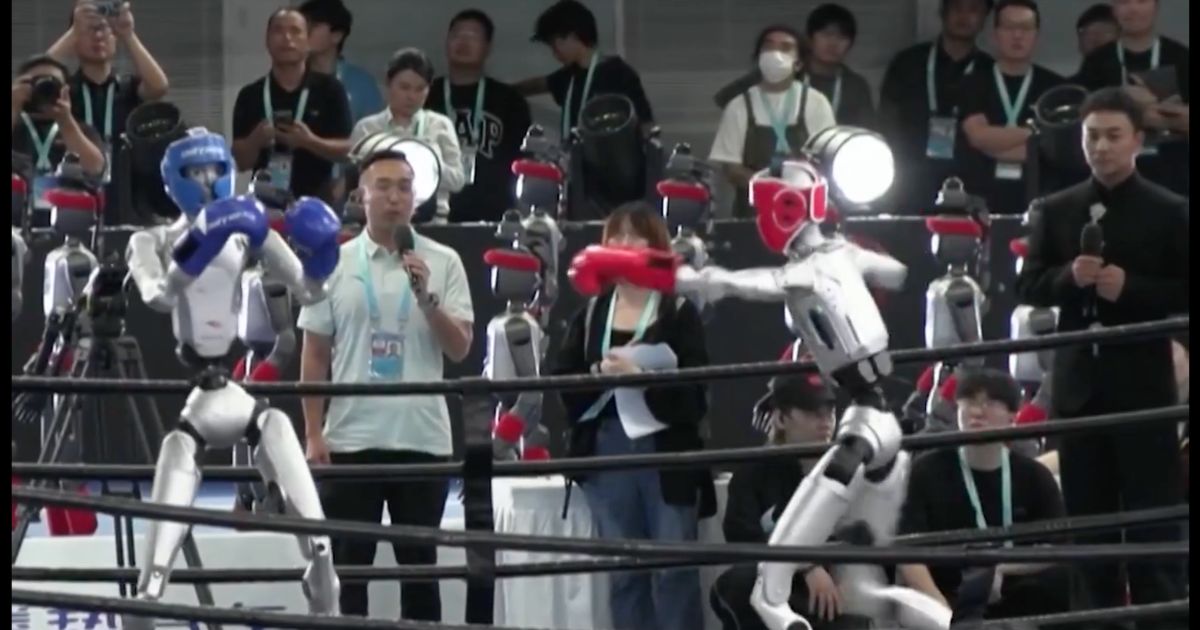
Artificial intelligence is no longer just something hidden inside computers and phones. In Beijing, it now runs, jumps, boxes, plays soccer, performs music — and increasingly looks and moves like us.
The 2nd World Humanoid Robot Games opened in Beijing on Saturday, bringing together 666 teams and 2,056 robots from 16 countries for five days of competition at the National Speed Skating Oval. Robots are competing in 51 events, ranging from athletics and soccer to boxing, table tennis and real-world industrial tasks.
And this year, the performances are already pushing the boundaries of what many people thought humanoid robots could do.
One Chinese humanoid robot completed a 100-meter preliminary heat in 9.39 seconds. For comparison, Usain Bolt’s human world record is 9.58 seconds. Another robot reportedly recorded 9.47 seconds. These are not official human athletics records, of course, but the comparison shows just how rapidly robotic speed has advanced. Last year, the winning robot at the same distance needed 21.50 seconds.
The jumping events produced another striking result. A humanoid robot reached 2.88 meters in a standing high jump demonstration, a dramatic leap from the best performance shown at last year’s event.
But the Games are about far more than running.
Humanoid robots are playing soccer, competing in boxing and combat-style events, lifting weights, playing table tennis and tennis, and taking part in other athletic challenges designed to test balance, coordination, reaction time and autonomous decision-making. Some events also move beyond sports into tasks that resemble the jobs robots may eventually perform in factories, warehouses, restaurants and emergency situations.
The opening ceremony itself looked like a glimpse into a different era.
Thirty-six humanoid robots equipped with human-like five-finger dexterous hands played musical instruments alongside human musicians, demonstrating how quickly robotic hands are becoming capable of increasingly delicate movements. Thousands of robots also appeared during the ceremony, including formations and a symbolic lighting of the Games flame.
Yet the event is also revealing how much work remains.
The fastest robots can now sprint at extraordinary speeds, but stopping is another matter. Some have crashed into padded barriers after races, a reminder that raw speed is only one part of creating a machine capable of moving safely through the unpredictable human world.
Perhaps that is what makes the 2nd World Humanoid Robot Games so fascinating.
For years, artificial intelligence has been largely invisible — algorithms running behind screens, answering questions, analyzing data and generating images or text.
In Beijing, AI has been given a body.
It can run.
It can jump.
It can box.
It can kick a soccer ball.
It can play an instrument with five mechanical fingers.
And while these robots are still far from replacing the complexity and adaptability of the human body, the distance between
science fiction and reality suddenly looks much shorter.
Source: CGTN / @CGTNOfficial on X; @KanekoaTheGreat on X
By NJ RADAR Team