

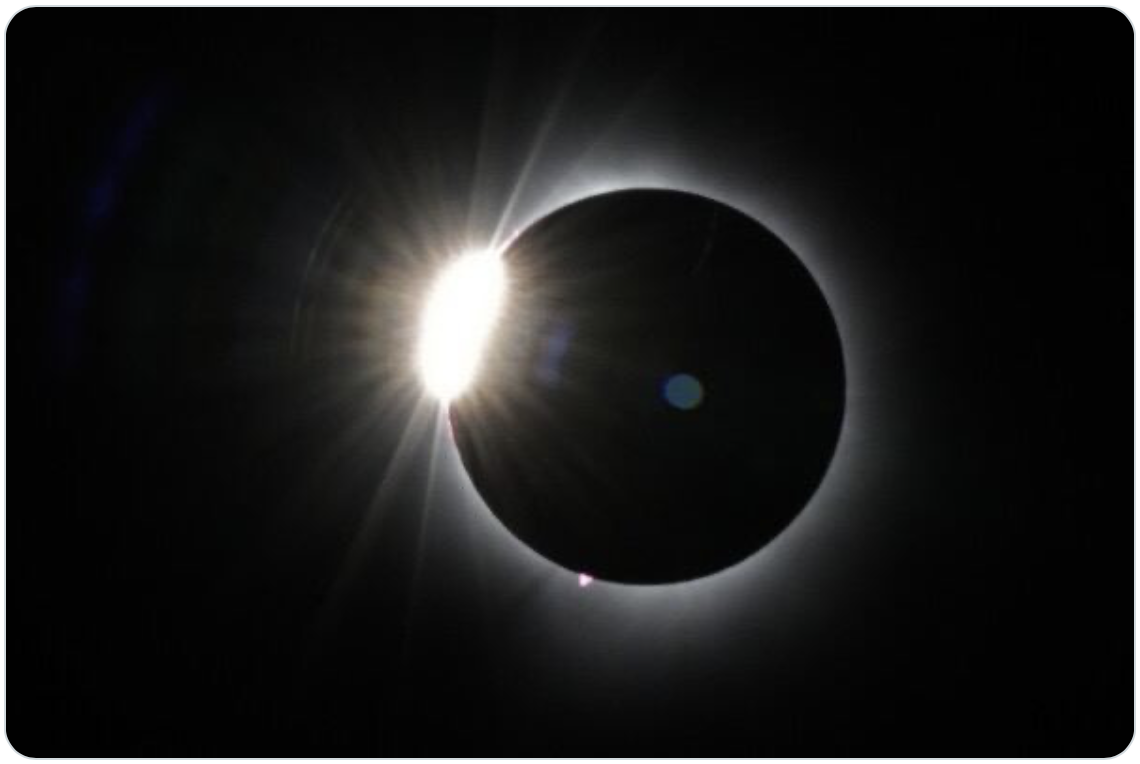
After a month filled with planets, meteors and a solar eclipse, August has one more celestial surprise left — and New Jersey will have a good seat for it.
NEW JERSEY — Skywatchers may want to stay up a little later next Thursday night.
On the night of Aug. 27 into Aug. 28, a deep partial lunar eclipse will sweep across the Americas, Europe and Africa, and it will be clearly visible from New Jersey. NASA confirms that the event will be visible across much of North and South America.
And this will not be an ordinary partial eclipse.
At its peak, about 96% of the Moon’s surface will be inside Earth’s darkest shadow, leaving only a narrow bright edge untouched. The result could make the Moon look almost completely eclipsed, with much of its surface taking on a rusty red or orange color.
When should New Jersey look up?
For viewers in New Jersey and the rest of the Eastern Time Zone, the partial phase begins at approximately 10:33 p.m. Thursday, Aug. 27.
The eclipse reaches its maximum at about 12:12 a.m. Friday, Aug. 28, when nearly the entire lunar disk will be covered by Earth’s shadow.
The partial phase ends around 1:51 a.m.
So anyone who does not want to stay outside for the entire event can simply aim for the period around midnight.
Why could the Moon turn red?
A lunar eclipse happens when the Earth moves between the Sun and a full Moon, causing Earth’s shadow to fall across the lunar surface.
But Earth does not block every ray of sunlight.
Some sunlight passes through the edges of Earth’s atmosphere before reaching the Moon. Our atmosphere scatters shorter blue wavelengths while allowing more red and orange light through — the same basic effect responsible for colorful sunsets.
That filtered light can give the eclipsed portion of the Moon its reddish or copper-colored appearance.
Because a tiny portion of the Moon will remain outside the darkest part of Earth’s shadow, this event technically will not be a total lunar eclipse or a true “Blood Moon.”
Visually, however, it may come remarkably close.
No eclipse glasses required
Unlike a solar eclipse, there is no danger in looking directly at a lunar eclipse.
No special glasses or eye protection are needed.
You can simply step outside and look at the Moon. Binoculars or a telescope can make the changing colors and the boundary of Earth’s shadow easier to see, but they are not necessary.
The biggest question for New Jersey will simply be the weather. Clear skies will be necessary for a good view.
August has been busy overhead
The lunar eclipse will cap an unusually active month for skywatchers.
August has already brought the Perseid meteor shower, a total solar eclipse visible from parts of Europe and the Arctic, and several notable planetary appearances. NASA listed the lunar eclipse as one of the month’s major skywatching highlights.
And this one may be worth making the effort to see.
Astronomers describe it as the most impressive lunar eclipse visible anywhere on Earth until a total lunar eclipse on Dec. 31, 2028.
So sometime before midnight on Aug. 27, New Jersey residents may want to turn off the lights, step outside and look up.
August apparently saved one of its best sky shows for last.
Sources: NASA Science, Space.com. Additional Source: Sputnik Brasil/X
By NJ RADAR Team