

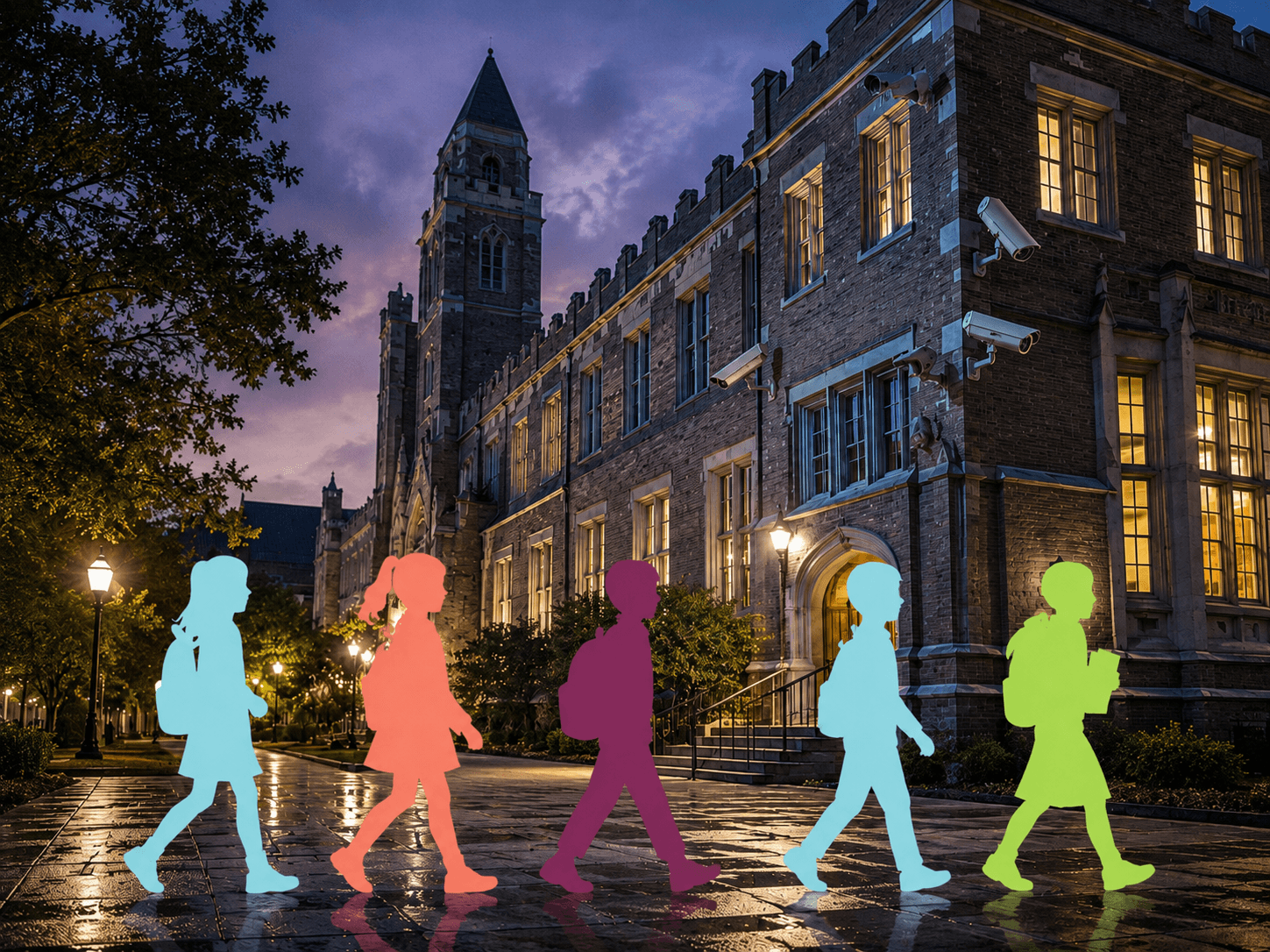
Thousands of cameras equipped with artificial intelligence capabilities are part of Newark Public Schools’ surveillance plans, raising a question that is becoming increasingly difficult to ignore: how much monitoring is too much when the people being watched are children? Now, New Jersey lawmakers are considering legislation that would require school districts using AI surveillance to explain exactly what their systems collect, how the information is used and who can access it.
Newark’s school district approved a roughly $12 million contract for more than 7,000 AI-enabled surveillance cameras in 2024. The scale of the project immediately attracted attention because it would place thousands of cameras throughout the district, potentially giving administrators access to far more sophisticated monitoring than traditional school security cameras provide.
The installation did not proceed as quickly as originally planned. NJ Spotlight News later reported that implementation of the system had been delayed, extending the debate over how the technology would eventually be used and what safeguards would accompany it.
What Can an AI Camera Do?
Traditional school cameras generally record video for security purposes.
AI-enabled systems can potentially go further by analyzing what the cameras see, identifying patterns or objects and helping operators search enormous amounts of footage much more quickly.
That capability can make surveillance more useful for responding to threats, but it also introduces questions that ordinary security cameras never raised to the same degree.
What information is being analyzed?
How long is it stored?
Can the system track an individual student from one part of a school to another?
Who is permitted to access the information?
And how much do parents and students know about what the technology is capable of doing?
Those questions are now reaching the New Jersey Legislature.
New Jersey Bill Would Require Schools to Explain Their AI Surveillance
Assembly Bill A1323, introduced for the 2026–2027 legislative session, would require school districts using video surveillance systems with artificial intelligence capabilities to adopt a formal policy governing their use.
Under the proposal, districts would have to explain the benefits and challenges of their surveillance technology and identify the type of information being collected.
The policy would also have to explain how that information would be used and who would be allowed to access it.
Schools would additionally be required to post signs notifying people that AI-capable surveillance is being used in buildings or on school grounds.
Parents and guardians would have to receive copies of the district’s surveillance policy.
Security Versus Privacy
Supporters of advanced surveillance technology can point to an obvious objective: schools are responsible for protecting thousands of children every day, and technology capable of identifying threats more quickly could potentially help administrators and law enforcement respond to emergencies.
But the same technology can create an unprecedented level of observation inside a place where children spend much of their lives.
The issue is therefore larger than whether schools should have cameras.
Schools have used security cameras for years.
The emerging question is what happens when those cameras are combined with artificial intelligence capable of analyzing enormous amounts of information.
New Jersey’s proposed legislation does not ban AI surveillance in schools. Instead, it attempts to establish transparency around its use by requiring districts to tell families what technology is operating and what happens to the information it produces.
For Newark, where plans for more than 7,000 AI-equipped cameras have already placed the district at the center of the debate, that discussion is particularly relevant.
The technology may be designed to make schools safer.
But as AI becomes increasingly capable of watching, analyzing and identifying what happens inside those schools, another question is becoming just as important:
Who is watching the watchers?
Sources: New Jersey Legislature; NJ Spotlight News
By NJ RADAR Team