
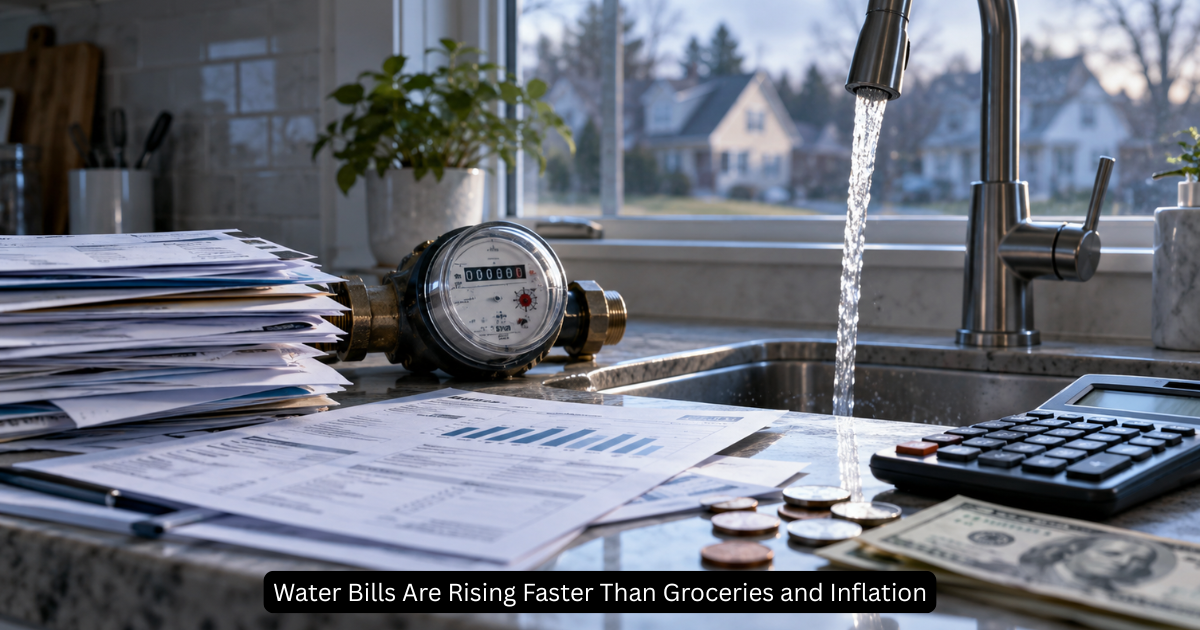
Household water bills across the United States have increased dramatically over the past decade, rising faster than overall inflation, grocery prices and household incomes, according to a new national analysis released this week.
The nonprofit Food & Water Watch examined billing data from the 500 largest community water systems in the country, serving about 155 million people — roughly 45% of the U.S. population.
The findings show that between 2015 and 2025, the average household drinking water bill increased by 62%.
That means water costs rose about 1.6 times faster than overall inflation and more than twice as fast as grocery pricesduring the same period. Water bills also increased about 19% faster than median household income, meaning families are devoting a larger share of their earnings to an essential service.
A Growing Affordability Problem
The study found major differences depending on where people live.
In 2025, the average household among the systems studied paid approximately $531 per year for drinking water, based on annual consumption of 60,000 gallons.
But costs ranged dramatically — from about $133 per year in the least expensive system to more than $1,400 in the most expensive.
The 25 most expensive systems charged households more than $1,000 annually.
Low-income households are particularly vulnerable because even relatively modest increases in utility costs can consume a significant portion of monthly income.
Why Are Water Bills Going Up?
Utilities across the country say they face increasing costs from aging pipes, treatment plants, pollution controls and stricter water-quality requirements.
Many water systems also need billions of dollars in infrastructure upgrades after decades of deferred maintenance.
Another issue is ownership.
Food & Water Watch found that publicly owned water systems charged an average of about $494 per year, while corporate-owned systems averaged around $823.
Industry groups argue that private utilities often operate systems requiring significant investment and that rising costs reflect the need to maintain reliable and safe drinking water.
Why This Matters in New Jersey
The issue is especially relevant in New Jersey, where regulators have already warned that major water infrastructure investments are coming.
Last month, New Jersey Board of Public Utilities Commissioner Michael Bange cautioned that ratepayers focused on electricity costs could soon face another affordability challenge from water-system upgrades.
“We’re talking billions of dollars,” Bange said while urging water utilities to communicate clearly with customers about coming changes.
Some New Jersey communities are already seeing higher rates.
Trenton Water Works, for example, began implementing a new water rate schedule on October 2. A typical residential customer using about 12 CCF per quarter is expected to pay approximately $109.84 per quarter under the new structure.
Officials say the additional revenue is needed to maintain and modernize a system serving about 217,000 residents across Trenton, Ewing, Hamilton, Hopewell and Lawrence Township.
Water Is Becoming Another Household Cost to Watch
For years, most affordability discussions have focused on rent, electricity, insurance and food.
But the new data suggests that water is increasingly becoming another major household expense.
Unlike many other costs, water use cannot simply be eliminated.
That makes the affordability issue especially difficult for lower-income households and communities where infrastructure requires extensive repairs.
The broader question now facing New Jersey and other states is how to fund those upgrades without making an essential service increasingly unaffordable.
Sources: Food & Water Watch; Stateline; New Jersey Monitor; New Jersey Board of Public Utilities; Trenton Water Works
By NJ RADAR Team