


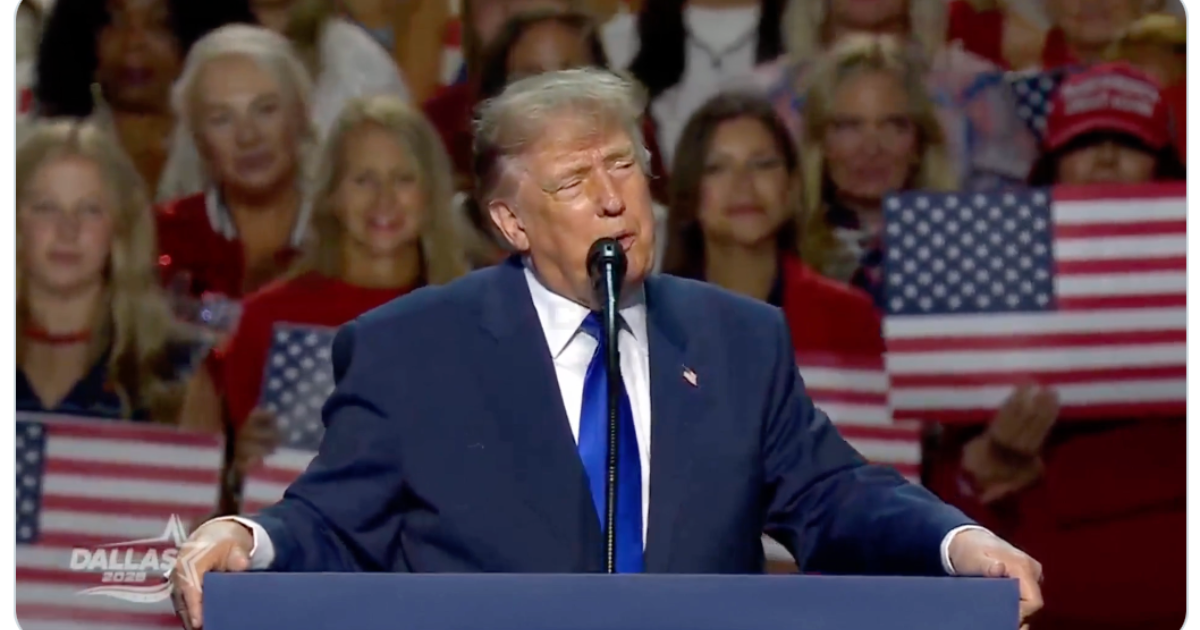
President Donald Trump has promised that every adult U.S. citizen would receive $5,000 if Republicans retain control of both the House of Representatives and the Senate in November’s midterm elections.
Speaking at the Republican convention in Dallas, Trump called the payment a “Trump Dividend” and directly tied it to his party’s victory: if Republicans win both chambers of Congress, he said, adult Americans would receive $5,000 each. He did not, however, present a detailed financing plan or explain exactly how the payments would be carried out.
That immediately raises a political question that is difficult to ignore. If the money were to come from tariff revenue, it would be public federal revenue, not Republican Party money. Critics could therefore argue that the federal treasury is being used as a political lever: public funds are being promised to citizens on the condition that one particular party remains in power.
That is still not the same as legally established vote-buying. Legal experts distinguish between promising a future public policy and directly paying an individual in exchange for that person’s vote. But the political controversy remains because the proposed payment has been explicitly tied to an election outcome.
The Economic Math Does Not Add Up
The proposal also faces a basic problem: the numbers do not match.
If roughly 270 million adult Americans received $5,000 each, the total cost would be about $1.35 trillion. That is far more than the federal government collects in tariff revenue in a year.
Vice President JD Vance has suggested that tariff revenue could help finance the payments, but such revenue would cover only part of the total cost.
It is also important to understand who actually pays tariffs. Tariffs are formally paid by U.S. importers, and some of that cost can then be passed on to American businesses and consumers through higher prices.
In that sense, a “Trump Dividend” could be described as returning to citizens part of the revenue the government had already collected through trade policy — but only after tying that payment to a Republican electoral victory.
The President Cannot Create Such a Fund Alone
There is also a constitutional obstacle. A president cannot simply take more than a trillion dollars from the federal treasury and distribute it to the public by executive order.
A program of this size would require Congressional approval, including legislation authorizing the spending.
That means that even if Republicans retain both chambers, Trump’s promise would not automatically become reality. Congress would still have to decide who qualifies for the payment, where the money would come from, how the program would be financed, and how much it could add to the federal deficit.
For now, there is no “Trump Dividend” fund.
There is a political promise worth more than a trillion dollars, tied to the victory of one party, without an enacted law and without a complete financing plan.
And that leaves the central question:
If the money is public, should the promise of receiving it be tied to which party wins an election?
Sources: Reuters; Associated Press; USA TODAY
By NJ RADAR Team
[…] Donald Trump is again promoting his proposal to send $5,000 payments to every adult American citizen if Republicans maintain control of both the House and Senate […]