


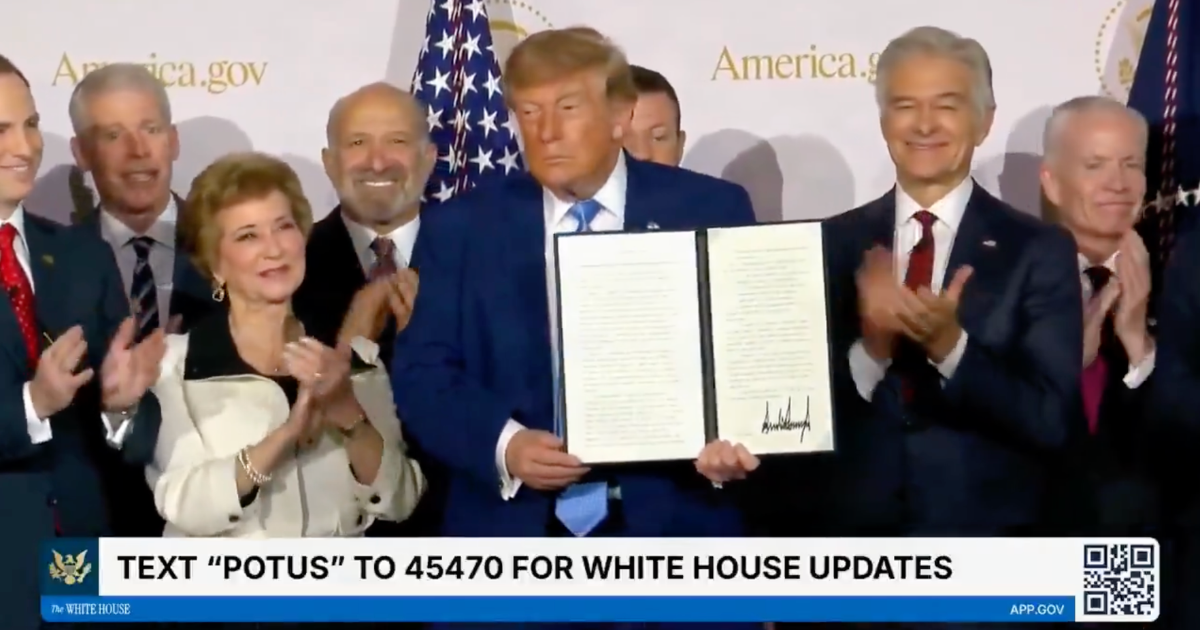
President Donald Trump on Tuesday signed an executive order directing federal agencies to begin integrating their digital services with America.gov, a newly launched AI-powered portal designed to serve as a single gateway to U.S. government services.
The administration says the platform is intended to make it easier for Americans to find federal programs, forms and services without navigating thousands of separate government webpages. Trump described the project as an effort to modernize how citizens interact with the federal government.
One Gateway for Federal Services
America.gov is designed to function as a centralized starting point for people looking for information from different parts of the federal government.
Instead of searching individual agency websites, users would be able to ask questions or search through the portal and be directed toward the appropriate government service.
Launch reporting says the first version of America.gov is already available, with additional capabilities expected to be added over the coming weeks and months.
Agencies Directed to Begin Integration
The new executive action calls for federal agencies to begin connecting their services with the platform, potentially bringing information and digital tools from multiple departments into one system.
The administration has presented the project as part of a broader effort to simplify government websites and reduce what Trump described as an “endless maze” of federal rules, forms and online services.
Details about how quickly individual agencies will complete the integration, and exactly which services will be available directly through America.gov, are expected to develop as implementation moves forward.
AI at the Center of the Project
Artificial intelligence is a central part of the new portal.
The system is intended to help users navigate government information conversationally rather than relying only on traditional website menus and search tools.
The launch comes as Washington is engaged in a broader debate over how rapidly AI should be adopted and how much oversight should accompany increasingly powerful systems.
Trump is also meeting Tuesday with major technology executives, including leaders from Nvidia, Meta, Google, Anthropic and OpenAI, for discussions about AI development, regulation and U.S. competition with China.
Questions About Accuracy and Oversight
The use of AI in a government portal also raises practical questions about accuracy, privacy and how the system handles politically sensitive information.
Associated Press reported Tuesday that America.gov has already attracted attention because some of its AI-generated responses changed after initially giving answers that conflicted with claims made by Trump.
That episode highlights one of the challenges facing the project: a government AI service will need to provide reliable information while maintaining public confidence that answers are not being shaped for political reasons.
A Major Shift in How Americans Access Government
If fully implemented, America.gov could significantly change how Americans interact with federal agencies.
Instead of navigating separate websites for benefits, taxes, health programs, immigration information, veterans’ services and other government resources, the administration’s goal is to create a common digital entry point.
The first version is only the beginning. The larger test will be whether federal agencies can successfully integrate their services while maintaining security, accuracy and public trust.
Tags: America.gov, Donald Trump, Artificial Intelligence, Federal Government, Government Services, AI, Technology, Digital Government, Executive Order
Sources: White House, Associated Press, Reuters, national launch reporting
By NJ RADAR Team
[…] Trump signed an executive order on September 29 instructing federal departments and agencies to use “Super Intelligence” and “SI” instead of “Artificial Intelligence” and “AI” in official correspondence, websites, reports and other non-statutory documents. The White House said the new terminology better reflects what it described as the rapidly expanding capabilities of modern AI systems. […]