


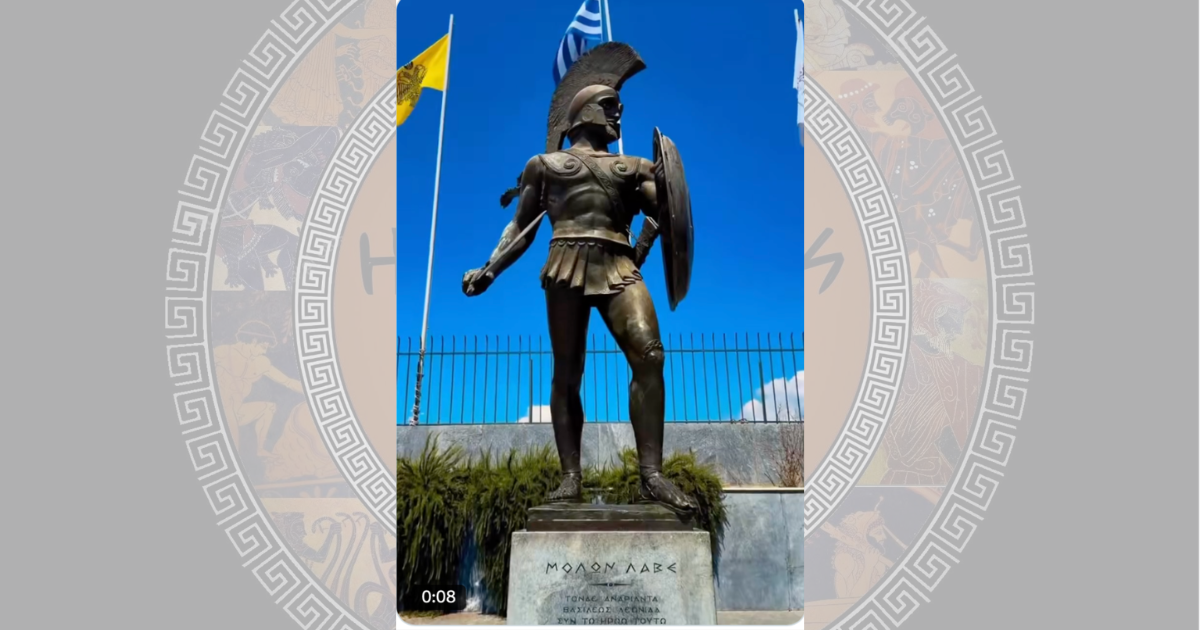
More than 2,500 years ago, during one of the most famous battles of the ancient world, a Spartan king is said to have answered an overwhelming enemy with just two words:
“Molon labe.”
The phrase, written in ancient Greek as μολὼν λαβέ, is commonly translated as “Come and take them.”
It is traditionally attributed to King Leonidas I of Sparta during the Battle of Thermopylae in 480 BCE.
According to the ancient Greek writer Plutarch, Persian King Xerxes demanded that the Greeks surrender their weapons. Leonidas responded with the now-famous phrase, refusing to submit even though the Persian forces vastly outnumbered the defenders.
Leonidas led a small Greek force at Thermopylae, including the famous 300 Spartans, along with warriors from several other Greek city-states. Their goal was to delay the Persian army at a narrow mountain pass and buy time for the rest of Greece to prepare its defense.
The battle ended in defeat for Leonidas and his men, but their resistance became one of the most enduring stories of courage and sacrifice in Western history.
The legend of Leonidas grew in the centuries that followed. Ancient tradition also connected the Spartan royal line to Heracles, known as Hercules in Roman mythology, giving the king an almost mythical ancestry.
What makes “Molon labe” remarkable is not only its origin, but its survival.
Two short words spoken in the ancient world have endured for more than two millennia as a symbol of resistance, defiance and refusal to surrender.
Today, the phrase appears in books, films, military history and popular culture. It is also used in modern political and gun-rights contexts, especially in the United States, although that contemporary use is far removed from the original setting of the Persian Wars.
Behind the modern slogan, however, remains the same ancient story: a king facing a vastly larger army, refusing to hand over his weapons and choosing resistance instead.
Sources: Plutarch | Herodotus | Encyclopaedia Britannica | Today in History / X
By NJ RADAR Team