


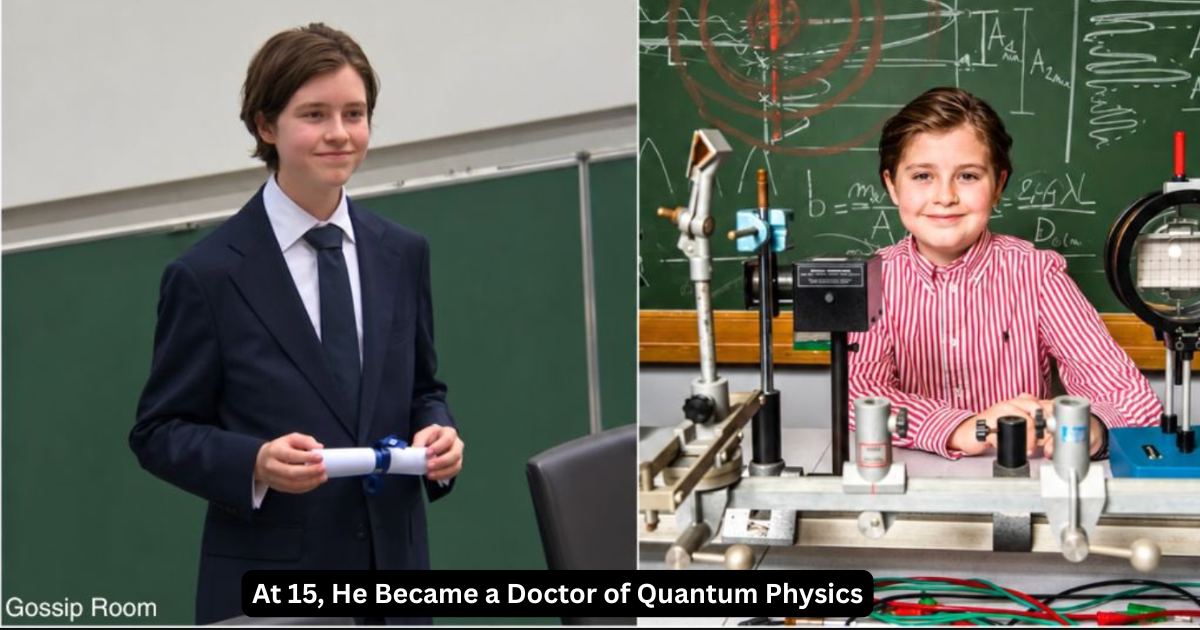
Belgian prodigy Laurent Simons earned a PhD in physics at just 15 years old, completing another extraordinary milestone in an academic career that began years before most children enter high school.
Simons defended his doctoral research at the University of Antwerp on November 17, 2025. His dissertation, titled Bose Polarons in Superfluids and Supersolids, explored highly complex phenomena involving ultracold quantum systems and states of matter such as superfluids and supersolids.
An extraordinary academic journey
Simons’ education progressed at an almost unprecedented pace.
He completed primary school at around six years old and finished high school at eight. By age 11, he had earned a bachelor’s degree in physics from the University of Antwerp, completing the usual three-year program in about 18 months. He later obtained a master’s degree in quantum physics before moving on to doctoral research.
His earlier master’s research was already focused on advanced quantum theory, including excitations in Bose-Einstein condensates, systems in which particles cooled to extremely low temperatures begin behaving collectively according to quantum-mechanical rules.
From quantum physics to medicine
But Simons does not intend to remain only in theoretical physics.
After completing his first doctorate, he began pursuing further research in medical science and artificial intelligence in Munich, according to The Brussels Times. His long-term interest is in combining physics, chemistry, medicine and AI to investigate human health, aging and ways technology might eventually extend human life.
That ambition has personal roots. Simons has previously spoken about wanting science to help people live longer and healthier lives, an interest reportedly influenced in part by health problems experienced by his grandparents.
Still only 16
Now 16, Simons has already completed an academic path that normally takes students well into their twenties.
Yet perhaps the most striking part of his story is that his first doctorate may only be the beginning. Having moved from quantum physics toward medicine and artificial intelligence, Simons is attempting to connect some of the most advanced areas of modern science with one ambitious goal: understanding how science could improve and perhaps extend human life.
Sources: University of Antwerp; The Brussels Times
By NJ RADAR Team