


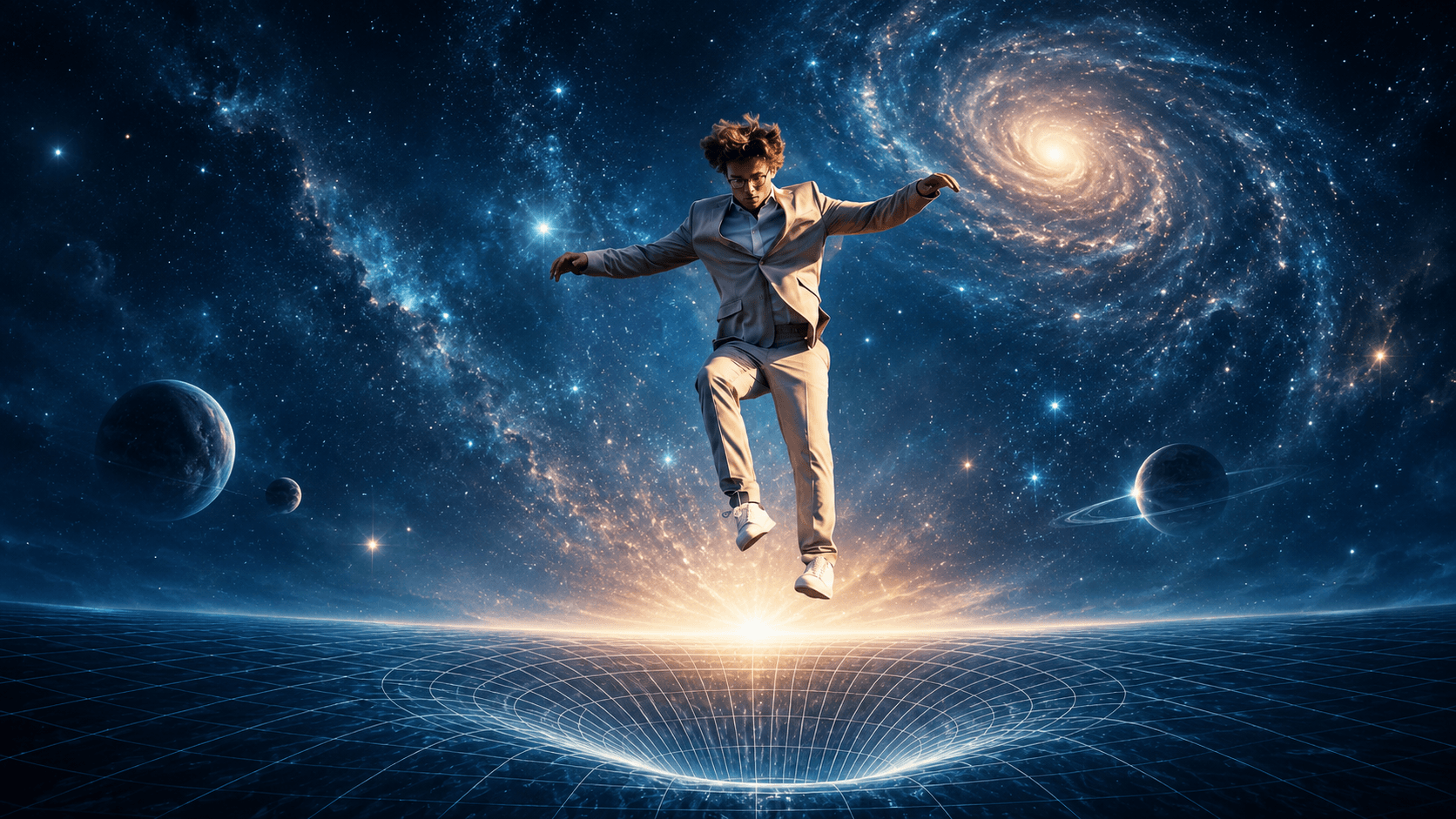
What if gravity is doing more than pulling planets, stars and galaxies together? A provocative idea from a physicist at the University of Portsmouth suggests gravity could also be behaving like an information-processing system — a possibility that has revived one of science’s strangest questions: Could our universe operate like a giant computer?
The research does not prove that we live in a simulation. But it proposes an unusual way of looking at gravity that researchers can debate and test.
Gravity as an information system
Physicist Melvin Vopson argues that gravity may emerge from the way information is organized in the universe.
In a paper published in AIP Advances, Vopson derives Newton’s gravitational law using information-theory concepts and proposes that matter naturally organizes itself in ways that reduce what he calls information entropy.
In simple terms, imagine the universe constantly trying to store information about matter in the most efficient way possible.
When matter is spread across space, more information may be required to describe where everything is located. When gravity causes matter to gather together, that information becomes more organized and potentially easier to encode.
Vopson suggests gravity could therefore function somewhat like a computational optimization process.
Why does this lead to the simulation hypothesis?
Modern computers constantly compress, organize and optimize information to reduce the resources required to process data.
Vopson sees similarities between that behavior and the way he believes information may be organized in nature.
His theory includes what he calls the second law of infodynamics, under which information entropy tends to decrease or remain minimal in certain physical systems.
If nature consistently behaves as though it is minimizing information and computational resources, Vopson argues, that could be compatible with the idea of a universe functioning like an enormous information-processing system. (University of Portsmouth)
That is where the simulation hypothesis enters the discussion.
The idea proposes that what humans experience as physical reality could theoretically be generated by an extraordinarily advanced computational system.
But compatibility is very different from proof.
No, scientists have not discovered that we live in a simulation
The headline may sound dramatic, but the distinction is important.
Vopson’s research presents a theoretical interpretation of gravity, not experimental evidence showing that someone or something is running our universe on a computer.
The underlying paper asks whether gravity could be evidence of a computational universe, and Vopson himself has presented the simulation connection as a possibility arising from his interpretation of information physics.
The theory remains speculative and will require scrutiny, further mathematical work and ultimately experimental evidence before scientists could determine whether it describes nature better than existing explanations.
The idea has roots beyond science fiction
The connection between physics and information is not new.
Information theory has become increasingly important across physics, particularly in quantum mechanics, black-hole research and discussions about entropy.
There are also previous theories suggesting gravity itself could be an emergent phenomenon rather than a fundamental force.
Vopson says his approach is consistent in some respects with earlier work on entropic gravity, although he reaches his result through a different information-based framework.
His broader research has also explored the idea that information may have physical properties and that the universe contains an enormous amount of encoded information.
So are we living inside a computer?
Science still has no answer.
But the new research raises an intriguing possibility: some of the fundamental laws governing the universe may also be describable in terms normally associated with information and computation.
Whether that means the universe is a computer, merely behaves in ways that can be understood computationally, or has nothing to do with simulation at all remains unresolved.
For now, gravity continues to keep our feet on the ground.
What it may eventually tell us about the nature of reality is a much bigger question.
Sources: AIP Advances, University of Portsmouth, Night Sky Today/X
By NJ RADAR Team