


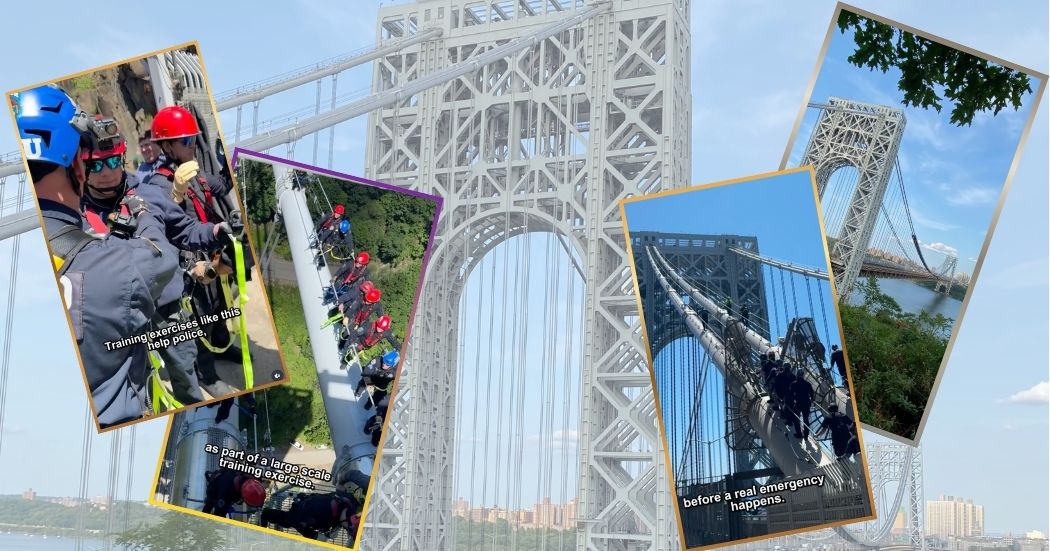
FORT LEE, NJ — The George Washington Bridge is drawing attention from two very different directions this week: high above the Hudson River, where first responders trained on the bridge’s massive steel cables, and down on the road, where a new phase of construction is bringing traffic changes and detours to Fort Lee.
For the thousands of people who cross the George Washington Bridge every day, almost everything happens at roadway level. But recent images shared by the Port Authority of New York and New Jersey offered a rare look at what happens far above the traffic.
Police officers, firefighters and other emergency responders took part in specialized training on the bridge, climbing along its enormous main cables high above the Hudson River.
The exercise was designed to prepare multiple agencies to work together during an emergency in one of the most challenging environments imaginable — high above the river, surrounded by steel, cables and one of the busiest transportation corridors in the region.
And while emergency crews were training above the bridge, another major operation was beginning on the Fort Lee side.
New Construction Brings Changes to Fort Lee
A new phase of the long-running rehabilitation of the George Washington Bridge begins Friday, August 14, affecting the Center Avenue overpass and ramps leading to and from Interstate 95.
The Port Authority says the right lanes and sidewalk on the northbound Center Avenue overpass, above the George Washington Bridge approach, will be closed for rehabilitation work.
The changes affect the ramp from New Jersey-bound I-95 to Center Avenue, as well as the ramp from Center Avenue to New York-bound I-95.
Drivers should expect multiple detours, including separate routes for trucks and buses. Officials are urging motorists to allow extra travel time and follow posted detour signs throughout the project.
Current Port Authority travel information also warns motorists to expect continuing restrictions around Center Avenue as the work progresses.
Why This Matters
Traffic delays and detours are inconvenient, but the work has a larger purpose.
- Safety — The George Washington Bridge is nearly a century old, and replacing aging structural components is part of keeping the crossing safe and reliable.
- Reducing the risk of future problems — Replacing worn components now can help reduce the need for unexpected repairs and emergency closures later.
- Better conditions for pedestrians — The Center Avenue project includes upgraded lighting and improved pedestrian features, which are especially relevant to Fort Lee residents.
- Improved traffic flow after construction — Modernized roadway features and ramps are designed to improve safety and traffic movement once the work is complete.
- Better emergency preparedness — The training taking place high above the bridge gives first responders an opportunity to practice coordination in a difficult environment before a real emergency occurs.
More Than a Routine Repair
The Center Avenue work is part of a much larger Port Authority effort to modernize and preserve the nearly century-old George Washington Bridge.
The agency’s “Restoring the George” program was launched in 2015 and includes 11 major projects totaling approximately $2 billion.
The program is designed to replace aging bridge components, strengthen the structure, improve safety and make travel easier for motorists and pedestrians.
Once the Center Avenue project is completed, the overpass is expected to feature upgraded structural components, improved lighting and better roadway and pedestrian amenities.
One Bridge, Two Very Different Views
For daily commuters, the next several months may mean detours, slower traffic and a little more patience.
But the emergency training taking place high above the Hudson offers an entirely different perspective on the bridge — one most drivers never see.
While hundreds of thousands of travelers move between New Jersey and New York below, emergency teams are training above them and construction crews are rebuilding around them, all with the same goal: keeping one of the region’s most important crossings safe and operating for years to come.
For Fort Lee residents, the George Washington Bridge is not simply the familiar structure at the edge of town.
Right now, it is also a major construction site, an emergency training ground and a massive infrastructure project unfolding almost simultaneously above and below the roadway.
Sources: Port Authority of New York and New Jersey; NJ 101.5.
By NJ RADAR Team