


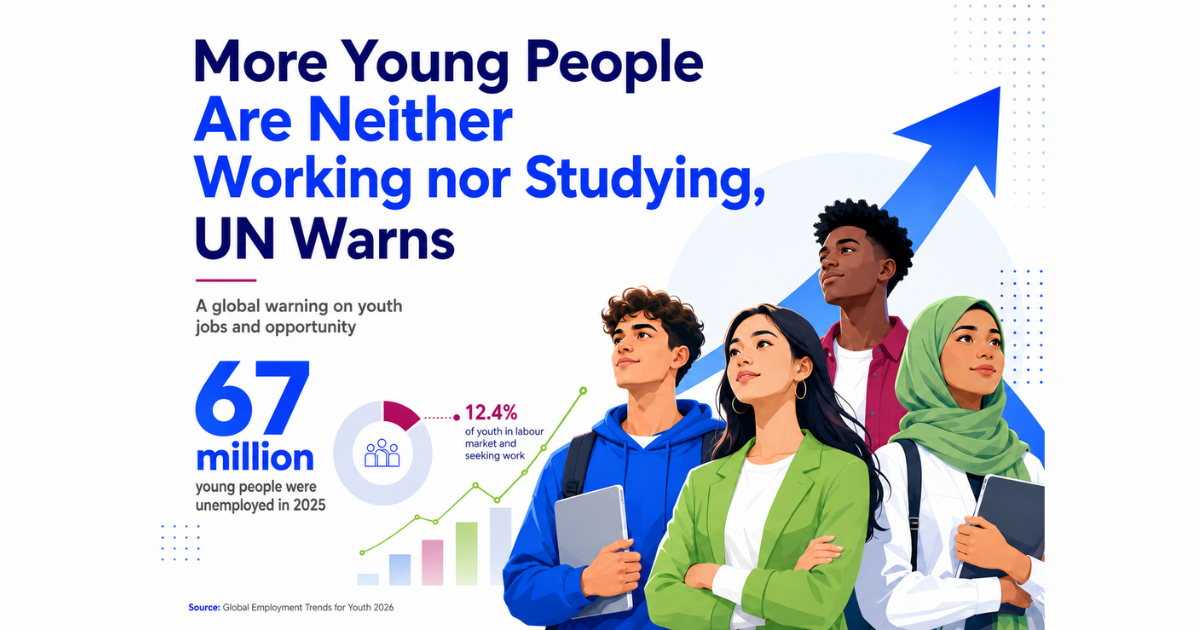
The number of young people who are unemployed or outside employment, education and training remains a major global concern. In a new message shared on International Youth Day, the United Nations emphasized that creating decent jobs for young people is not only a social necessity, but an investment in future economic growth.
The United Nations drew attention Wednesday to the challenges facing young people entering the global labor market, as millions remain unable to find work or gain access to education and training.
According to the International Labour Organization’s latest global employment assessment, the youth unemployment rate reached 12.4% in 2025, while approximately 260 million young people worldwide — about one in five — were not in employment, education or training, a group commonly referred to as NEET.
Young People Face a Tougher Labor Market
The problem goes beyond unemployment alone.
A young person classified as NEET may not be actively looking for a job and therefore may not appear in traditional unemployment statistics. The category includes young people who are neither working nor participating in school or professional training.
That distinction matters because long periods outside both employment and education can make it more difficult for young people to gain experience, develop skills and eventually establish themselves in the labor market.
The UN’s 2026 Sustainable Development Goals report also highlights persistent disadvantages for young workers, including a significantly greater likelihood of experiencing working poverty compared with adults.
Women Remain Disproportionately Affected
The challenge is particularly pronounced for young women.
ILO data have consistently shown a significant gender gap among young people outside employment, education or training. Globally, young women are substantially more likely than young men to fall into the NEET category, reflecting barriers that can include unequal access to jobs and education as well as unpaid caregiving responsibilities.
AI and Automation Add Another Challenge
The changing nature of work could make the transition into employment even more complicated.
The ILO warned in its 2026 employment outlook that artificial intelligence and automation may create additional difficulties for young people, particularly educated workers trying to obtain their first high-skilled jobs.
At the same time, technological changes are expected to transform a significant share of existing occupations, increasing pressure on governments, schools and employers to ensure that young people receive skills that match the jobs being created.
UN: Decent Jobs Are an Investment
In its message Wednesday, the United Nations summed up the issue simply: creating decent employment opportunities for young people should not be viewed only as a social responsibility.
It is also an economic investment.
Giving young people a pathway into stable work means building experience, increasing economic participation and preventing an entire generation from becoming disconnected from education and the labor market.
Sources
United Nations — International Youth Day post on X
International Labour Organization — Employment and Social Trends 2026
United Nations — Sustainable Development Goals Report 2026
ILO youth employment and NEET data