


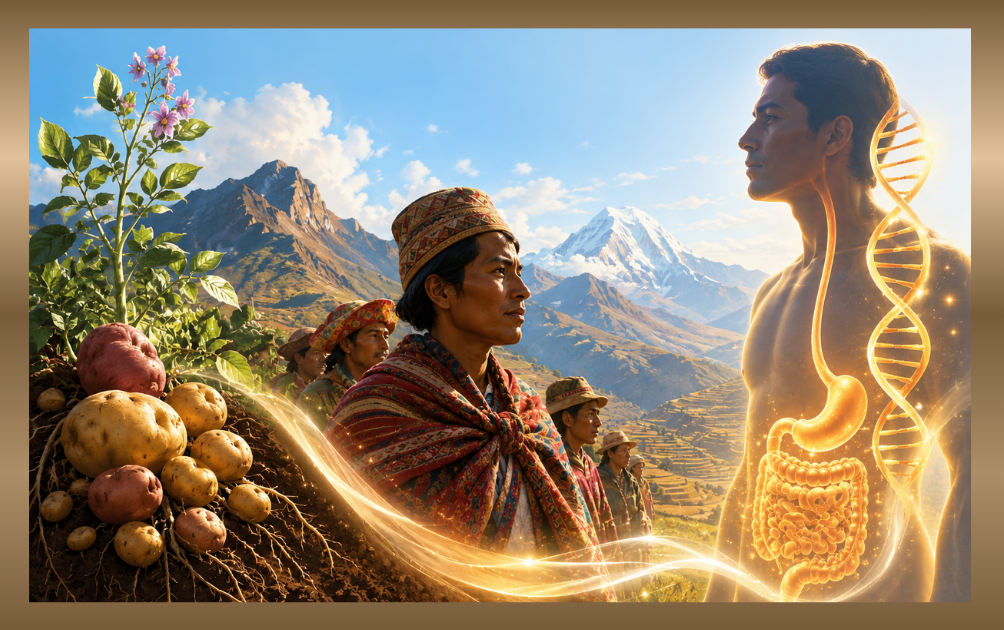
The Indigenous peoples of the Andes, who were the first in the world to domesticate the potato, carry a genetic advantage found in no other known population on the planet.
A new study by researchers from UCLA and the University at Buffalo, published in Nature Communications, reveals something remarkable: today’s descendants of these peoples in Peru have the highest known number of copies of the AMY1 gene. This gene controls the production of the enzyme amylase in saliva – the enzyme that begins breaking down starch right in your mouth, before food even reaches your stomach.
While most people worldwide have an average of 6 to 7 copies of this gene, Indigenous Andeans have an average of 10. Some individuals carry even more. This allows them to digest starch-rich foods far more efficiently – and potatoes, of course, are the ultimate starch-rich food.
How did this happen?
Around 6,000 to 10,000 years ago, when the potato became a staple food in the high Andes, people with more copies of the AMY1 gene had a small but real advantage. They digested starch better, got energy from food more easily, and – according to the researchers’ estimates – had about 1.24% higher chance of survival or reproduction in each generation.
That might sound like a tiny percentage. But over thousands of years, across hundreds of generations, that tiny edge became a massive evolutionary force. Those with fewer copies of the gene gradually disappeared from the population, while those with more stuck around, reproduced, and passed this “supergene” down to their children. That’s how today’s genetic gift came to be – a natural adaptation to the food that fed them for millennia.
What does this mean?
This is one of the rare and clear examples of how the food we eat can literally reshape our DNA. It’s not that the potato “changed” their genes – rather, selective pressure over time favored those who already had a genetic predisposition for better starch digestion.
And this isn’t unique to the Andeans. Similar adaptations have been observed in other populations too: Northern European peoples who historically grew grains and drank milk, for example, also have more copies of the AMY1 gene compared to populations that ate more meat or fish. But the Andeans are the record holders – no one on Earth has more copies of this gene than they do.
The potato as a symbol
And while we eat potatoes today as something ordinary, everyday, even mundane – this story reminds us of something deeper. The potato isn’t just food. For the Andean Indigenous peoples, it was the foundation of survival, a key source of energy at high altitudes where growing grains is tough. And they, literally, “gave back” – they adapted their bodies to it.
Today, when children in Peruvian villages eat potatoes in hundreds of ways – from chuño to sopa, from huancas to ocope – they carry within them a thousand-year-old story of the bond between people and the land. A story written in their DNA.
In the end
The potato gave the Andean Indians something more than sustenance – it gave them a supergene. But perhaps the real “supergene” is their ability to recognize the value of what the earth offers, to live in harmony with it, and to pass that knowledge down through millennia.
Because in the end, it’s not the gene that makes a people strong – it’s their connection to the ground they walk on. And the Andeans have proved that – not just in their culture, but in their very blood.
Primary Source
- Journal: Nature Communications
- Title: “Rapid adaptive increase of amylase gene copy number in Indigenous Andeans”
- DOI: https://doi.org/10.1038/s41467-026-71450-8