


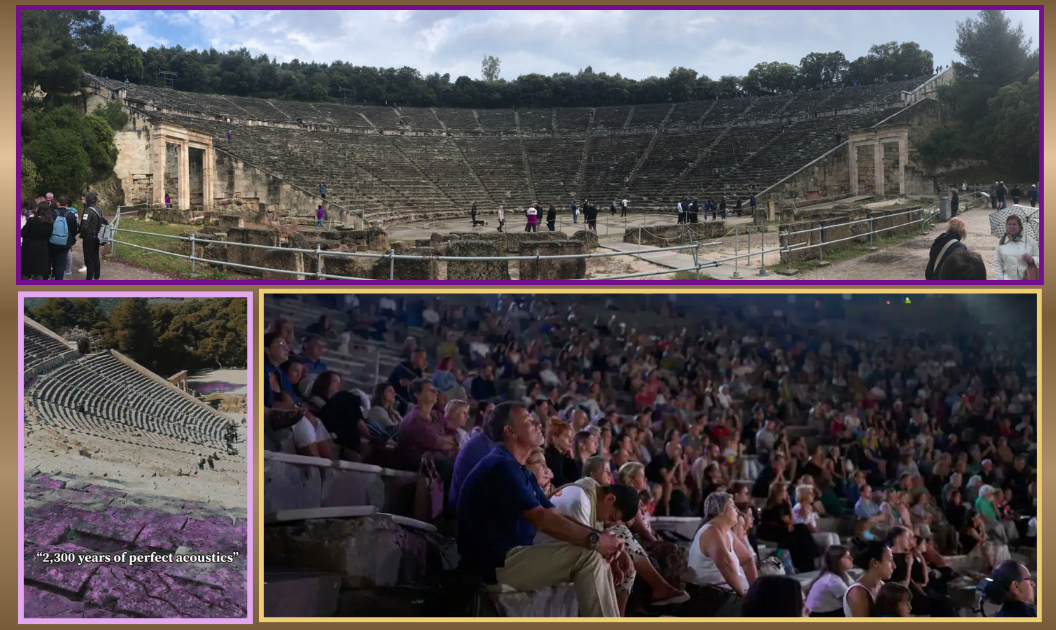
More than 2,300 years after the ancient Theatre of Epidaurus was built, it has made history again with its first fully accessible performance. Once part of one of the ancient world’s great healing centers, the theatre still amazes visitors with acoustics that seem almost impossible even today. The stones remain the same. But the society sitting on those stones continues to change.
Today, I came across a story that instantly took me back to Greece, to one of those places you visit but somehow never truly leave behind — the ancient Theatre of Epidaurus.
Euripides’ The Trojan Women has now written a new chapter in its history. At a theatre approximately 2,300 years old, the first fully accessible performance was held, making the experience available to people with disabilities as well.
The production featured 22 actors, including performers with disabilities, while accessibility measures for the audience included audio description, Braille programs, tactile materials and surtitles.
It is a beautiful story on its own.
But for me, it brought back the memory of the day I first sat among the ancient stone rows of Epidaurus.
We Climbed All the Way to the Last Row
Our guide told us about the extraordinary acoustics of the theatre.
Of course, when someone tells you that more than two thousand years ago people built a theatre where around 14,000 spectators could follow a performance without microphones, speakers or any kind of modern amplification, the first thing you want to do is test it yourself.
And we did.
We climbed all the way to the top.
Not just somewhere high up — we went to the very last rows.
While we sat at the top, someone remained far below, near the stage area.
Then came the test.
A match was struck.
And we heard it.
We were sitting in the last rows of an enormous open-air theatre, far above the stage, yet we could hear that tiny, brief sound.
No microphone.
No speakers.
No electricity.
Just stone, space and the knowledge of people who built this place more than 2,300 years ago.
I have never forgotten that moment.
Acoustics That Scientists Still Study Today
The Theatre of Epidaurus was built in the 4th century BC and is considered one of the masterpieces of ancient Greek architecture. Following a later expansion, it could accommodate approximately 14,000 spectators.
Its acoustics continue to fascinate scientists today.
Research has shown that the theatre’s shape, the steep incline of the seating and the carefully arranged rows of stone seats all play an important role in the way sound travels through the space.
Interestingly, researchers have studied the very same small “experiments” that visitors and guides perform at Epidaurus — whispering, dropping coins and even striking matches.
We knew nothing about those scientific studies at the time.
We simply sat at the top and listened.
And we heard it.
Epidaurus Was Never Just a Theatre
But there is another part of its history that makes today’s story particularly meaningful to me.
Epidaurus was not simply a place where people came to watch performances.
The theatre was part of the Sanctuary of Asklepios, one of the most important healing centers of the ancient Greek world.
People traveled there seeking treatment and healing. The complex included buildings associated with medical care, rest, religious rituals and physical activity.
The ancient Greeks did not view health simply as treating the body. Music, drama, physical activity, rest and shared human experiences were part of a much broader understanding of well-being.
That meant the theatre was not merely entertainment.
A performance could be part of the emotional and spiritual experience of people who came to Epidaurus seeking healing.
Many of the structures that once formed the ancient healing complex did not survive the passage of time.
The theatre did.
And Then, 2,300 Years Later…
That is precisely why what happened at Epidaurus this month carries such powerful symbolism.
On August 2, Euripides’ The Trojan Women was presented in what organizers described as the first fully accessible performance in the theatre’s approximately 2,300-year history.
Blind and visually impaired audience members were provided with audio description, Braille programs and tactile materials, while surtitles were available for deaf and hard-of-hearing spectators.
Actors with and without disabilities shared the ancient stage.
There is something almost symbolic about that.
A place that more than two thousand years ago formed part of a complex dedicated to healing and human well-being has now taken another step — toward making art accessible to everyone.
The stones remain the same.
But the society sitting on those stones continues to change.
Some Places Simply Refuse to Become the Past
When we visit ancient ruins, we usually try to imagine the people who once walked through them.
Epidaurus is different.
It is not simply a remnant of the past.
It still works.
Actors still step onto its ancient stage.
Audiences still climb its stone rows.
Human voices still travel through the same open air.
And somewhere at the very top, in the last row, someone can still sit on stones where people sat more than two thousand years ago and hear a sound coming from the stage far below.
I know.
Because I sat there.
And when I read today that Epidaurus had once again written a small page of history, the first thing I remembered was not its size, its photographs or even those 2,300 years.
I remembered an ordinary match.
And the sound of it striking far below, traveling across an ancient theatre all the way to where we were sitting.
By Jenny