

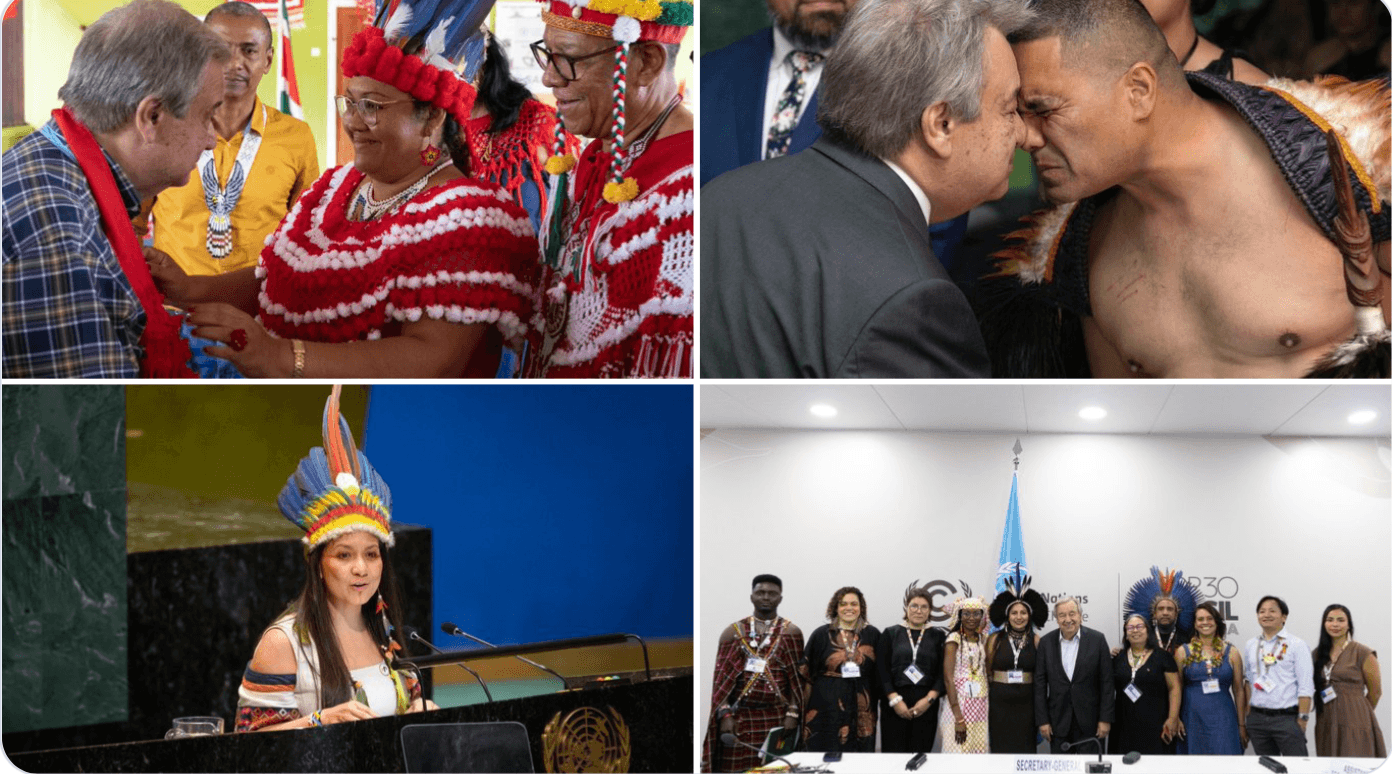
UNITED NATIONS — United Nations Secretary-General António Guterres is calling for stronger protection of Indigenous Peoples around the world, describing them as “guardians of cultural heritage, stewards of vital ecosystems, and crucial contributors to our shared future” — while warning that their communities continue to face disproportionate threats.
The message comes ahead of the International Day of the World’s Indigenous Peoples, normally observed annually on August 9. Because that date falls on a Sunday this year, the official observance has been shifted to Monday, August 10, 2026, when the UN will hold a virtual commemoration opening with an Indigenous spiritual ceremony, statements from senior UN officials, and a statement from the Chair of the Permanent Forum on Indigenous Issues.
This Year’s Focus: Indigenous Midwives
Unlike previous years, which have spotlighted themes such as artificial intelligence and Indigenous data rights, this year’s observance carries the theme “Honouring Indigenous Midwives: Safeguarding Life and Well-being.” In his message, Guterres pointed specifically to the stark disparities in maternal and infant health faced by Indigenous communities, where complications and deaths during childbirth remain far more prevalent than among the wider population.
“That is why, on this International Day of the World’s Indigenous Peoples, we celebrate Indigenous midwives,” Guterres said, noting that evidence shows they improve outcomes for mothers and babies, strengthen trust in health systems, and ensure continuity of care. He added that, as knowledge holders and community leaders, midwives also help preserve the languages, values, and practices that sustain Indigenous cultures across generations.
The UN said it is working with member states and Indigenous Peoples to advance rights-based approaches to health, and the day’s programming will include a dialogue titled “Indigenous Midwives as Knowledge Holders and Guardians of Well-being,” aimed at raising awareness of Indigenous midwifery as a living knowledge system and outlining policy pathways to protect Indigenous-led systems of care.
A Broader Pattern of Threats
Beyond maternal health, Guterres and the UN have repeatedly warned that Indigenous Peoples continue to face threats that disproportionately affect their communities, including the loss of ancestral lands and natural resources, discrimination, violence, and the growing effects of climate change. In many regions, development projects and resource extraction have created ongoing conflicts over land traditionally inhabited or used by Indigenous communities.
Indigenous Peoples represent more than 6% of the world’s population — an estimated 476 million people living across 90 countries, according to the United Nations — encompassing thousands of distinct cultures and communities. Despite that scale, they account for at least 15% of the world’s poorest people.
Their traditional knowledge has increasingly gained international attention, particularly as governments and scientists search for ways to protect forests, biodiversity, and other ecosystems threatened by climate change. But the UN has repeatedly noted that Indigenous communities are often among those most vulnerable to environmental destruction, despite having contributed relatively little to many of the forces driving climate change.
A Day With Decades of History
The International Day of the World’s Indigenous Peoples was established by the UN General Assembly in December 1994, following the first meeting of the UN Working Group on Indigenous Populations in 1982. The inaugural observance took place the following year, on August 9, 1995.
More than three decades later, the annual observance remains focused not only on celebrating Indigenous cultures but also on protecting their rights, languages, lands, and ability to determine their own futures. Guterres called on governments and societies to ensure that Indigenous Peoples are not merely consulted about decisions affecting their communities, but are able to participate meaningfully in shaping them.
As the world marks this year’s observance, the UN’s message centers on a specific but powerful symbol of that broader goal: the Indigenous midwife, whose work sits at the intersection of ancient knowledge and the future of Indigenous communities.
Sources: United Nations; Office of the UN Secretary-General; UN Division for Inclusive Social Development (DISD).