


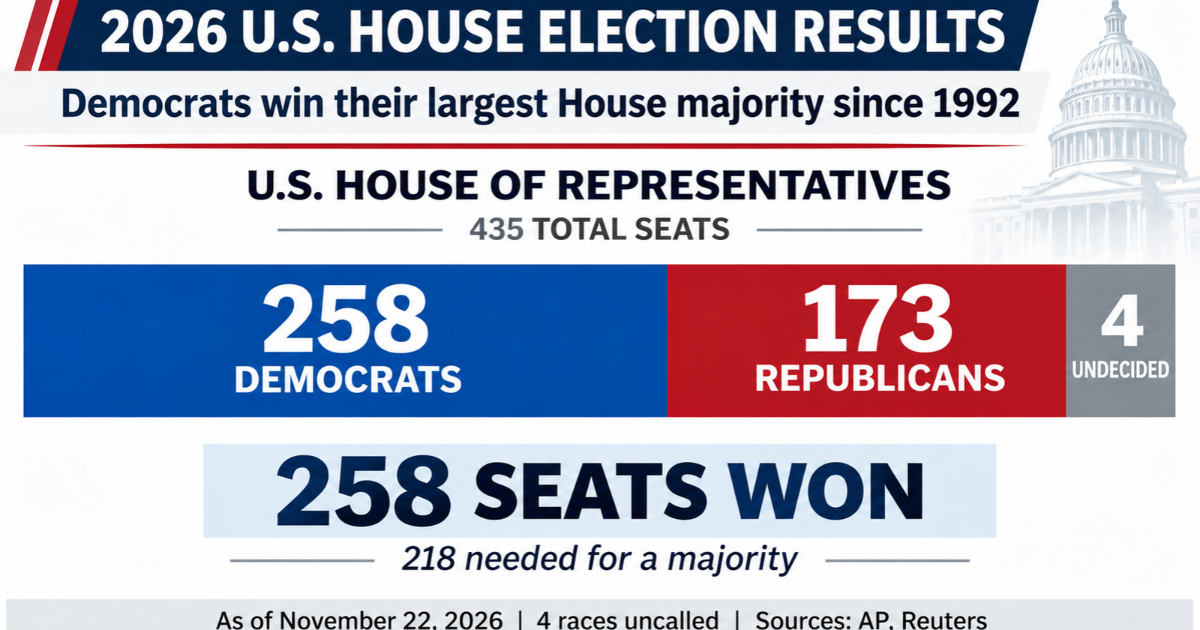
The historic Democratic victory, the largest House election result since 1992, gives the party sweeping new power in Congress as President Donald Trump prepares to face two years of divided government.
WASHINGTON, D.C. — November 22, 2026 — Democrats have secured at least 258 seats in the U.S. House of Representatives, achieving the largest House majority won by either political party in a national election this century and dramatically reshaping the balance of power in Washington.
The milestone came Sunday when Democrat Chuck Hubbard defeated longtime Republican Representative Virginia Foxx in North Carolina’s 5th Congressional District following a recount.
His victory brought the Democratic total to 258 seats, far beyond the 218 needed for a majority in the 435-member House.
Republicans have won at least 173 seats, with four races still unresolved.
The result represents the Democrats’ strongest House performance since 1992 and sets the stage for a major confrontation between Congress and President Donald Trump’s administration.
A Historic Political Shift
Democrats have gained a net 44 House seats in the November 3 midterm elections, surpassing the 40-seat gain they achieved during Trump’s first presidency in 2018.
Their victory reaches well beyond traditional Democratic strongholds. Republican-held districts in several parts of the country changed hands, reflecting widespread voter dissatisfaction over economic conditions, the war with Iran, and the direction of the federal government.
The party’s 258-seat total also surpasses the 257 seats Democrats won in 2008, when Barack Obama was elected president.
The last comparable Democratic victory came in 1992, when the party won 258 seats during Bill Clinton’s first presidential election.
With four races still undecided, the Democratic majority could grow further.
North Carolina Delivers the Decisive Seat
The latest Democratic victory came in a district that Republicans had controlled for decades.
Chuck Hubbard defeated Virginia Foxx, an 11-term Republican congresswoman who chaired the powerful House Rules Committee.
The contest was extraordinarily close.
After a recount, Hubbard led Foxx by just 330 votes, according to the North Carolina State Board of Elections.
Foxx conceded Sunday, ending a political career in Congress that began in 2005.
Her defeat highlighted the reach of the Democratic gains, which extended into districts previously considered reliably Republican.
The victory also pushed Democrats past a symbolic threshold, securing a House majority larger than any party has won in the 21st century.
Democrats Will Control Both Chambers of Congress
The House victory is part of a broader Democratic comeback.
Democrats also secured a 56-seat majority in the 100-member Senate, giving them control of both chambers when the new Congress convenes in January 2027.
President Trump, however, will remain in the White House.
That creates divided government, with Democrats controlling Congress and Republicans holding the presidency.
The shift will significantly change how Washington operates.
Democrats will be able to determine which legislation reaches the House floor, lead congressional committees, conduct investigations, and demand testimony and documents from federal officials.
In the Senate, their majority will give them additional influence over legislation, confirmation proceedings, and congressional oversight.
However, major legislation will still require cooperation across political lines or enough votes to overcome procedural obstacles, particularly in the Senate.
Hakeem Jeffries Moves Toward House Speakership
House Democratic leader Hakeem Jeffries is positioned to become the next speaker when the new Congress meets on January 3, 2027.
If elected by the House, Jeffries would become the first Black speaker in American history.
His party’s large majority would give him considerably more flexibility than outgoing Republican Speaker Mike Johnson, whose narrow majority frequently made legislative negotiations difficult.
Jeffries has described the election as a mandate for change and has indicated that Democrats intend to move quickly on their legislative priorities.
Among the issues expected to dominate the new Congress are healthcare costs, federal spending, housing affordability, immigration policy, and oversight of the Trump administration.
Democratic lawmakers have also signaled plans to investigate several administration decisions, including federal immigration enforcement and government spending.
What the Results Mean for President Trump
The election represents a major change in Trump’s political environment.
During the previous Congress, Republicans controlled both chambers, allowing the administration to pursue much of its agenda with support from congressional leadership.
Beginning in January, that relationship will change.
Democratic committee chairs will gain investigative authority, including the power to issue subpoenas and hold hearings examining executive branch actions.
The White House will also face a Congress with greater ability to block legislative proposals, challenge spending priorities, and demand explanations from federal agencies.
At the same time, Democrats will face pressure to demonstrate that their expanded majority can deliver practical results.
Voters who supported the party in November will be watching whether its leaders can address rising living costs, healthcare expenses, and other economic concerns.
Four House Races Remain Unresolved
Although Democrats have already secured a commanding majority, the final composition of the House has not yet been determined.
Four congressional races remain outstanding, including contests in Minnesota and Tennessee and two Louisiana districts scheduled for December runoff elections.
Those results could adjust the final seat totals, but they cannot change which party will control the House.
The Democratic victory is already one of the most consequential midterm election outcomes in modern American politics.
After years of narrow congressional majorities and closely divided legislative battles, Washington is preparing for a House in which one party holds a margin of at least 85 seats over the other.
The next Congress will begin on January 3, 2027, with Democrats controlling both chambers and President Trump entering the second half of his term facing a dramatically different political landscape.
Sources: Associated Press, November 22, 2026; Reuters, November 22, 2026; The Washington Post, November 22, 2026; North Carolina State Board of Elections.
By NJ RADAR Team