


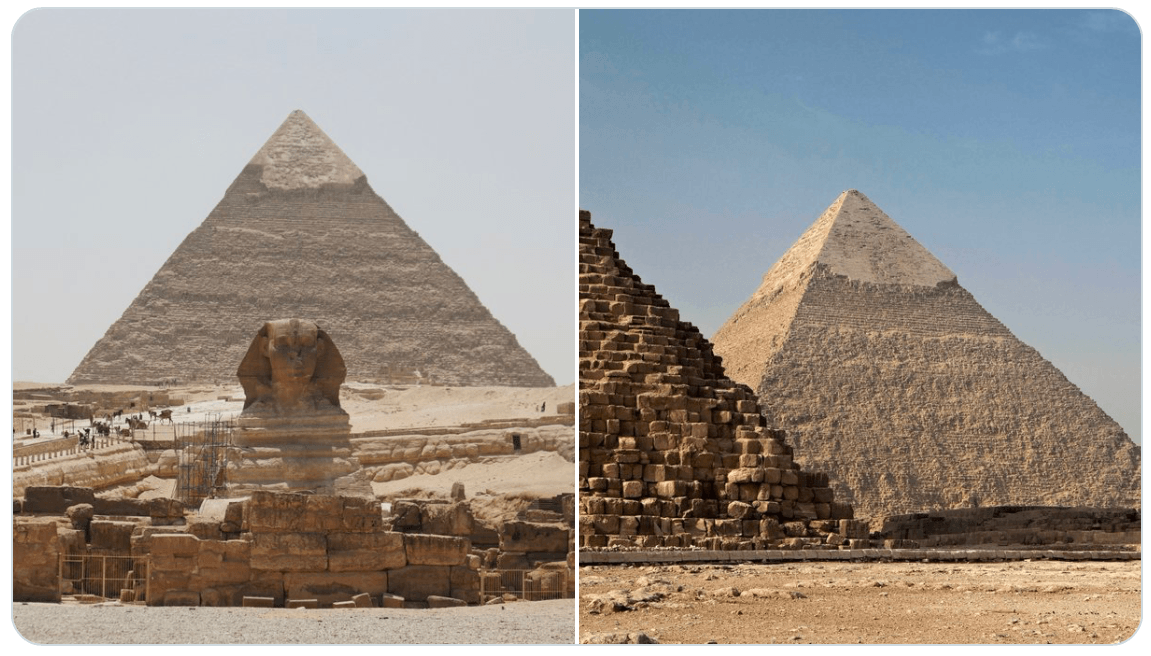
For more than 4,600 years, the Great Pyramid of Giza has withstood the test of time, wars, and earthquakes. Now, scientists believe they have uncovered one of the reasons behind its remarkable resilience.
In a new study published in Scientific Reports, researchers analyzed the vibrations of the pyramid and the surrounding ground. They found that the pyramid and the soil beneath it do not vibrate at the same frequency during seismic activity, significantly reducing the risk of resonance—a phenomenon that can severely damage structures during earthquakes.
The researchers also found that the relieving chambers above the King’s Chamber help distribute and dissipate seismic energy, while the pyramid’s massive stone construction, broad base, symmetrical design, and solid limestone foundation further enhance its structural stability.
Although there is no evidence that the ancient Egyptians intentionally designed the pyramid to withstand earthquakes, the researchers believe their exceptional engineering techniques and careful planning resulted in a structure that has proven extraordinarily durable over the millennia.
The Great Pyramid, also known as the Pyramid of Khufu, is the only surviving wonder of the ancient Seven Wonders of the World. Throughout its history, it has survived several significant earthquakes, including those in 1847 and 1992, suffering only minor damage to its outer casing while its core structure remained largely intact.
Sources:
- Scientific Reports – Architectural and Geotechnical Aspects Affecting Earthquake Resilience for the Ancient Egyptian Khufu Pyramid
- Reuters
- X (@earthcurated) – image used for illustration.