

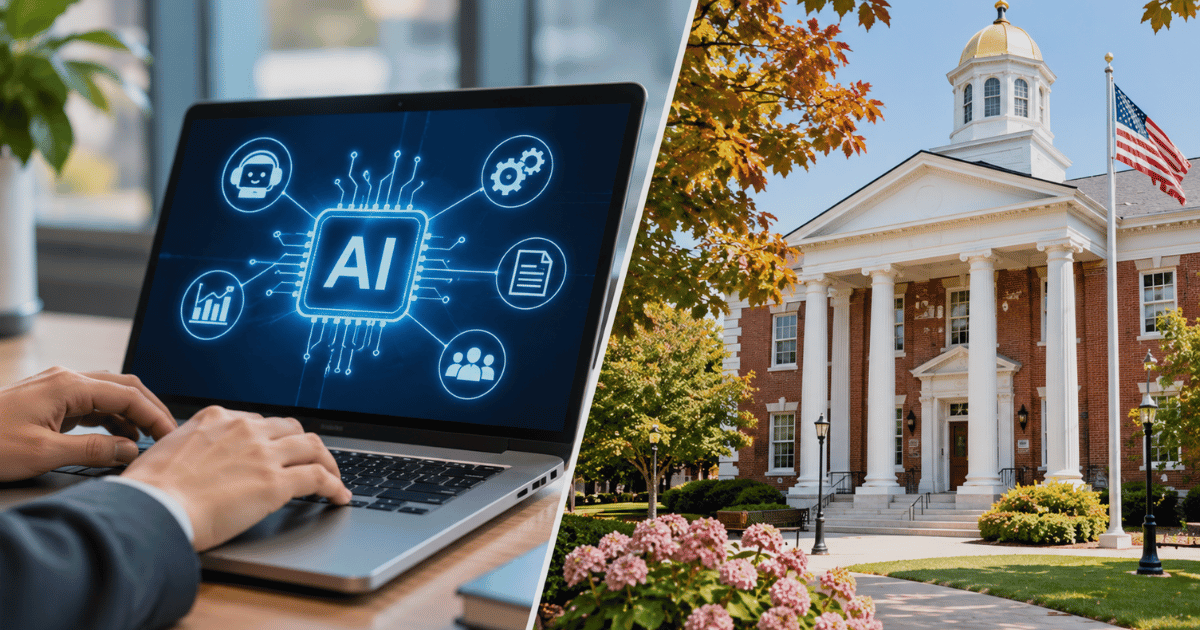
ATLANTIC CITY, NJ — November 19, 2026 — Artificial intelligence is becoming an increasingly important topic for local governments across New Jersey, and the growing interest was evident Wednesday when a presentation on AI technology attracted more attendees than the conference room could accommodate.
The session, held during the New Jersey State League of Municipalities Annual Conference at the Atlantic City Convention Center, brought together mayors, municipal administrators, clerks, finance officers and other government representatives interested in how AI could improve public services.
The presentation, titled “AI in Government: Opportunities, OPRA & Practical Guidance,” began at 9 a.m. on November 18. Attendance was so high that some participants had to be turned away.
Among the speakers was Morris County Surrogate Heather J. Darling, who shared her office’s experience using artificial intelligence to assist residents with government services. Robert McQueen and Marc Pfeiffer also participated in the discussion.
Meet Hannah, the AI Receptionist Working Around the Clock
One of the examples presented at the conference was Hannah, a multilingual AI-powered virtual receptionist introduced by the Morris County Surrogate’s Office in January 2026.
Unlike a conventional automated telephone menu, Hannah can respond to frequently asked questions, schedule appointments and help callers obtain information about probate proceedings, estate administration and related court services.
The system operates 24 hours a day, seven days a week.
During regular business hours, it provides additional support to office employees. After hours, it handles incoming inquiries when staff members are unavailable.
Hannah can also provide appointment reminders and information about documents residents need to bring when visiting the office.
The Surrogate’s Court has introduced a separate AI chatbot on its website to help residents find information online.
These services are intended to reduce routine administrative work while allowing employees to concentrate on residents who need more complicated assistance or personal attention.
Can AI Make Local Government More Accessible?
For residents, navigating government offices can be frustrating, particularly when information is difficult to locate or offices are closed outside regular business hours.
AI-powered receptionists could make certain services easier to access by answering routine questions immediately and helping residents prepare necessary paperwork before appointments.
Multilingual capabilities may also make government information more accessible to communities where English is not the primary language.
Darling said the strong attendance demonstrated the interest among local officials in using AI responsibly.
“The response at this session tells you everything — local governments across New Jersey want to know how to use AI responsibly to serve residents better,” she said.
She also emphasized that the technology is intended to support employees rather than eliminate the need for personal service, particularly when residents are dealing with sensitive family and estate matters.
Public Records and Responsible Use of AI
The conference discussion went beyond the practical benefits of artificial intelligence.
Speakers also examined how AI tools relate to New Jersey’s Open Public Records Act, commonly known as OPRA, which governs public access to government records.
As more municipal agencies begin using AI systems, questions involving data accuracy, privacy, recordkeeping and public accountability become increasingly important.
Government offices must consider how information handled or generated by AI fits within existing legal requirements.
Another challenge is ensuring that automated systems provide accurate information and that residents can still reach qualified employees when human judgment is necessary.
The session was presented in coordination with NJGMIS, an organization supporting information technology professionals in New Jersey government.
A New Direction for New Jersey Municipal Services
Morris County’s experience offers one example of how local governments are beginning to integrate artificial intelligence into everyday administrative operations.
Darling’s office introduced Hannah earlier this year and has since shared its experience with other public officials interested in similar technology.
Whether these systems become common across New Jersey municipalities will depend on implementation costs, technological reliability, privacy protections and the ability of local governments to maintain public trust.
For now, the unusually large attendance at Wednesday’s conference suggests that AI is no longer just a technology-sector discussion. It is becoming a practical question for the local officials responsible for delivering everyday public services.
Sources: WRNJ Radio (November 19, 2026) | Morris County Surrogate’s Office (January 2026) | Morris County Economic Development Alliance (January 28, 2026)
By NJ RADAR Team