


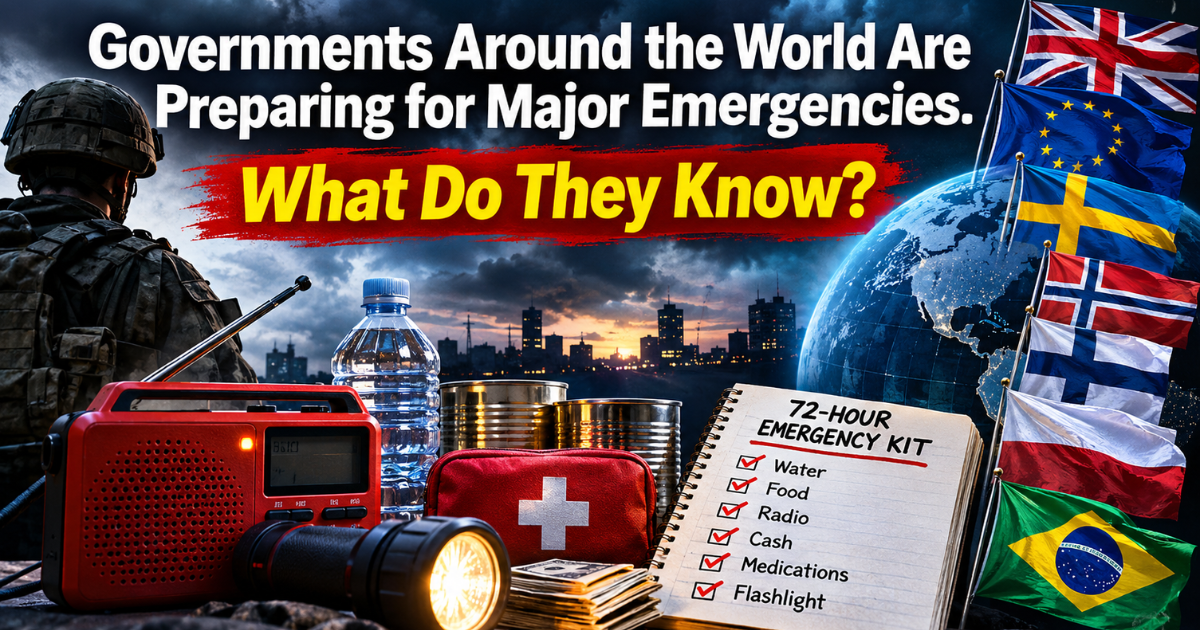
November 7, 2026 — From emergency radio studios in Britain to household survival kits in Europe, Asia, and South America, governments are paying renewed attention to a question many people rarely consider: What happens when electricity, running water, internet access, and telephone networks suddenly stop working?
Over the past several days, reports about emergency preparedness have circulated widely on social media. Some describe plans for prolonged power outages, others advise families to store food and drinking water, and several explicitly mention the possibility of war.
The developments have raised an unsettling question among people watching international tensions grow: Are governments simply preparing for emergencies, or are they responding to dangers the public does not fully understand?
A review of official government guidance shows that emergency preparedness has become a greater priority in recent years. Some countries have expanded existing recommendations, while others have introduced new instructions covering military conflict, cyberattacks, sabotage, and disruptions to essential infrastructure.
The changes are real, although they have not all happened at once.
Britain Prepares to Keep Radio Broadcasting During a Nationwide Blackout
One of the latest examples comes from the United Kingdom.
On November 7, the BBC published details of an emergency broadcasting plan known as Black Sky, designed to keep radio services operating if a major crisis disables electricity, internet connections, and telephone networks.
According to the BBC report, approximately 100 employees could operate a special emergency radio studio using secure communication systems independent of the internet.
The facility would have enough food, drinking water, and fuel to operate for at least three days without outside supplies.
Radio transmission sites would rely on backup generators and fuel reserves. Some facilities have diesel tanks capable of holding up to 40,000 liters.
The emergency broadcasts would include government instructions on drinking water, sanitation, and other essential matters. The BBC also reported that guidance has been prepared for situations in which ordinary sewage systems cannot operate.
The purpose is straightforward: even if mobile phones, television services, and internet connections fail, people with battery-powered or hand-cranked radios could continue receiving information.
The disclosure follows Britain’s renewed public campaign encouraging households to prepare for at least 72 hours without essential services.
The government’s Be Ready guidance recommends keeping drinking water, nonperishable food, medication, flashlights, batteries, and other basic supplies available.
Britain’s contingency planning is not new, but the latest reporting provides an unusually detailed look at how the country intends to communicate with millions of people during a widespread infrastructure failure.
European Governments Are Expanding Civilian Preparedness
Britain is far from alone.
In March 2025, the European Commission introduced its Preparedness Union Strategy, calling for closer cooperation between civilian authorities, emergency services, businesses, and military organizations.
Among its recommendations was a plan to help residents remain self-sufficient for at least 72 hours during a major emergency.
The strategy goes well beyond household supplies. It addresses cyberattacks, damage to critical infrastructure, disruptions to water and energy supplies, and the need for stronger coordination between civilian and military institutions.
The European Commission also called for preparedness education in schools and improved public warning systems.
The strategy reflects Europe’s changing security environment, particularly following Russia’s invasion of Ukraine in 2022.
For European governments, the threat of war is no longer treated solely as a military issue. The ability of hospitals, transportation networks, communication systems, and ordinary households to continue functioning has become part of national security planning.
Sweden, Norway and Finland Have Already Changed Their Guidance
Some of Europe’s most extensive preparedness efforts have taken place in the Nordic countries.
In November 2024, Sweden distributed an updated version of its civil defense brochure, In Case of Crisis or War, to approximately 5.2 million households.
The publication explains how residents should prepare for disrupted water supplies, power outages, communication failures, evacuation, and armed conflict.
It also advises households to maintain enough supplies to manage independently for at least one week.
Norway made a similar change in May 2024, increasing its recommended household preparedness period from three days to seven.
Norwegian authorities specifically identify extreme weather, accidents, sabotage, and war among the events that could interrupt electricity, drinking water, sewage systems, internet access, and electronic payments.
Finland published a new national preparedness guide in November 2024. It includes instructions for extended power outages, interruptions in telecommunications, cyber threats, and military conflict.
These governments are not issuing identical warnings, but they share a common concern: modern societies depend heavily on systems that can fail simultaneously.
Poland’s New Safety Guide Explicitly Includes War
Poland has taken particularly direct steps to prepare its population.
In August 2025, the Polish government introduced a national safety guide developed by its defense ministry, interior ministry, and government security center.
The handbook covers evacuation procedures, emergency supplies, sheltering, warning sirens, cyberattacks, and what residents should do during military threats.
It also addresses chemical, biological, radiological, and nuclear emergencies.
Polish officials have linked the updated guidance to the experience of the war in neighboring Ukraine and the changing security environment in Europe.
The government has made the guide available online and arranged for printed copies to reach households.
While emergency preparedness materials existed before, the new publication places greater emphasis on the possibility that civilians may have to function for some time without normal public services during an armed conflict.
Brazil Joins the Latest Wave of Emergency Warnings
On November 6, Brazil’s National Civil Defense agency encouraged families to prepare emergency kits containing enough basic supplies for 72 hours.
The recommendation received widespread attention as severe weather warnings affected southern Brazil.
Reports indicated that hundreds of municipalities in Paraná, Santa Catarina, and Rio Grande do Sul faced dangerous storm conditions, with forecasts of heavy rainfall, powerful winds, hail, and possible flooding.
Brazilian authorities warned that major disasters can interrupt electricity, drinking water, and communications, while damaged roads may prevent emergency responders from reaching affected communities immediately.
The recommended supplies include water, food, medications, flashlights, portable radios, documents, and essential personal items.
Unlike the military preparedness campaigns in parts of Europe, Brazil’s latest warnings are primarily connected to natural disasters and infrastructure disruptions.
Nevertheless, the basic message is the same: households should be capable of meeting their most immediate needs until emergency services can reach them.
Why Are So Many Countries Recommending 72 Hours?
The three-day recommendation is not a new international standard introduced in November 2026.
Emergency management agencies have used similar advice for years.
The United States Federal Emergency Management Agency, or FEMA, has long encouraged families to keep emergency supplies that could sustain them for several days.
Japan’s disaster preparedness guidance recommends at least three days of supplies, preferably enough for a week, reflecting the country’s exposure to earthquakes, tsunamis, and other natural hazards.
Finland recommends at least 72 hours, while Norway and Sweden have moved toward seven-day preparedness.
The reasoning is practical. During a major disaster, rescue services may need time to restore electricity, clear roads, repair water systems, and reach people requiring urgent assistance.
Families able to manage temporarily without outside help place less immediate pressure on emergency services.
But the increasingly frequent references to war, cyberattacks, and communications failures indicate that governments are also considering threats beyond traditional natural disasters.
What Has Changed Since the War in Ukraine?
Emergency preparedness was part of government planning long before the current international conflicts.
During the Cold War, many countries maintained civil defense programs, public shelters, emergency broadcasting systems, and instructions for surviving nuclear attacks.
Those programs were gradually reduced in several countries after the Cold War ended.
Russia’s invasion of Ukraine brought renewed attention to the vulnerability of civilian infrastructure.
Attacks on power plants, electrical grids, water facilities, and communication networks demonstrated how quickly essential services could be disrupted during war.
Cyberattacks and sabotage have added another dimension to these concerns.
A widespread power failure can affect far more than household lighting. It can disrupt water pumping stations, fuel distribution, banking systems, transportation, hospitals, supermarkets, and telecommunications.
Without functioning electronic payment systems, even people with money in their bank accounts may be unable to purchase basic necessities.
These interconnected risks help explain why official preparedness guidance increasingly includes cash, battery-powered radios, printed emergency contacts, and alternative sources of lighting.
Are Governments Preparing for a Specific Catastrophe?
The growing number of emergency preparedness announcements has fueled speculation online that governments possess information about an approaching international disaster.
Some viral posts have presented recommendations from different countries as if they were issued simultaneously in response to a single undisclosed threat.
The official records tell a more complicated story.
Norway expanded its guidance in May 2024. Sweden and Finland issued updated materials later that year. The European Commission adopted its preparedness strategy in March 2025. Poland published its new handbook in August 2025, while Britain’s latest public campaign and emergency broadcasting coverage appeared in 2026.
These dates show a gradual shift in government priorities rather than a sudden, coordinated global alert.
There is also an important distinction between preparing for a possible event and predicting that it will happen.
A plan designed to maintain radio broadcasts during a nationwide blackout does not establish that a blackout is imminent. Similarly, a recommendation to keep food and water at home is not evidence that authorities expect war to begin within days.
What the documented changes do establish is that many governments now consider prolonged infrastructure disruptions serious enough to warrant greater public attention.
What Does This Mean for Americans?
The United States already has an established emergency preparedness system through FEMA, state emergency management agencies, and local authorities.
FEMA recommends keeping water, nonperishable food, flashlights, first-aid supplies, medications, and a battery-powered or hand-cranked radio available.
Residents are also encouraged to prepare emergency contact information and consider how they would communicate if cellular networks stopped working.
For New Jersey, emergency preparedness is particularly relevant because of the state’s dense population, extensive transportation network, coastal exposure, and dependence on regional electrical and communications infrastructure.
Hurricanes, severe storms, flooding, and major power outages have previously demonstrated how quickly ordinary routines can be disrupted.
Hurricane Sandy in 2012 remains one of the clearest examples. Millions of residents across the region lost electricity, and some communities experienced prolonged interruptions to transportation, fuel supplies, and communications.
A household emergency plan may be useful whether the cause is a hurricane, a cyberattack, an extended power failure, or another major disruption.
A Changing Approach to Public Safety
What stands out in the recent government announcements is not simply the recommendation to store water and canned food.
It is the broader recognition that civilian preparedness has become closely connected to national security.
Governments are increasingly asking how societies would function if the systems supporting everyday life stopped working for several days.
The renewed attention to emergency broadcasting, household reserves, civil defense, and infrastructure protection reflects risks that officials have been discussing and planning for over several years.
There is no verified evidence that the countries issuing these recommendations are responding to a single undisclosed catastrophe.
But their changing guidance does reveal something important: preparing civilians for serious disruption is no longer a subject confined to military planners and emergency specialists.
It is becoming part of ordinary public policy, with households themselves expected to play a role.
Sources: BBC News, UK Government Be Ready Campaign, European Commission, Norwegian Directorate for Civil Protection, Swedish Civil Contingencies Agency, Finnish Government Suomi.fi, Polish Government, Brazilian National Civil Defense, FEMA.
By NJ RADAR Team