


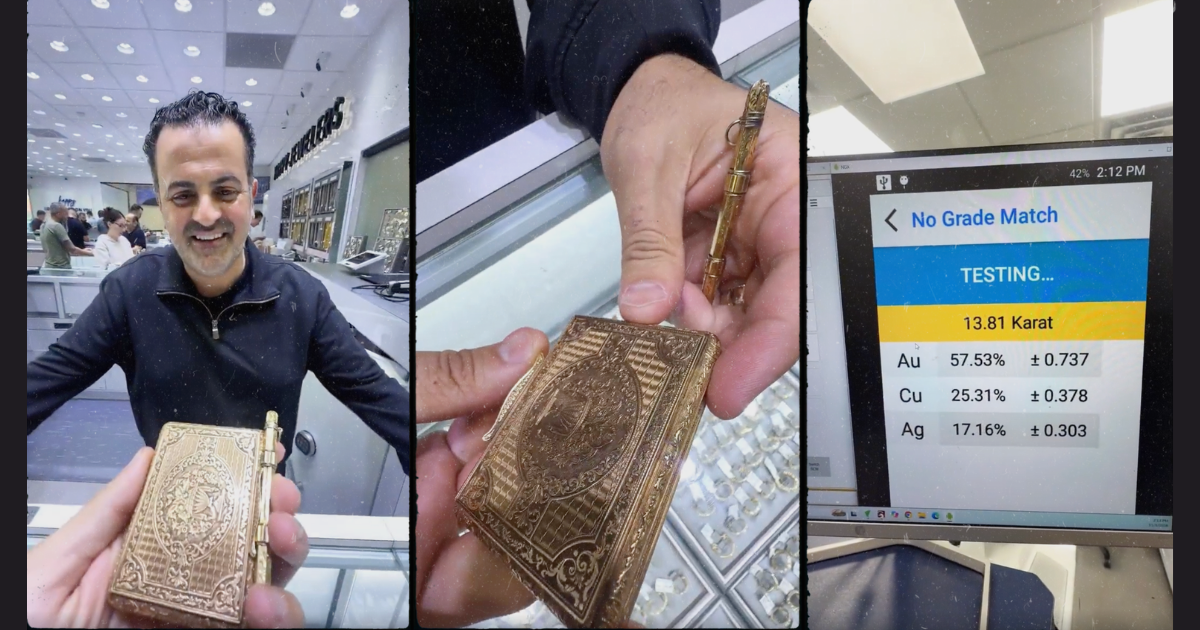
November 7, 2026 — A flea market shopper reportedly turned a $120 purchase into $9,000 after discovering that an old object was made of gold.
The unusual transaction attracted attention after a video shared by Bulvarpress circulated on X and was later reposted by Defence Index. Turkish news outlet Haberler also reported the story, describing a secondhand purchase that allegedly proved far more valuable than its original price suggested.
According to the report, the buyer purchased an unidentified object at a flea market and later discovered that it contained gold. A jeweler reportedly agreed to buy it for $9,000 — 75 times the original purchase price.
That would leave the shopper with a gain of $8,880 before expenses.
The story has an intriguing gap, however. Neither the buyer’s identity nor the location of the flea market was disclosed, and the reports do not identify the object itself. NJ Radar Online could not independently verify the transaction.
How Can an Ordinary-Looking Object Be Worth Thousands?
Gold is not always easy to recognize, especially when it appears in older jewelry, decorative objects, or items that have spent decades in storage.
A scratched, tarnished, or damaged piece may look unremarkable to someone unfamiliar with precious metals. Some gold objects also feature small markings that reveal their composition, but these can be difficult to read without magnification.
Gold purity is commonly expressed in karats. Pure gold is classified as 24 karats, while 18-karat gold contains 75% gold and 14-karat gold contains approximately 58.3%.
The difference matters when determining an object’s value.
Two pieces of identical weight may be worth considerably different amounts depending on their gold content. A solid gold object can also be much more valuable than one made of gold-plated metal.
Professional jewelers use several methods to assess precious metals, including electronic testing and X-ray fluorescence analysis. These tests help establish whether an object contains gold and, in many cases, estimate its purity.
For an item reportedly worth $9,000, both its weight and gold content would be important in understanding the price.
Was the Value in the Gold or the Object Itself?
There is another possibility: the jeweler may have valued the piece for reasons beyond the metal it contained.
Antique jewelry, collectible ornaments, and objects produced by recognized makers sometimes command prices above their intrinsic gold value.
A rare design or historical significance can attract collectors willing to pay more than the price of the precious metal alone.
For example, an antique gold brooch may have one value if sold for melting and another if preserved as a collectible piece. The difference depends on its maker, condition, rarity, and demand among buyers.
The published account does not explain whether the reported $9,000 reflected the object’s gold content, collectible value, or a combination of both.
Why Flea Markets Can Hold Unexpected Finds
Flea markets bring together goods from estate sales, household collections, storage clearances, and private sellers. Objects sometimes arrive without documentation or any reliable history of ownership.
For collectors, that uncertainty is part of the appeal.
An unfamiliar hallmark, an unusual design, or a material that has been mistaken for something inexpensive can make a closer examination worthwhile.
But finding an overlooked treasure is far from guaranteed. Brass, gold-plated jewelry, and other metals can resemble solid gold, while apparently old objects are not necessarily rare or valuable.
Anyone who suspects a secondhand purchase contains precious metal can seek an assessment from a qualified jeweler or independent appraiser before deciding whether to sell it.
The appraisal should distinguish between the item’s metal value and any additional value as jewelry or a collectible.
A Remarkable Return, With Details Still Missing
The reported sale has captured attention because of the enormous difference between the purchase price and what the jeweler allegedly paid.
For someone browsing a flea market, spending $120 and receiving $9,000 would be an extraordinary outcome.
Whether the object was an overlooked piece of jewelry, a decorative antique, or something entirely different remains unknown.
What makes the story interesting is also what leaves it unresolved: a seemingly inexpensive object, an unexpectedly high valuation, and no clear explanation of how its true value escaped notice in the first place.
Sources: Haberler, Defence Index / X, Bulvarpress / X.
By NJ RADAR Team