


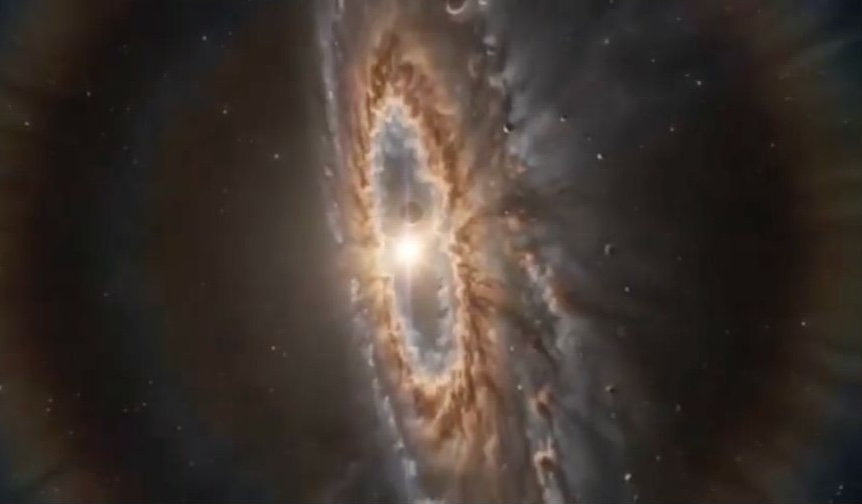
Astronomers using NASA’s James Webb Space Telescope have discovered a giant planet that had been hiding for years inside the Beta Pictoris system — one of the most extensively studied planetary systems in astronomy.
The young, nearby star Beta Pictoris, located about 63 light-years from Earth, was already known to host two giant planets: Beta Pictoris b, one of the first exoplanets ever directly imaged, and Beta Pictoris c. Now astronomers have identified a third world — Beta Pictoris d, a giant planet estimated to be between two and four times the mass of Jupiter.
What makes this discovery particularly interesting is how it was made. Unlike its two “sibling” planets, which were discovered through direct imaging, Beta Pictoris d was detected through the chemical fingerprint of its atmosphere, revealing traces of carbon monoxide, water vapor, and methane hidden within the bright debris disk surrounding the star.
Astronomers weren’t even searching for a new planet. The team was using Webb’s Near-Infrared Spectrograph (NIRSpec) to study the atmosphere of the already-known planet Beta Pictoris b when an unexpected signal appeared in the data.
“We were not looking for a new planet,” said Aidan Gibbs, lead author of the study and a researcher at the University of California, San Diego. “We were trying to understand one we already knew existed. Then this telltale signal appeared in the data where we did not expect it.”
With the discovery of this third planet, Beta Pictoris becomes only the second known planetary system in the Milky Way with at least three directly imaged planets.
The star is only about 23 million years old — a mere infant by astronomical standards — giving scientists a rare opportunity to observe how young planets interact with the leftover material from their own formation in a system that, it turns out, is still full of surprises.
Researchers say continued observations with the James Webb Space Telescope will help refine the planet’s orbit, temperature, and atmospheric composition, while demonstrating a powerful new way to detect planets that remain hidden inside dusty planetary systems.
Sources: NASA Science, The Astrophysical Journal Letters, STScI, ScienceDaily. Story tip: @Stellarixorine on X.