


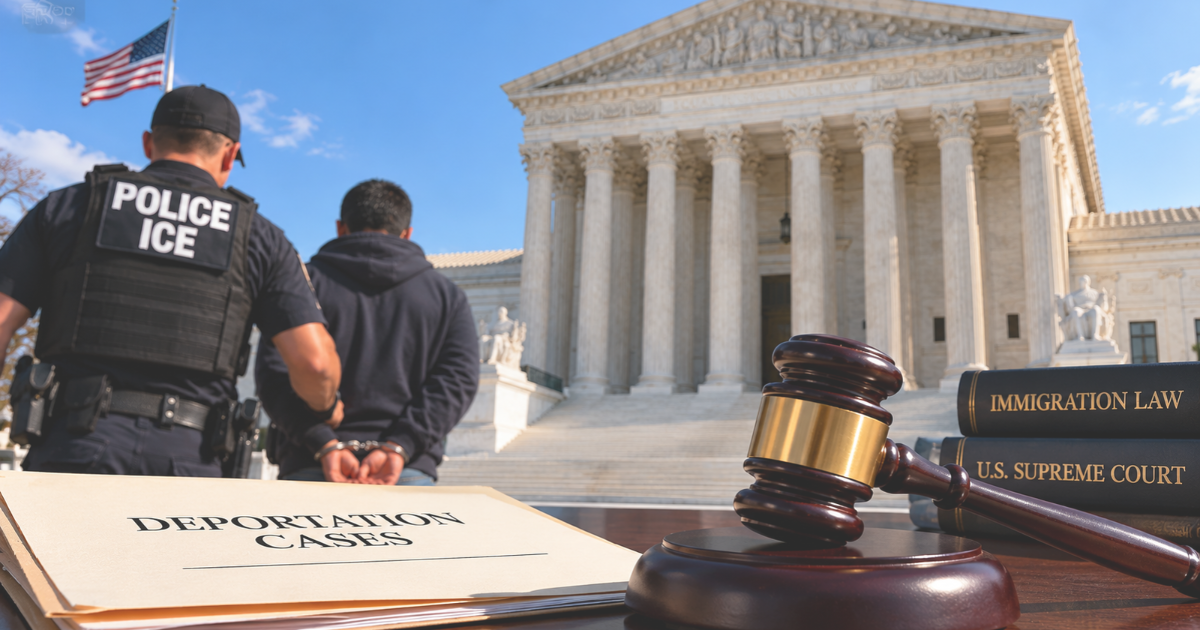
WASHINGTON, October 27, 2026 — The U.S. Supreme Court on Tuesday declined to restore immigration judges’ authority to temporarily set aside certain deportation cases, leaving in place a restriction supported by the Trump administration and the state of Texas.
The decision limits a longstanding procedure that allowed immigration judges to temporarily remove cases from their active schedules while immigrants pursued other legal avenues to remain in the United States.
The ruling could have significant consequences for immigrants facing deportation, including those awaiting decisions on separate immigration applications.
What Did the Supreme Court Decide?
The justices rejected an emergency request from three American cities — Baltimore, Maryland; Columbus, Ohio; and New Haven, Connecticut — along with immigrant legal advocacy organization Centro Legal de la Raza.
The applicants sought to suspend a federal court order blocking a 2024 Biden administration regulation that authorized immigration judges to use a procedure known as administrative closure.
The Supreme Court issued a brief, one-sentence order without explaining its reasoning. No justice publicly dissented.
The underlying legal dispute remains ongoing, meaning Tuesday’s decision was not a final ruling on every question surrounding the regulation.
What Is Administrative Closure?
Administrative closure allowed immigration judges to temporarily remove deportation cases from their active calendars without formally dismissing them.
For example, an immigrant facing deportation might also have a pending application for lawful immigration status.
Under the previous regulation, a judge could temporarily set aside the deportation case while the separate immigration application was being considered.
The case could later be reopened if necessary.
The procedure was also used in cases involving crime victims and vulnerable young immigrants pursuing legal protections.
According to government statistics cited in reporting on the dispute, approximately 360,000 immigration cases have received administrative closure since 1990.
How Did the Dispute Begin?
The practice has been contested for years.
During President Donald Trump’s first administration, immigration authorities attempted to restrict immigration judges’ use of administrative closure.
The Biden administration subsequently adopted regulations in 2024 recognizing judges’ authority to use the procedure.
After Trump returned to office, his administration stopped defending the regulation.
Texas challenged the rule in federal court, arguing that administrative closure allowed immigration cases to remain unresolved for extended periods.
In June 2026, Texas and the Trump administration agreed to a court judgment blocking the regulation.
Immigrant advocacy organizations and several cities challenged that outcome, arguing that the agreement eliminated an important legal procedure without sufficient opportunity for affected parties to defend it.
Their request eventually reached the Supreme Court.
What Does the Decision Mean for Immigrants?
Tuesday’s decision leaves the restriction on administrative closure in effect.
As a result, immigration judges have lost an important procedural tool for temporarily setting aside deportation proceedings.
Immigrants awaiting decisions on other applications may face greater uncertainty because their deportation proceedings can continue while those applications remain unresolved.
However, the decision does not automatically order deportations, eliminate all forms of immigration relief, or prevent judges from granting other legally authorized postponements.
Each case continues to depend on the individual’s circumstances and applicable immigration law.
Different Views on the Decision
Supporters of the restriction argue that administrative closure can leave deportation cases unresolved indefinitely and interfere with immigration enforcement.
Texas maintained that the practice had expanded significantly during the Biden administration.
Opponents argue that administrative closure helps immigration courts manage their workloads and allows vulnerable individuals to pursue legal protections without simultaneously facing active deportation proceedings.
The cities challenging the restriction also expressed concerns that the change could discourage immigrant crime victims from cooperating with law enforcement.
The Justice Department argued that the cities lacked the legal standing necessary to challenge the agreement and had not demonstrated sufficient immediate harm.
Why This Matters for New Jersey
Although the Supreme Court case did not originate in New Jersey, the restriction applies to the federal immigration court system and therefore may affect immigration proceedings involving New Jersey residents.
Immigrants with pending deportation proceedings and separate applications for legal status may need to consider how the restriction affects their cases.
The decision does not change the legal status of every immigrant or green card holder, but it does remove a procedure that previously offered flexibility in certain cases.
What Happens Next?
The underlying litigation may continue, but the Supreme Court’s refusal to intervene leaves the existing restriction in force.
The justices did not provide an explanation for declining emergency relief, and their order should not be interpreted as a comprehensive ruling on all immigration judges’ authority.
For immigrants facing deportation, the immediate consequence is clear: a previously available way to temporarily set aside certain cases remains blocked, even when other immigration matters have not yet been resolved.
Sources: Reuters, October 27, 2026; Associated Press, October 27, 2026; U.S. Supreme Court filings.
By NJ RADAR Team