


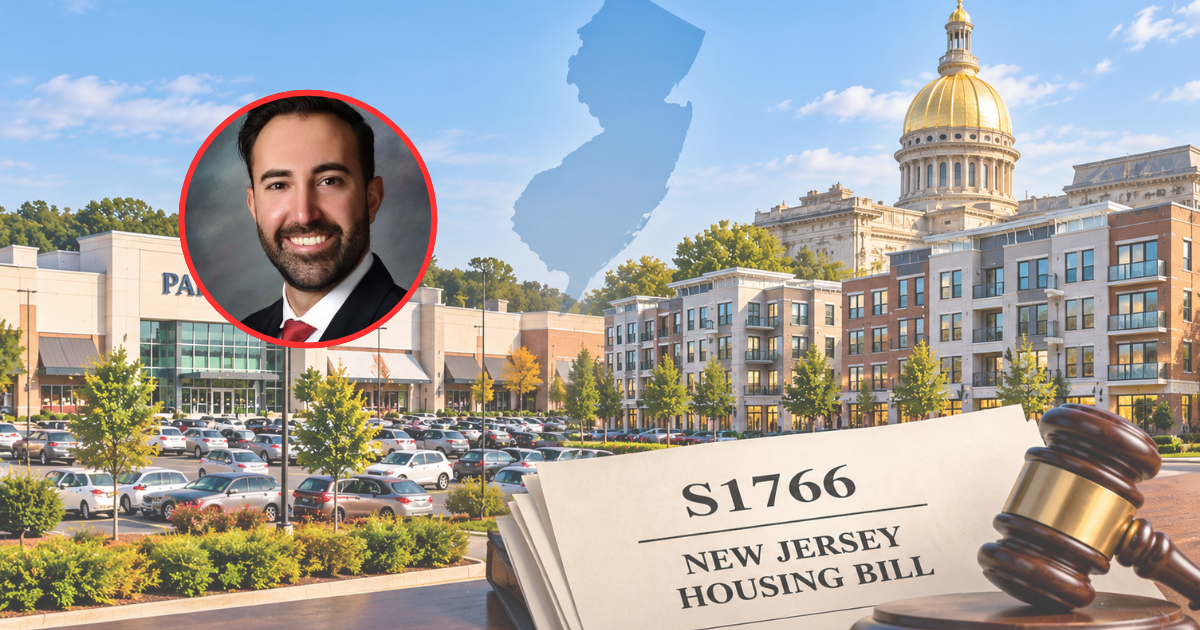
The proposed New Jersey housing law raises an important question: Who should control development decisions, the state or local governments? Both approaches have advantages, but both carry risks of favoritism, political influence, and abuse of power. Transparency, accountability, and public oversight are essential to ensure that decisions serve the interests of residents rather than a select few.
October 22, 2026
A proposed New Jersey law allowing struggling shopping centers and office parks to be converted into housing has sparked a dispute between Paramus Mayor Chris DiPiazza and state lawmakers over who should control local development decisions.
Paramus Mayor Chris DiPiazza has strongly criticized a proposed state law that could allow developers to build residential housing on certain commercial properties, even when existing municipal zoning rules do not permit it.
The legislation, Senate Bill S1766, is intended to encourage redevelopment of vacant or financially struggling shopping centers and office parks throughout New Jersey.
However, DiPiazza argues that decisions about land use should remain in the hands of local governments.
“Who the heck is Senator Troy Singleton and who the hell is he to tell local municipalities how to zone?” DiPiazza wrote in a Facebook post Wednesday.
His comments were directed at Democratic state Senator Troy Singleton, one of the bill’s sponsors.
What Would the New Law Allow?
Under the proposed legislation, certain large commercial properties could be redeveloped into mixed-use projects combining residential housing with businesses or other permitted uses.
Eligible properties would include office parks of at least 50,000 square feet and qualifying retail centers with large commercial spaces.
Properties would also need to meet specific financial or vacancy requirements.
At least 20% of the residential units in qualifying projects would have to be designated as affordable housing.
The legislation would allow certain developments to move forward without obtaining the usual local zoning variance, although other development standards and approvals would still apply.
Paramus Mayor Defends Local Control
DiPiazza believes municipal officials are better positioned to determine how development affects their communities.
“Republican or Democrat, local officials know their town the best,” he told News 12.
He raised concerns about traffic congestion, neighborhood character, school capacity, and the potential consequences of allowing state lawmakers to override local land-use decisions.
Paramus is home to several major shopping centers, making redevelopment policies particularly relevant to the Bergen County municipality.
Senator Says New Jersey Needs More Housing
Senator Singleton defended the proposal, arguing that New Jersey faces a serious housing shortage while many commercial properties remain vacant or underused.
He believes converting struggling shopping centers and office parks into mixed-use developments could create additional housing opportunities without requiring development on previously undeveloped land.
Singleton acknowledged concerns about local control but said communities must also address changing economic conditions and growing housing needs.
Municipalities Raise Concerns
The New Jersey State League of Municipalities has also opposed the bill, warning that it would weaken local planning authority and bypass established zoning procedures.
The organization urged municipal officials to contact state lawmakers ahead of the Senate’s scheduled consideration of the legislation on Thursday, October 22.
Supporters view the proposal as an opportunity to transform declining commercial properties into productive spaces while expanding affordable housing.
Opponents argue that municipalities should retain the authority to determine where housing belongs and how new construction affects surrounding neighborhoods.
Local Control, Political Influence, and Transparency
While Mayor Chris DiPiazza argues that municipalities should maintain control over local development, the debate raises another important question: Can too much power at the local level create opportunities for favoritism and political influence?
Local governments have considerable authority over zoning decisions, development approvals, and land use. When these decisions lack transparency, concerns may arise about whether all developers are treated equally or whether personal relationships and political connections influence the process.
Establishing clearer statewide standards could reduce opportunities for arbitrary decisions and make the approval process more consistent across municipalities. It could also prevent local authorities from unnecessarily blocking projects that meet established legal requirements.
However, transferring more authority to the state does not automatically eliminate the risk of favoritism or improper influence. Transparency, public participation, and independent oversight remain essential at every level of government.
Opponents of the bill also raise legitimate concerns that statewide rules could weaken residents’ influence over decisions affecting their neighborhoods, traffic, schools, and infrastructure.
Ultimately, the debate should not be limited to whether the state or municipalities have greater power. The more important question is how to ensure that development decisions serve the public interest rather than the interests of a small number of politically connected individuals.
The Future of New Jersey’s Communities
As New Jersey faces growing housing demands, the challenge is to balance the need for new homes with the interests of local communities.
Whether decisions are made at the state or municipal level, transparency, accountability, and public oversight must remain essential. Residents deserve a fair process that protects their communities and ensures development decisions serve the public interest.
Sources: News 12 New Jersey, October 21, 2026; New Jersey Legislature, Senate Bill S1766; New Jersey State League of Municipalities, October 21, 2026.
By NJ RADAR Team