


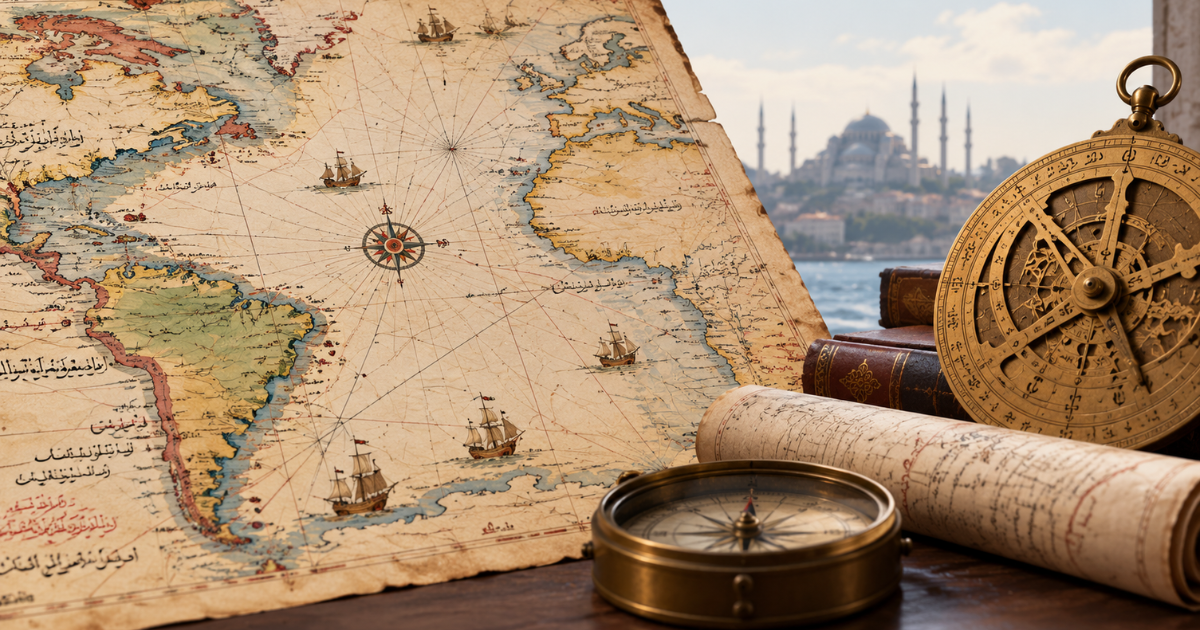
Why did the Ottomans, who possessed enormous military power, a powerful navy, and great wealth, not set out for America?
The Discovery of America and the Race for the New World
When Christopher Columbus reached the American continent in 1492, he believed he had discovered a western sea route to India. However, it soon became clear that this was an entirely different part of the world, previously unknown to Europeans.
After Columbus’s voyages, Portugal sent an expedition in 1501 that included the Italian navigator Amerigo Vespucci. While exploring the coasts of South America, Vespucci contributed to the realization that Columbus had not reached Asia, but that this was a new continent. In 1507, the continent was named America in his honor.
The discovery of new lands sparked intense competition among European powers. Portugal and the Spanish kingdoms were among the first to embark on conquest and colonization, followed by England, France, and the Netherlands, which sent their explorers, colonizers, and military expeditions in an effort to conquer as much of the American continent as possible.
Over the following centuries, people from different parts of the world began arriving in America. Some came in search of a better life, land, and new opportunities, while millions of Africans were forcibly brought there through the slave trade. All of this took place on continents where Indigenous peoples had lived for thousands of years before the arrival of Europeans.
But while European powers sought to conquer their share of the New World, one of the largest and most powerful states of that time remained outside this race, the Ottoman Empire.
Why the Ottoman Empire Stayed Away from America
At the turn of the 15th and 16th centuries, particularly during the reigns of Selim I and Suleiman the Magnificent, the Ottoman Empire was at the height of its power. At the very time when the Spanish and Portuguese were discovering new maritime routes and expanding into the Americas, an intriguing question arises: Why did the Ottomans never send expeditions across the Atlantic and attempt to claim part of the newly discovered lands?
The answer is not that the Ottomans were unaware of the New World. America was known, at least to some Ottoman scholars and cartographers. The famous 1513 map by Piri Reis included parts of the American coastline, and the idea of a “Vilayet of Antilia,” or a possible future Ottoman province in the Antilles, has also been mentioned in discussions of Ottoman ambitions. In other words, information and interest existed, but the empire’s priorities lay elsewhere.
The Ottoman Empire was a major land and naval power, with a formidable fleet that dominated the eastern Mediterranean and operated in the Red Sea and the Indian Ocean. Its strength rested on control of important overland trade routes between Europe and Asia, a powerful army, and naval supremacy. European overseas exploration was partly a response to Ottoman control of major trade routes, while the Ottomans themselves had less incentive to seek alternative routes across the Atlantic.
Moreover, the empire lacked a fleet specifically equipped for transatlantic expeditions and had no logistical bases along the Atlantic coast. Spanish and Portuguese fortifications near Gibraltar and along the North African coast created additional obstacles to Ottoman expansion into the open Atlantic.
Ibrahim Pasha and the Possibility of an American Expedition
In this context, Ibrahim Pasha, the grand vizier of Suleiman the Magnificent, is sometimes mentioned. Historical accounts and traditions have linked him to discussions about whether the empire should expand westward and participate in the emerging transoceanic world. Some accounts suggest that Ibrahim Pasha supported such a direction, while others describe a more cautious attitude, including the view that the empire had “no business in distant seas.”
Whatever the case, the possibility of an Ottoman expedition to the Americas has been discussed in historical narratives, although documentary evidence of a concrete plan remains uncertain. The idea is sometimes described as having been abandoned following Ibrahim Pasha’s death in 1536. Ottoman attention remained focused on Europe, the Mediterranean, and increasingly the East.
The central reason the empire missed the opportunity to establish a presence in the Americas lay in its strategic orientation. Ottoman military campaigns pushed deep into Central Europe, reaching the gates of Vienna. At the same time, the empire became increasingly involved in exhausting conflicts with the Safavid Empire, centered in what is now Iran.
This rivalry was not merely territorial but also ideological: the Sunni Ottoman Empire confronted the Shiite Safavid Empire. The wars continued for decades, consuming military resources and placing enormous pressure on the imperial treasury. Ottoman armies operated far from their supply bases, often across the difficult terrain of the Iranian plateau. Although Ottoman forces repeatedly captured Tabriz, they struggled to maintain permanent control of the city.
As a result, the empire faced a form of pressure on two major fronts. Fighting in the East diverted manpower, financial resources, and political attention from European campaigns and maritime ambitions.
The prolonged wars with Iran weakened the economy, contributed to internal unrest, and gradually consumed imperial resources. In this sense, the confrontation with the Safavids can be regarded as one of the important factors contributing to the Ottoman Empire’s long-term weakening.
Of course, the decline of the Ottoman Empire was a complex, centuries-long process involving internal political crises, economic transformations, the growing strength of European states, and the gradual shift of global commerce toward overseas maritime routes.
Nevertheless, the wars with the Safavids were a significant factor in draining Ottoman resources at a time when the empire might otherwise have directed more of its power toward different strategic ambitions.
The historical contrast is striking: while Spain and Portugal were building overseas empires and opening new transatlantic trade networks, the Ottomans continued investing enormous resources in territorial struggles across Europe and the Middle East.
In conclusion, the Ottoman Empire did not launch expeditions to the Americas because its strategic priorities centered on continental expansion, the Mediterranean, and the Indian Ocean. It lacked a dedicated Atlantic expeditionary fleet and had little incentive to bypass the trade routes it already controlled. Accounts of possible American ambitions remained marginal and never developed into a sustained imperial policy.
Instead, the empire committed substantial resources to prolonged wars with Iran, creating pressure on multiple fronts and contributing to the gradual erosion of its power.
The Ottoman Empire did not collapse because it failed to reach America, nor can its eventual decline be attributed to its wars with Iran alone. But its strategic choices during this decisive period of global transformation helped shape the different historical paths of the Ottoman and emerging European overseas empires.
Sources: Encyclopaedia Britannica | Library of Congress | The Cambridge History of Turkey | Iranian Studies | Encyclopaedia Iranica
By Aziza Smailovic