


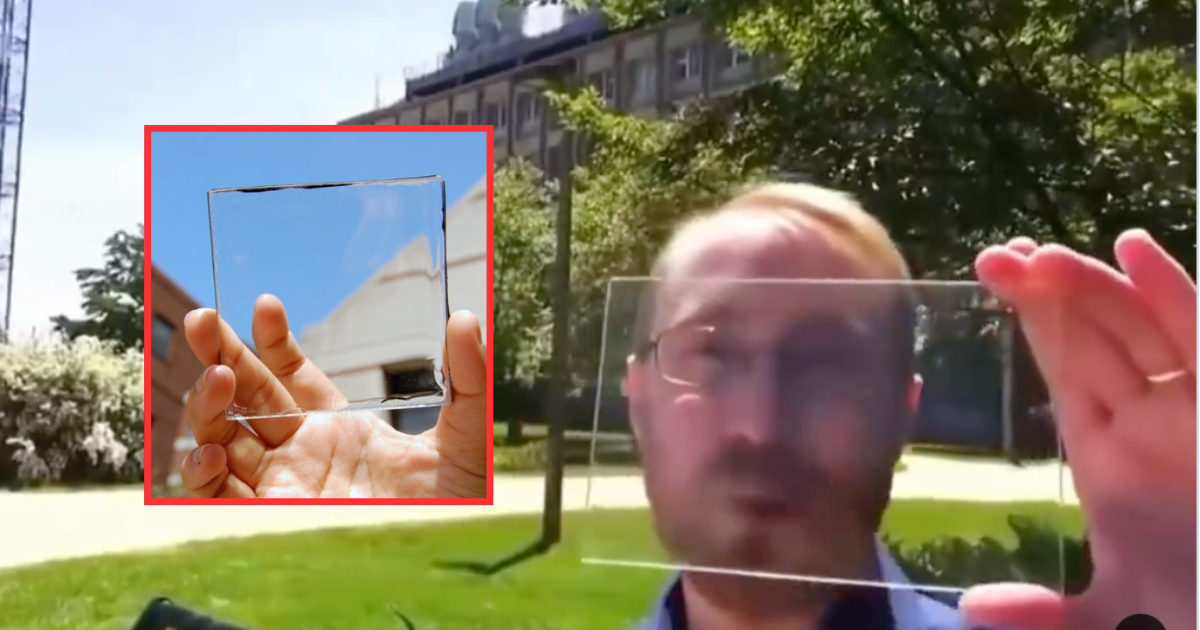
Researchers at Michigan State University have developed transparent solar technology that allows ordinary-looking glass to generate electricity, opening new possibilities for buildings, offices, and urban energy production.
MICHIGAN — Imagine looking through an ordinary window while that same piece of glass quietly generates electricity from sunlight.
What sounds like science fiction has already been demonstrated by researchers at Michigan State University, where Professor Richard Lunt and his colleagues have pioneered technology that turns transparent glass into an energy-generating surface.
Unlike traditional solar panels, which are usually dark and visibly installed on rooftops, these innovative solar panels allow visible light to pass through while collecting energy from portions of sunlight that the human eye cannot see.
The development could eventually transform millions of windows into sources of renewable electricity.
How Can a Transparent Window Produce Electricity?
Traditional solar panels absorb sunlight and convert it into electricity. Because they capture a significant portion of visible light, their surfaces are generally dark.
Transparent solar technology takes a different approach.
The materials developed by Lunt’s research team selectively absorb ultraviolet and near-infrared wavelengths while allowing much of the visible light to pass through.
These invisible portions of sunlight can be harvested and converted into electrical energy.
As a result, a window can remain nearly transparent while generating electricity.
The technology offers a particularly interesting possibility for large glass buildings, where extensive window surfaces could become part of a building’s renewable energy system.
The Scientist Behind the Innovation
Richard Lunt is a professor of chemical engineering and materials science at Michigan State University.
His research focuses on advanced materials, organic electronics, and new methods of harvesting solar energy.
Working with colleagues, Lunt helped pioneer transparent solar technologies that can be integrated into windows and other surfaces.
He also co-founded Ubiquitous Energy, a company established to develop and commercialize transparent photovoltaic technology.
The research has been underway for more than a decade, so recent social media posts describing it as a brand-new discovery do not reflect its actual history.
Nevertheless, its potential applications remain significant.
The Technology Has Already Been Tested on a University Building
In August 2021, Michigan State University installed approximately 100 square feet of transparent solar glass above the entrance to its Biomedical and Physical Sciences Building.
The panels were developed and manufactured by Ubiquitous Energy in collaboration with Lunt.
The installation was designed to generate enough electricity to power lighting in the building’s atrium.
One of its most remarkable features is its appearance.
From the street, the solar glass looks almost identical to ordinary windows, making it possible to produce renewable energy without dramatically changing a building’s design.
The installation demonstrated that transparent solar technology was no longer confined to laboratory experiments.
Could Entire Skyscrapers Become Solar Power Plants?
One of the most promising applications of this technology is in modern architecture.
Cities around the world contain thousands of buildings with large glass facades.
Today, most of those windows primarily provide natural light and views. With transparent solar technology, they could potentially serve a second purpose: generating electricity.
Researchers have examined possible applications in office towers, residential buildings, greenhouses, automobiles, and portable electronic devices.
The concept is especially attractive in densely populated cities, where rooftop space for conventional solar installations is limited.
Instead of relying exclusively on rooftops, buildings could potentially harvest solar energy across much larger portions of their exterior surfaces.
How Efficient Are Invisible Solar Panels?
Transparent solar technology still faces important technical challenges.
Because the panels must allow visible light to pass through, they cannot absorb as much of the solar spectrum as conventional opaque panels.
This generally results in lower energy conversion efficiency.
In research published in Advanced Energy Materials in 2021, scientists demonstrated transparent solar concentrators with power conversion efficiency exceeding 3%, while maintaining average visible light transmission above 75%.
That is an important laboratory achievement, but it remains below the efficiency of conventional commercial solar panels.
The advantage of transparent panels is therefore not necessarily that they produce more electricity per square foot.
Instead, they can generate electricity from surfaces that would otherwise produce none.
Researchers continue working to improve efficiency, durability, manufacturing costs, and practical applications.
A New Possibility for Renewable Energy
As cities seek ways to reduce their dependence on fossil fuels, transparent solar panels offer another option for integrating renewable energy into everyday infrastructure.
Rather than requiring separate installations, this technology could eventually allow buildings to generate part of their electricity through existing architectural elements.
However, widespread commercial adoption will depend on further engineering advances, cost reductions, and successful long-term performance.
Transparent solar windows are not yet a universal replacement for ordinary windows or traditional rooftop panels.
They are an emerging technology with demonstrated potential.
When Ordinary Glass Becomes Part of the Energy Solution
The idea behind transparent solar panels is both simple and ambitious: surfaces that already surround us could become tools for producing clean electricity.
Windows have traditionally served two main purposes — allowing daylight inside and providing a view of the outside world.
Research at Michigan State University suggests that they may eventually serve a third purpose.
The buildings of the future may not simply consume electricity. Their windows could help generate it.
Sources: Michigan State University | MSU Innovation Center | Advanced Energy Materials | Ubiquitous Energy
By NJ RADAR Team