


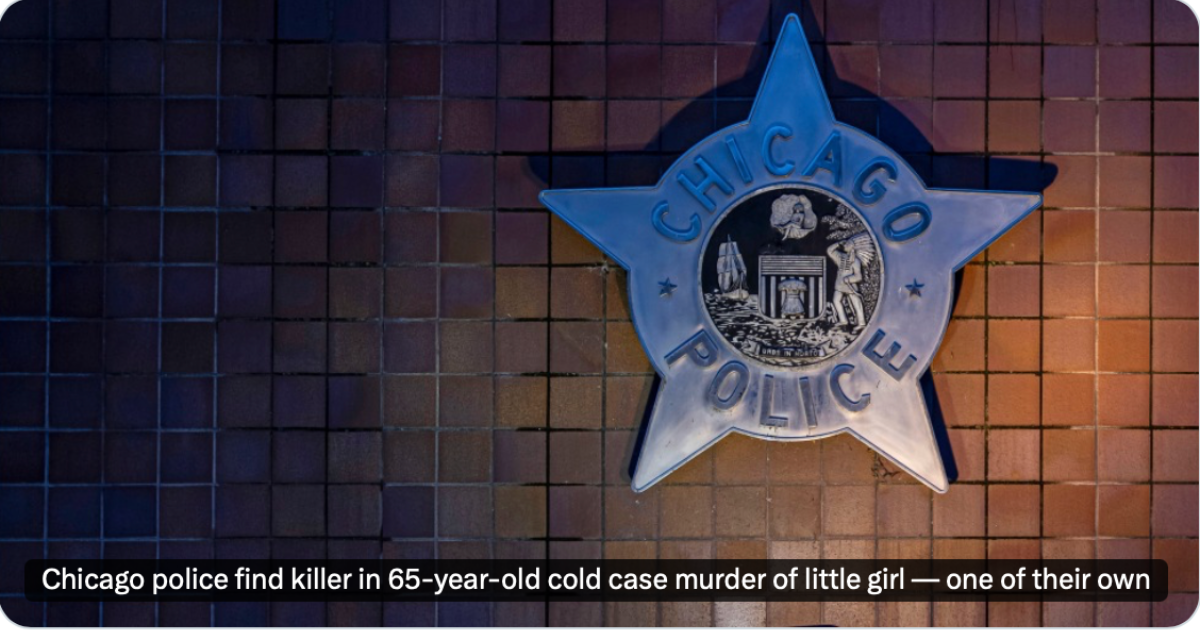
An eight-year-old girl was abducted and murdered in 1960. More than six decades later, DNA technology and a preserved fingerprint led investigators to a disturbing discovery: the man they identified as her killer had spent nearly three decades serving in the Chicago Police Department.
CHICAGO — October 12, 2026 — A murder investigation that remained unsolved for more than 65 years has finally reached a breakthrough, revealing a deeply troubling connection between a child’s death and the police department responsible for protecting the community.
Chicago police announced that Thomas Francis McInerney Jr., a former police officer who later became a homicide detective, was responsible for the 1960 murder of eight-year-old Gloria Kowalewicz.
McInerney spent 28 years with the Chicago Police Department before retiring in 1987. He died in 2006 without ever being charged in connection with the child’s death.
The case was solved through advances in DNA analysis, genetic genealogy, and fingerprint examination, using evidence carefully preserved by investigators more than six decades ago.
What Happened to Eight-Year-Old Gloria Kowalewicz?
On November 12, 1960, Gloria Kowalewicz left her home in Chicago’s West Englewood neighborhood to walk to a nearby church.
She never arrived.
The eight-year-old girl was abducted during what should have been a short, familiar walk through her neighborhood.
Her body was discovered in a wooded area of the Palos Hills forest preserve, several miles from her home.
Gloria had been shot twice in the head.
The murder shocked Chicago and prompted an extensive investigation involving police officers, firefighters, community volunteers, and other search teams.
Investigators collected numerous pieces of evidence, including the child’s clothing, shoes, and a white communion purse containing her prayer book.
A fingerprint was recovered from the strap of the purse.
Police interviewed more than 1,300 people and followed hundreds of leads, but none resulted in the identification of the killer.
For decades, Gloria’s murder remained one of Chicago’s unresolved crimes.
Who Was the Man Identified as Her Killer?
The man investigators have now identified was Thomas Francis McInerney Jr., a Chicago police officer who was just 24 years old when Gloria was killed.
McInerney had joined the Chicago Police Department in 1959, approximately one year before the murder.
He was also a U.S. Army veteran and lived near Gloria’s family.
During his police career, he held several assignments, eventually working as a detective investigating violent crimes, including homicides.
He retired from the department in 1987 after 28 years of service.
Following his retirement, McInerney moved to Nevada, where he also worked as an investigator for the Federal Public Defender’s Office.
He died in Las Vegas in 2006 at the age of 70.
For nearly half a century after Gloria’s death, the man police now identify as responsible continued living without facing criminal charges for her murder.
Authorities have not established that McInerney personally investigated Gloria’s killing. His later work as a homicide detective, however, makes the discovery particularly disturbing.
How DNA Technology Solved the 65-Year-Old Mystery
The breakthrough came through a combination of modern forensic science and evidence preserved in 1960.
Investigators used advanced DNA testing and investigative genetic genealogy, a technique that allows detectives to identify potential suspects by comparing genetic material with information available through genealogy databases.
The FBI assisted Chicago police in examining genetic evidence linked to the decades-old crime.
By July 2026, investigators had identified McInerney as the source of biological evidence recovered from Gloria’s clothing.
They then revisited an important piece of evidence collected during the original investigation: a fingerprint found on the strap of the girl’s purse.
Investigators compared that fingerprint with McInerney’s police employment records from 1959.
The prints matched.
Ballistics evidence also supported the investigation. Records showed that McInerney had owned revolvers of the same type associated with the bullet recovered from the crime scene.
Together, the forensic findings led Chicago police to conclude that McInerney was responsible for Gloria’s murder.
The case demonstrates how preserving physical evidence can allow investigators to solve crimes decades after the original investigation.
The Most Disturbing Part: The Killer Worked as a Detective
Perhaps the most unsettling aspect of the case is that the man identified as Gloria’s killer later served in the same profession dedicated to investigating violent crimes.
McInerney spent much of his adult life as a law enforcement officer.
During that time, Gloria’s murder remained unsolved, and her family continued waiting for answers.
The Chicago Police Department acknowledged the devastating implications of the discovery.
In its statement, the department said McInerney should never have worn a Chicago police badge and expressed regret that he had not been identified and held accountable during his lifetime.
The findings raise troubling questions about how a man involved in such a serious crime could continue serving in law enforcement for decades without being identified.
However, investigators have not established that McInerney committed other murders or that he used his police position to interfere with the investigation into Gloria’s death.
A Family That Waited Decades for Answers
Gloria’s parents spent the rest of their lives without knowing who had killed their daughter.
Both died before investigators finally identified the man responsible.
For surviving family members, the discovery brings long-awaited answers but cannot provide the justice of a criminal trial.
McInerney died 20 years before the case was solved.
He cannot be arrested, prosecuted, or convicted.
Gloria’s brother has expressed relief that investigators finally determined what happened, while also acknowledging the painful reality that the man responsible will never face a courtroom.
The Chicago Police Department said it hopes the findings will bring some measure of closure to Gloria’s family and everyone affected by the crime.
Justice After 65 Years — But No Trial
The case highlights both the extraordinary advances in forensic science and the limits of justice when a suspect is identified after death.
DNA technology, investigative genetic genealogy, fingerprints, and historical police records helped detectives reach a conclusion that investigators in 1960 could not establish.
Yet the passage of time means there will never be a criminal trial or judicial determination of guilt.
Chicago police consider the murder solved based on the evidence, but that conclusion is different from a conviction in court.
For Gloria’s family, the truth has finally emerged after more than six decades.
The revelation also leaves a disturbing historical fact: a man identified by police as the killer of an eight-year-old child went on to serve for decades as a detective investigating violent crimes, while the murder of that child remained unsolved.
Gloria Kowalewicz was only eight years old when her life ended in 1960.
Sixty-five years later, her name has returned to the headlines — not only because investigators finally identified the man they believe killed her, but because her case demonstrates why even the oldest unsolved murders should never be forgotten.
Sources: CBS Chicago | NBC News | Chicago Tribune | Chicago Police Department
By NJ RADAR Team