


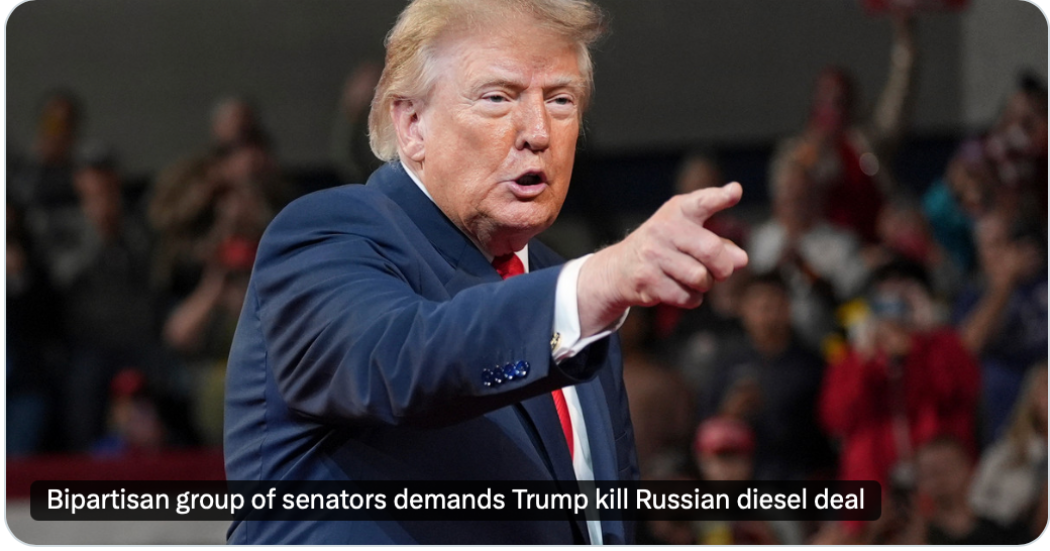
President Donald Trump is facing growing opposition from members of his own Republican Party after announcing a controversial agreement with Russian President Vladimir Putin to import millions of tons of diesel fuel.
Seven U.S. senators, including four Republicans and three Democrats, have called on the Trump administration to reverse the decision, warning that the agreement could violate federal law and provide Russia with additional funding for its war in Ukraine.
The unusual bipartisan criticism comes as Trump argues that importing Russian diesel will help reduce rising fuel prices for American farmers, truck drivers, and consumers.
A Deal Intended to Lower Fuel Prices
Trump announced the agreement on Friday, October 9, following a conversation with Putin.
According to the president, Russia would initially supply more than 300,000 tons of diesel, followed by another 500,000 tons in November and approximately one million tons shortly afterward.
An additional three million tons are expected under later stages of the proposed arrangement.
Trump presented the agreement as a way to ease pressure on American businesses and households struggling with higher energy costs.
However, critics question whether the arrangement would significantly lower prices while potentially providing substantial economic benefits to Moscow.
Republicans and Democrats Unite in Opposition
The opposition includes Republican senators Susan Collins, Lisa Murkowski, Thom Tillis, and John Curtis, alongside Democratic senators Jeanne Shaheen, Richard Blumenthal, and Ron Wyden.
In a joint statement issued October 11, the lawmakers argued that Congress explicitly banned Russian energy imports in 2022 to prevent American money from supporting Russia’s invasion of Ukraine.
They also criticized the administration for failing to consult Congress or provide a legal explanation for the decision.
The senators warned that the United States should not offer Putin a financial lifeline while Russian military operations continue to kill Ukrainian civilians.
They demanded that the administration immediately reverse its decision.
Could Trump’s Agreement Violate US Law?
One of the central questions surrounding the deal is its legality.
Congress restricted Russian energy imports in 2022 following Russia’s full-scale invasion of Ukraine. Lawmakers argue that allowing new diesel purchases contradicts those restrictions.
Republican Senator Thom Tillis suggested that there is a legitimate legal basis for challenging the administration’s decision.
The Trump administration maintains that it has the legal authority to proceed and argues that the agreement serves American economic interests.
No court has yet determined that the proposed diesel arrangement violates federal law.
A Growing Dispute Over Ukraine
The controversy comes amid increasingly tense relations between Trump and Ukrainian President Volodymyr Zelenskyy.
Trump recently criticized Ukraine’s attacks on Russian oil refineries, arguing that such strikes threaten international fuel supplies and could worsen economic conditions in the United States.
He also suggested that Ukraine should have a new president.
Meanwhile, Zelenskyy and other international leaders have expressed concern that easing energy restrictions on Russia could weaken economic pressure intended to end the war.
The disagreement raises a difficult question for Washington: Can the United States reduce domestic fuel prices through Russian energy purchases without undermining its sanctions policy?
Political Divisions Inside the Republican Party
The dispute illustrates divisions within the Republican Party over relations with Russia.
Some Republicans support Trump’s efforts to lower energy prices, while others argue that purchasing Russian fuel contradicts years of American efforts to economically isolate Moscow.
Former Vice President Mike Pence and Republican Representative Don Bacon have also criticized the decision.
For Trump, the controversy comes as rising energy prices place additional pressure on American households ahead of the November congressional elections.
The administration now faces criticism not only from Democrats and international allies but also from members of the president’s own party.
Whether the agreement proceeds could have consequences for American energy policy, congressional authority, and Washington’s relations with both Russia and Ukraine.
Sources: Financial Times, Reuters, Associated Press, U.S. Senate Foreign Relations Committee, Senator Susan Collins’ Office, The Washington Post.
By NJ RADAR Team